Xiaomi MiMo-V2.6-Flash-MOPD Benchmark Results for Data Analysis
Nov 25, 2026: Xiaomi's open-weight MiMo checkpoint, tested on real-world data analysis.
At Plotly, we keep a close eye on model releases. Our agentic analytics products, Plotly Studio Desktop and Plotly Studio Embedded, and our open source libraries Plotly and Dash work with any model, and our customers look to us for recommendations.
On September 27, Xiaomi announced MiMo-V2.6-Flash-MOPD, part of its MiMo-V2.6 family. Its model card calls it "the MOPD upgrade of the MiMo-V2.6-Flash-RL checkpoint". MOPD stands for Multi-teacher On-Policy Distillation, which, in Xiaomi's words, "distills several domain-specialized teachers into the student on-policy".
Xiaomi's post focuses on one problem: tool-call repetition, "an easy-to-overlook failure mode in which the model keeps issuing the same or highly similar tool calls, appearing busy while making no progress". Xiaomi says this checkpoint mitigates it. That matters for an agent like ours, which answers every question through a chain of tool calls.
It's a sparse mixture-of-experts model with 309 billion parameters in total, 15 billion of them active, a context window of 1 million tokens, and text, image, video and audio input. The weights are out under the MIT license on Hugging Face. On OpenRouter, Featherless is the only provider, at $0.15 per million input tokens, $0.42 per million output tokens and $0.02 per million cached input tokens.
We ran it through our data analytics exam. MiMo-V2.6-Flash-MOPD passed 36 of 43 questions (84%, a B) for $0.35, with a median of 8.4 seconds a question. That's the fastest median of the 57 models we've tested.
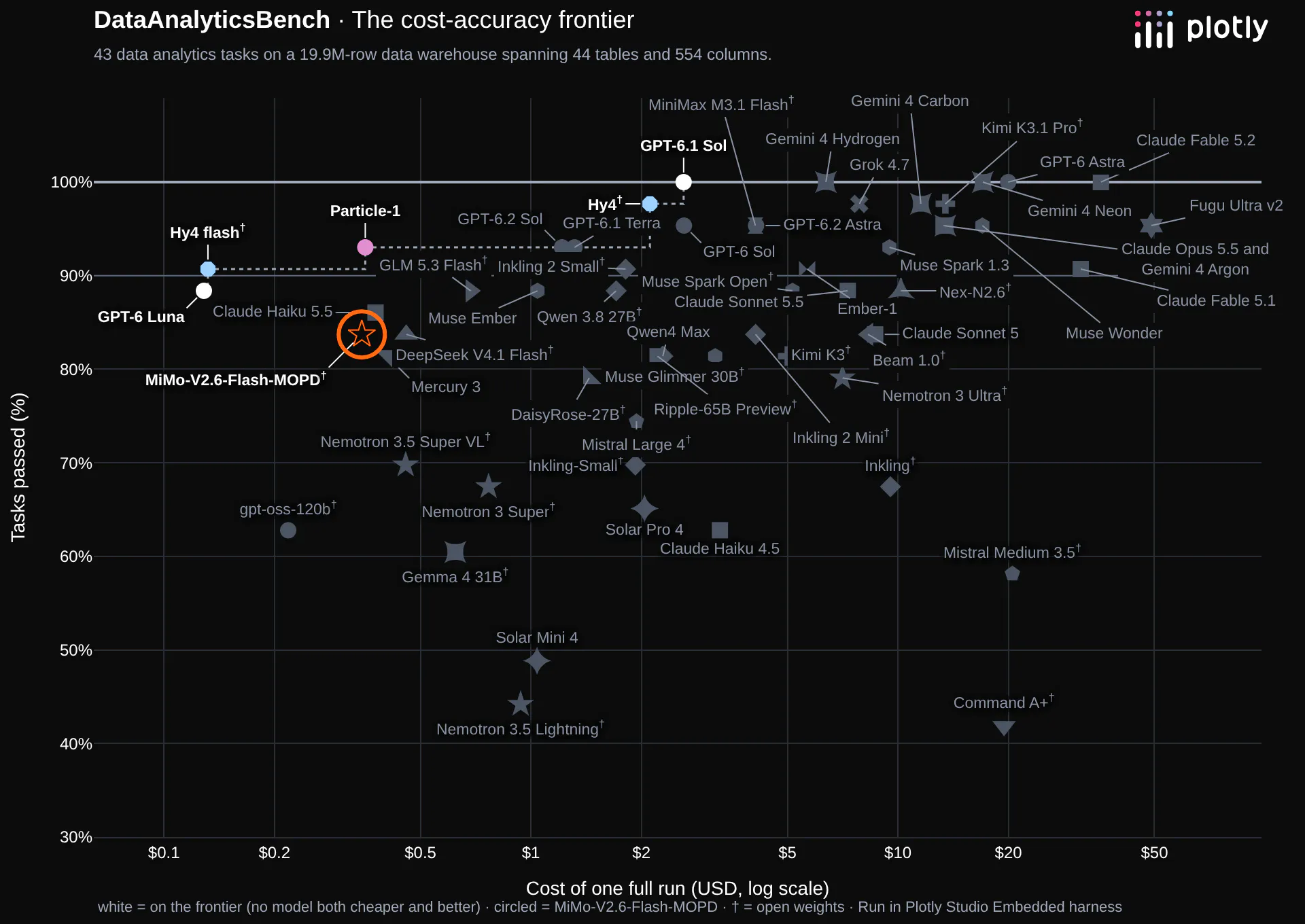
It doesn't join the cost-accuracy frontier, though. Hy4 flash scored three more for under 40% of the price, and Particle-1 scored four more for about the same price. On the chart below, MiMo-V2.6-Flash-MOPD sits below the frontier.
MiMo-V2.6-Flash-MOPD vs. Mercury 3, Hy4 flash and Particle-1
MiMo-V2.6-Flash-MOPD
Mercury 3
Hy4 flash
Particle-1
Score
36 / 43
35 / 43
39 / 43
40 / 43
Analytics questions
19 / 20
20 / 20
20 / 20
20 / 20
Ambiguous questions
5 / 5
5 / 5
5 / 5
5 / 5
Impossible requests
5 / 5
5 / 5
5 / 5
5 / 5
Data quality
2 / 3
2 / 3
3 / 3
2 / 3
Statistics traps
3 / 5
2 / 5
4 / 5
5 / 5
Hidden needles
2 / 5
1 / 5
2 / 5
3 / 5
Open weights
Yes
No
Yes
No
Cost of one full run
$0.35
$0.41
$0.13
$0.35
Per person per year*
$20
$24
$8
$21
Median time per question
8.4 seconds
9.3 seconds
29 seconds
16 seconds
Wall time for the exam
14 minutes
11 minutes
33 minutes
28 minutes
*1,000 people each asking 10 questions a day, 250 working days a year, at OpenRouter's prices when each model ran.
MiMo-V2.6-Flash-MOPD ties four other models at 36: Beam 1.0, Claude Sonnet 5, DeepSeek V4.1 Flash and Inkling 2 Mini. Of the 57 models on our board, 32 score higher.
One run per model is a single sample. In our repeat runs of other models, scores moved by up to three points between runs, so treat a one- or two-point gap as close to a tie.
The fastest model we've tested
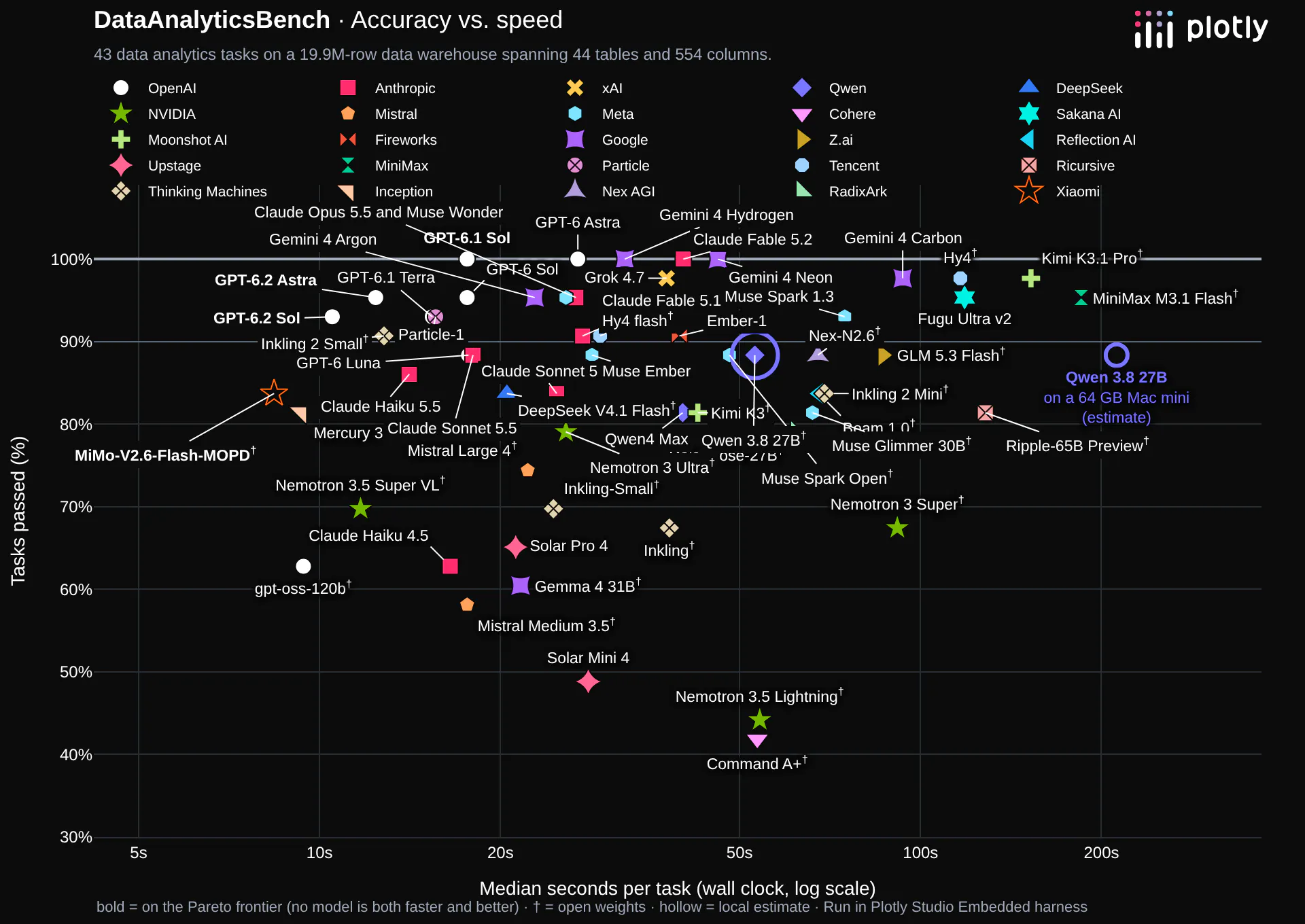
Its median question took 8.4 seconds. The next fastest are Mercury 3 at 9.3 seconds (35 of 43), gpt-oss-120b at 9.4 (27) and GPT-6.2 Sol at 10.5 (40). The median across all 57 models is 28 seconds.
That makes MiMo-V2.6-Flash-MOPD the new leftmost point on the accuracy-vs-speed frontier, taking that spot from Mercury 3, which it beats by one question. The speed frontier now runs from MiMo-V2.6-Flash-MOPD (36) to GPT-6.2 Sol (40), GPT-6.2 Astra (41) and GPT-6.1 Sol (43).
Its mean was 17.5 seconds, pulled up by a handful of longer questions. We run questions in parallel, and the whole exam took 14 minutes. Mercury 3 and GPT-6.2 Sol finished their whole runs a little sooner, in 11 and 13 minutes, so the edge is in the typical question rather than every question.
If speed is what you need, GPT-6.2 Sol is worth a look too. It's about two seconds slower at the median and scored four more, for about 3.5 times the cost ($1.22).
MiMo-V2.6-Flash-MOPD among open-weight models
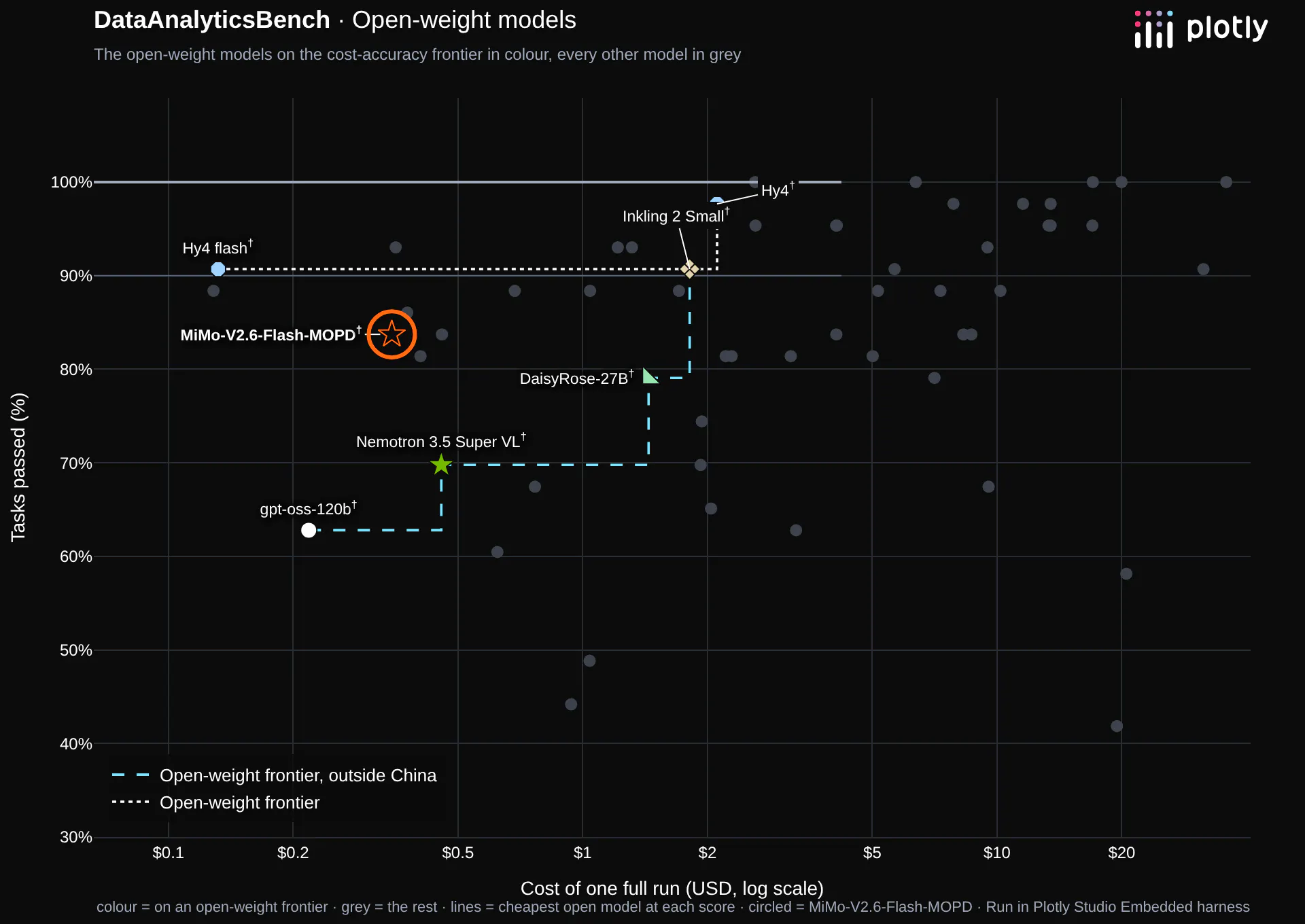
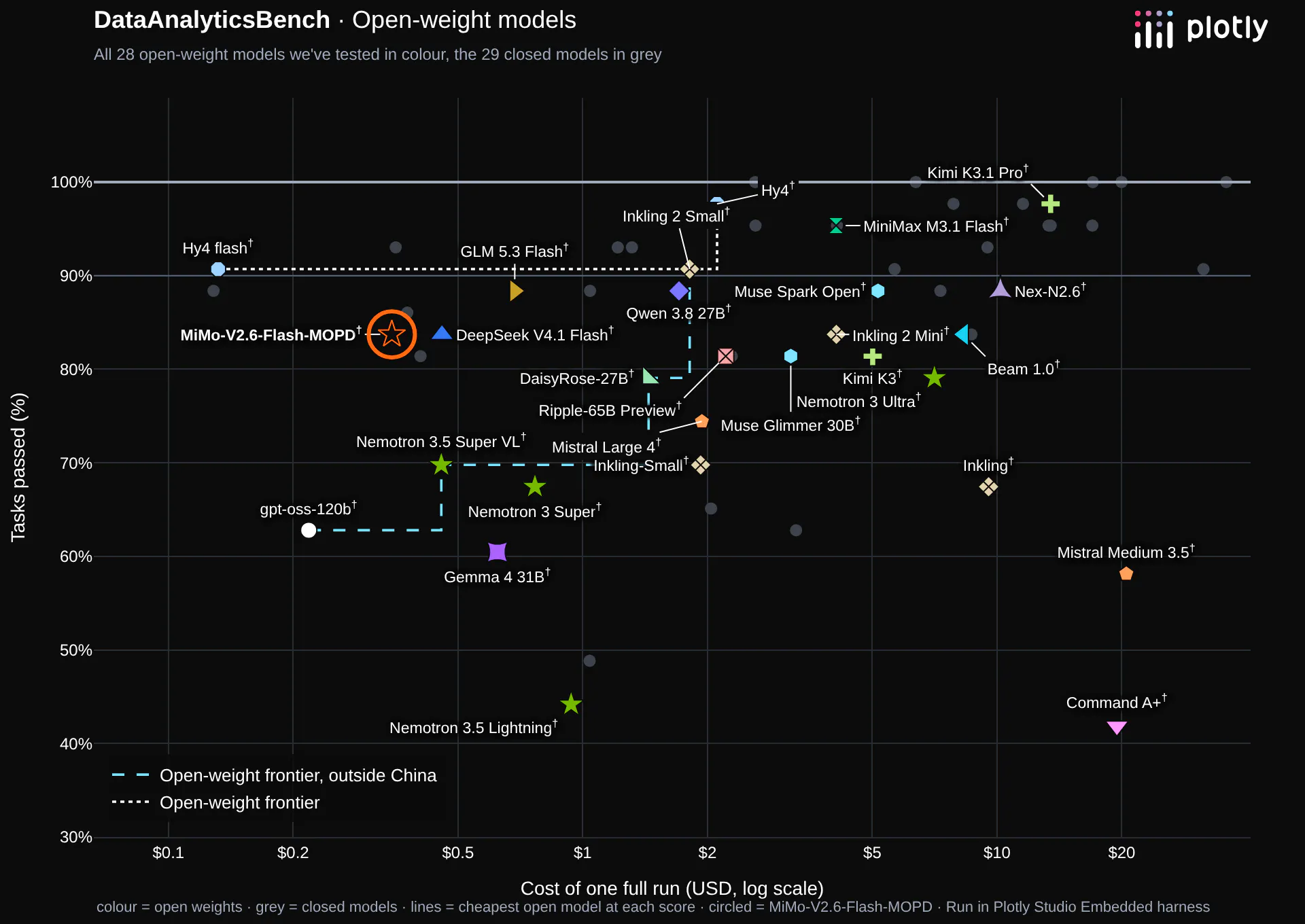
We've tested 28 open-weight models, and MiMo-V2.6-Flash-MOPD joins neither open-weight cost frontier. The open-weight frontier runs from Hy4 flash (39 for $0.13) to Hy4 (42 for $2.11), and Hy4 flash scored three more than MiMo-V2.6-Flash-MOPD for under 40% of the cost.
The second frontier, for labs outside China, runs from gpt-oss-120b to Nemotron 3.5 Super VL, DaisyRose-27B and Inkling 2 Small. Xiaomi is based in Beijing, so that line doesn't apply.
Where it does stand out is speed. It's the fastest open-weight model we've tested, ahead of gpt-oss-120b at 9.4 seconds, which scored nine fewer. The first chart shows both frontiers, and the second labels every open-weight model.
What it got right
MiMo-V2.6-Flash-MOPD asked about or stated its assumptions on all five ambiguous questions, and it turned down all five impossible requests instead of inventing an answer. It got 19 of the 20 straightforward analytics questions and caught two of the three data quality problems we planted in the warehouse. It found two of the five hidden patterns, as many as Hy4 flash.
It's efficient. It made 302 model calls across the exam, about 7 per question, and wrote about 5,100 output tokens per question. Of the 10.8 million prompt tokens it read, 97% came from the provider's cache, which is a big part of why the run cost so little. The run had no model errors.
On 42 of the 43 questions, we saw no repeated-call loops, where a model keeps issuing the same query while making no progress. That's the failure mode Xiaomi set out to reduce, and it can be expensive: Inkling 2 Mini made 585 queries on a single question.
Where it lost points
It missed seven questions: one analytics question, one data quality problem, two statistics traps and three of five hidden patterns. We checked all seven by hand against the transcripts and the answer key, and every verdict stands.
On the analytics question, it grouped on the wrong side of a join and attributed repeat work to the wrong person. In a data quality audit, it flagged a legitimate pattern as a defect.
The three hidden patterns went three different ways. In one, it computed the evidence but wouldn't call it a fault. In another, it compared at too coarse a level and missed the pattern. In the third, it recommended the option its own queries showed performed worst in the field.
On one statistics trap, it attributed a trend to the wrong cause. On the other, it never answered: its final message was malformed tool-call text containing about 20 copies of the same query. There's some irony in that, since tool-call repetition is exactly what this checkpoint was trained to reduce. It was the only time we saw it in the run.
Cost
At $0.35 a run, MiMo-V2.6-Flash-MOPD comes to about $20 per person per year at our rollout numbers. That's cheap, but not the cheapest for its score. GPT-6 Luna scored 38 and Hy4 flash scored 39, each for $0.13, or about $7 to $8 per person per year. Particle-1 costs about the same as MiMo-V2.6-Flash-MOPD and scored 40.
Against other low-cost models it holds up well. DeepSeek V4.1 Flash scored the same 36 for $0.46, with a 20.5-second median, and Claude Haiku 5.5 scored one more for $0.38, at 14.1 seconds. GLM 5.3 Flash scored 38 for $0.69, but took 87 seconds a question.
The cost-accuracy frontier is unchanged: GPT-6 Luna, Hy4 flash, Particle-1, Hy4 and GPT-6.1 Sol.
Can you run it locally?
At 4-bit, about 0.6 GB per billion parameters, MiMo-V2.6-Flash-MOPD's 309 billion parameters need about 185 GB for the weights. That's far beyond a Mac mini or a MacBook Pro, so you'd need something like a Mac Studio with 512 GB of memory.
With only 15 billion parameters active per token, it should run quickly on hardware that can hold it, though we haven't measured that. For smaller options, see our best local LLMs post.
The Test Harness
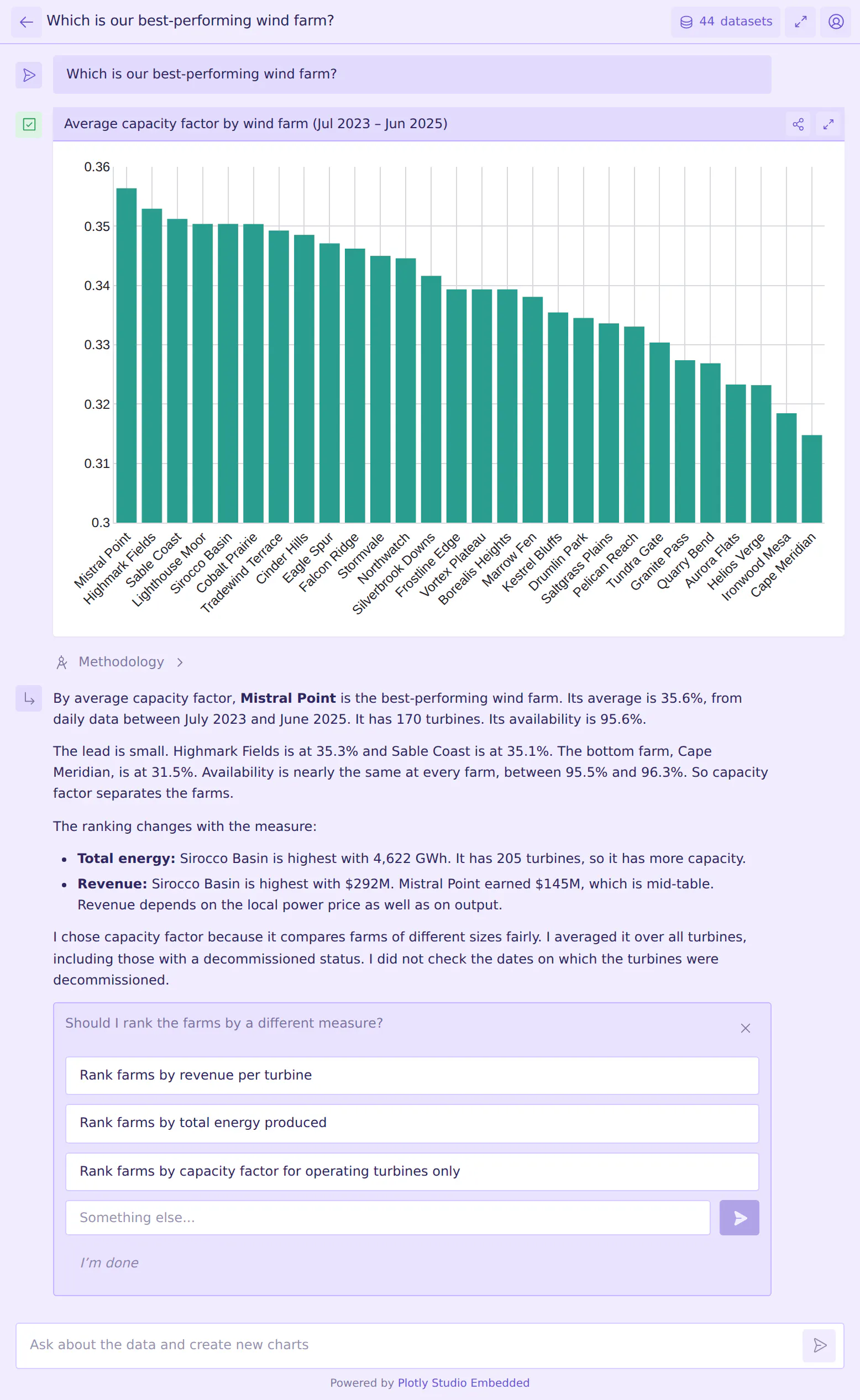
We run every model in Plotly Studio Embedded, a drop-in analytics agent that runs on Dash apps. This harness is tuned to run data analytics queries and make charts with multi-turn tool calling, with less emphasis on writing text. It's meant to put the data front and center.
Frequently asked questions
How good is MiMo-V2.6-Flash-MOPD at data analysis?
On PlotlyDataAnalyticsBench it passed 36 of 43 questions (84%, a B), tied with Beam 1.0, Claude Sonnet 5, DeepSeek V4.1 Flash and Inkling 2 Mini. It was perfect on ambiguous questions and impossible requests, and lost most of its points on hidden patterns and statistics traps.
Is MiMo-V2.6-Flash-MOPD the fastest model for data analysis?
On our board, yes. Its median question took 8.4 seconds, the fastest of the 57 models we've tested, ahead of Mercury 3 at 9.3 seconds and gpt-oss-120b at 9.4. The median across all models is 28 seconds.
How much does MiMo-V2.6-Flash-MOPD cost?
On OpenRouter, Featherless serves it for $0.15 per million input tokens, $0.42 per million output tokens and $0.02 per million cached input tokens, with output capped at 32,768 tokens. Our whole exam cost $0.35, or about $20 per person per year at 10 questions a day.
Is MiMo-V2.6-Flash-MOPD open source?
Its weights are open, under the MIT license, on Hugging Face. It's the fastest open-weight model we've tested, though it doesn't join either open-weight cost frontier (more in our open vs. closed models post).
Did it get stuck repeating tool calls?
Once. On one statistics question, its final message was malformed tool-call text with about 20 copies of the same query, so it never answered. On the other 42 questions, we saw no repeated-call loops.
Can I run it on a Mac?
Only a big one. At 4-bit it needs about 185 GB for its weights, so you'd need something like a Mac Studio with 512 GB of memory.
About the benchmark
We run new models through the same exam as they're released, and we'll keep sharing what we find. We ran MiMo-V2.6-Flash-MOPD through OpenRouter, where Featherless serves it, on November 24, with the same harness and grading as every other model.
To see every model on one chart and in a full results table, along with cost, speed and how the exam works, see Introducing DataAnalyticsBench.
The exam is private and we're sharing it with researchers. We're keeping it private so that the answer key doesn't make its way into the training set. For the same reason, the data is fabricated: the warehouse is a synthetic wind-energy fleet, built to look like a real operator's data, so its answers don't exist anywhere else.
If you'd like access, reach out to Chris Parmer at Plotly.