Inkling 2 Small Benchmark Results for Data Analysis
Nov 12, 2026: Thinking Machines' second-generation open-weight model, tested on real-world data analysis.
At Plotly, we keep a close eye on model releases. Our agentic analytics products, Plotly Studio Desktop and Plotly Studio Embedded, and our open source libraries Plotly and Dash work with any model, and our customers look to us for recommendations.
On November 5, Thinking Machines announced Inkling 2 Small, the first model of its second generation. It's a mixture-of-experts model with 594 billion parameters, 17 billion of them active for each token, and it accepts images as well as text. Thinking Machines describes pretraining it itself, starting with a first phase of 8.4 trillion tokens, and doesn't describe it as built on another model. It says its later training mixes were mostly trajectories sampled from earlier models, including Kimi K3 and its own. It also says the model scores 31 on the Artificial Analysis Intelligence Index, far above its previous models. Today Thinking Machines released the weights under the Apache 2.0 license on Hugging Face, along with an MXFP8 version. On OpenRouter, Together and Cloudflare serve it at $0.30 per million input tokens and $1.00 per million output tokens, with a context window of 1 million tokens.
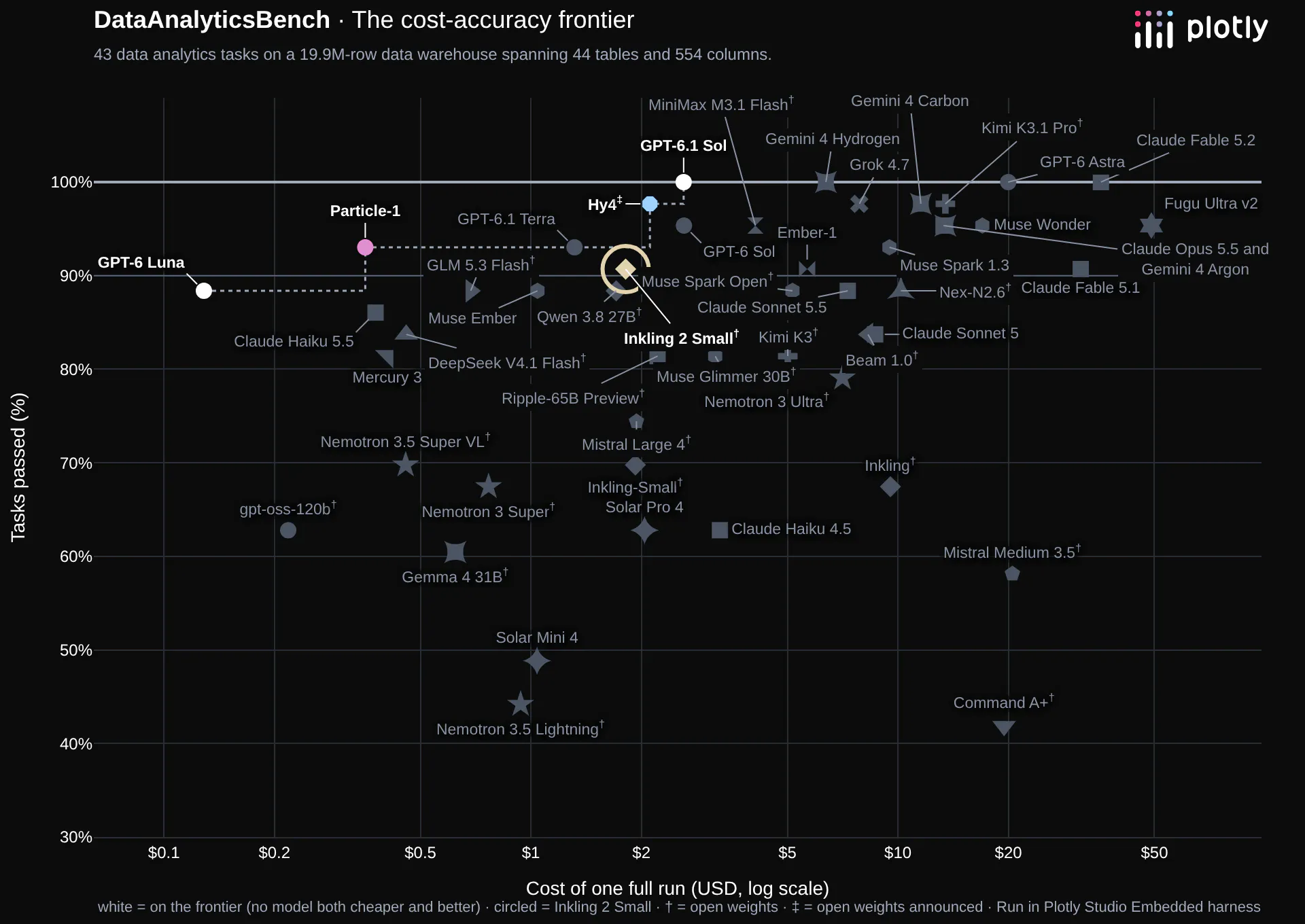
A free endpoint appeared on OpenRouter first, but it refused our harness, so we waited for paid hosting and tested it once that appeared. Inkling 2 Small passed 39 of 43 questions (91%, an A) for $1.81, with a median of 13 seconds a question. That makes it the most accurate open-weight model from a U.S. lab we've tested, a point ahead of Meta's Muse Spark Open, and the third most accurate open-weight model overall, after Moonshot's Kimi K3.1 Pro (42) and MiniMax M3.1 Flash (41), which take about 2½ and 3 minutes a question. It's nine points better than Thinking Machines' Inkling-Small, for about the same cost and twice as fast. But Particle-1 scored 40 for $0.35, so on the chart below, Inkling 2 Small sits off the cost-accuracy frontier.
Inkling 2 Small vs. Inkling-Small, Muse Spark Open and Particle-1
Inkling 2 Small
Inkling-Small
Muse Spark Open
Particle-1
Score
39 / 43
30 / 43
38 / 43
40 / 43
Analytics questions
19 / 20
16 / 20
20 / 20
20 / 20
Ambiguous questions
5 / 5
5 / 5
5 / 5
5 / 5
Impossible requests
5 / 5
5 / 5
5 / 5
5 / 5
Data quality
3 / 3
1 / 3
2 / 3
2 / 3
Statistics traps
5 / 5
3 / 5
4 / 5
5 / 5
Hidden needles
2 / 5
0 / 5
2 / 5
3 / 5
Open weights
Yes
Yes
Yes
No
Cost of one full run
$1.81
$1.93
$5.16
$0.35
Per person per year*
$105
$112
$300
$21
Median time per question
13 seconds
25 seconds
48 seconds
16 seconds
*1,000 people each asking 10 questions a day, 250 working days a year, at OpenRouter's prices when each model ran.
Inkling 2 Small was perfect in four of the six categories: it handled every ambiguous question and impossible request, and it caught all three planted data quality problems and all five statistics traps. Of the open-weight models whose weights are out, it's the only one to get both of those last two categories perfect.
One run per model is a single sample. In our repeat runs of other models, scores moved by up to three points between runs, so treat a one- or two-point gap as close to a tie.
What it got right
The biggest gains over Inkling-Small came on the questions that take judgment rather than SQL. The statistics traps are questions where the obvious calculation gives a misleading answer. Inkling 2 Small caught all five, which 15 of the 49 models on our board have done; among U.S. open-weight models, only Ricursive's Ripple-65B Preview has done it too. Inkling-Small caught three. Inkling 2 Small also caught every planted data quality problem, where Inkling-Small caught one and Inkling none.
It's efficient, too. It made about 13 model calls per question and wrote only about 5,700 output tokens per question, against about 7,800 for Muse Spark Open and 32,000 for MiniMax M3.1 Flash. About 96% of the input tokens it read came from the provider's cache, which is a big part of why the whole run cost $1.81.
What it got wrong
It missed four questions. We checked each one by hand against the transcript and the answer key, and all four are real misses. On one analytics question it worked out the answer but wrote its final table call out as text instead of running it, so the table never appeared.
The other three were hidden-pattern questions, the hardest part of our exam. Each one points toward something unusual in the data without naming it, and the model has to go looking. Inkling 2 Small found two of the five, tied with Muse Spark Open for the most of any U.S. open-weight model, while Kimi K3.1 Pro and MiniMax M3.1 Flash found all five. It did go looking: it ran about 46 queries on each of those questions, more than most models on our board, where the median is about 26.
Cost and speed
At $1.81 a run, Inkling 2 Small comes to about $105 per person per year at our rollout numbers. No other open-weight model scores 39 or more for less: MiniMax M3.1 Flash costs $4.09 a run and Kimi K3.1 Pro $13.47. Two models without open weights do better for less, though: Particle-1 scored 40 for $0.35 and GPT-6.1 Terra 40 for $1.31.
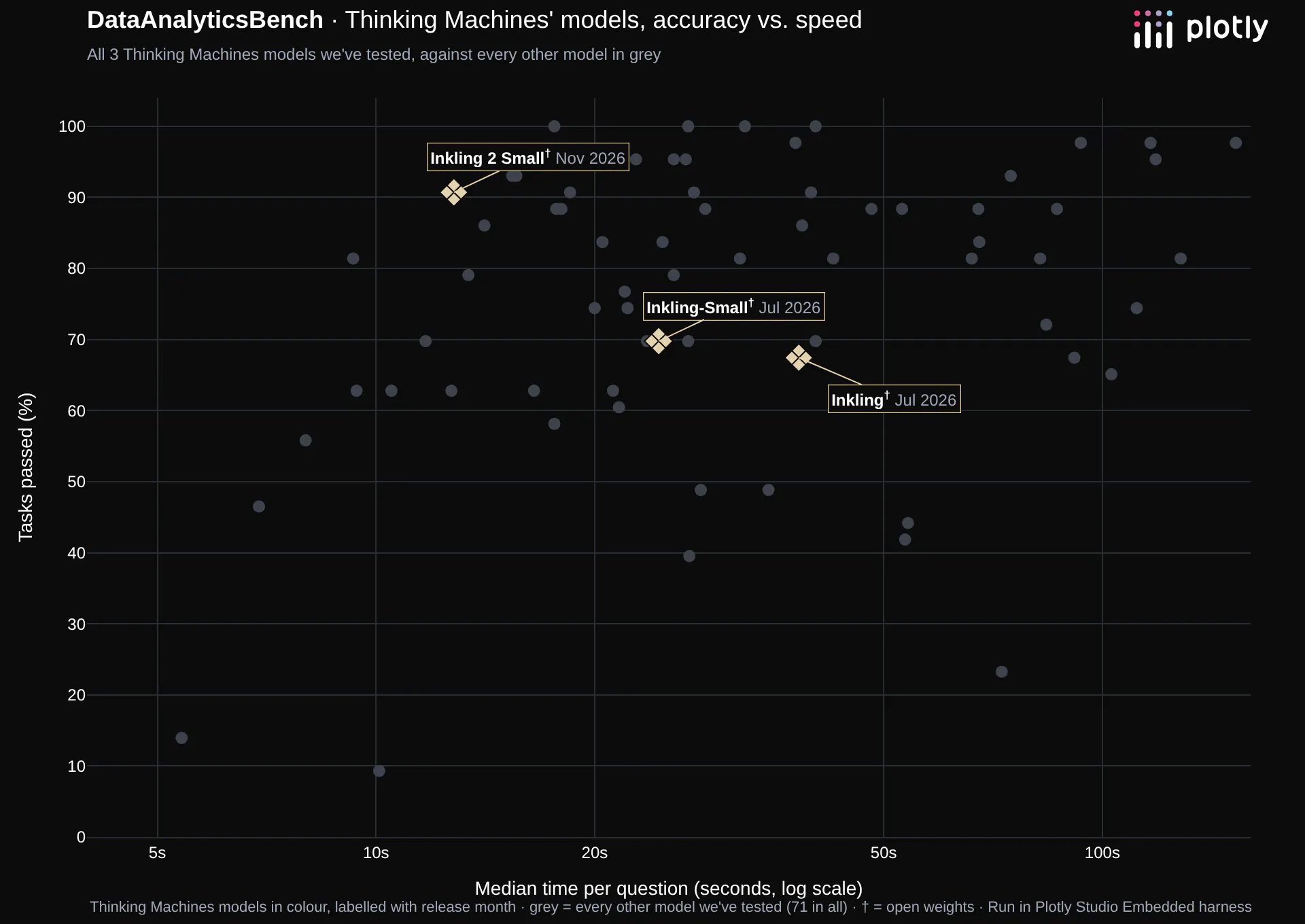
It's fast. Its median question took 13 seconds, and the whole exam about 16 minutes. Only three of the 49 models on our board have a faster median, Inception's Mercury 3, OpenAI's gpt-oss-120b and NVIDIA's Nemotron 3.5 Super VL, and they scored 35, 27 and 30. No model that scored 39 or more, open or closed, has been faster: GPT-6.1 Terra and Particle-1 take about 15 seconds.
If you want an open-weight model from a U.S. lab, Inkling 2 Small is now the one we'd pick for data analysis: it's the most accurate of them, it costs less than most, and no model on our board answers faster at its score. At 4-bit it needs about 356 GB of memory, which fits on one 512 GB Mac Studio (more in our guide to the best local LLMs). If you don't need open weights, GPT-6.1 Terra scores a point higher for less.
Thinking Machines' models over time
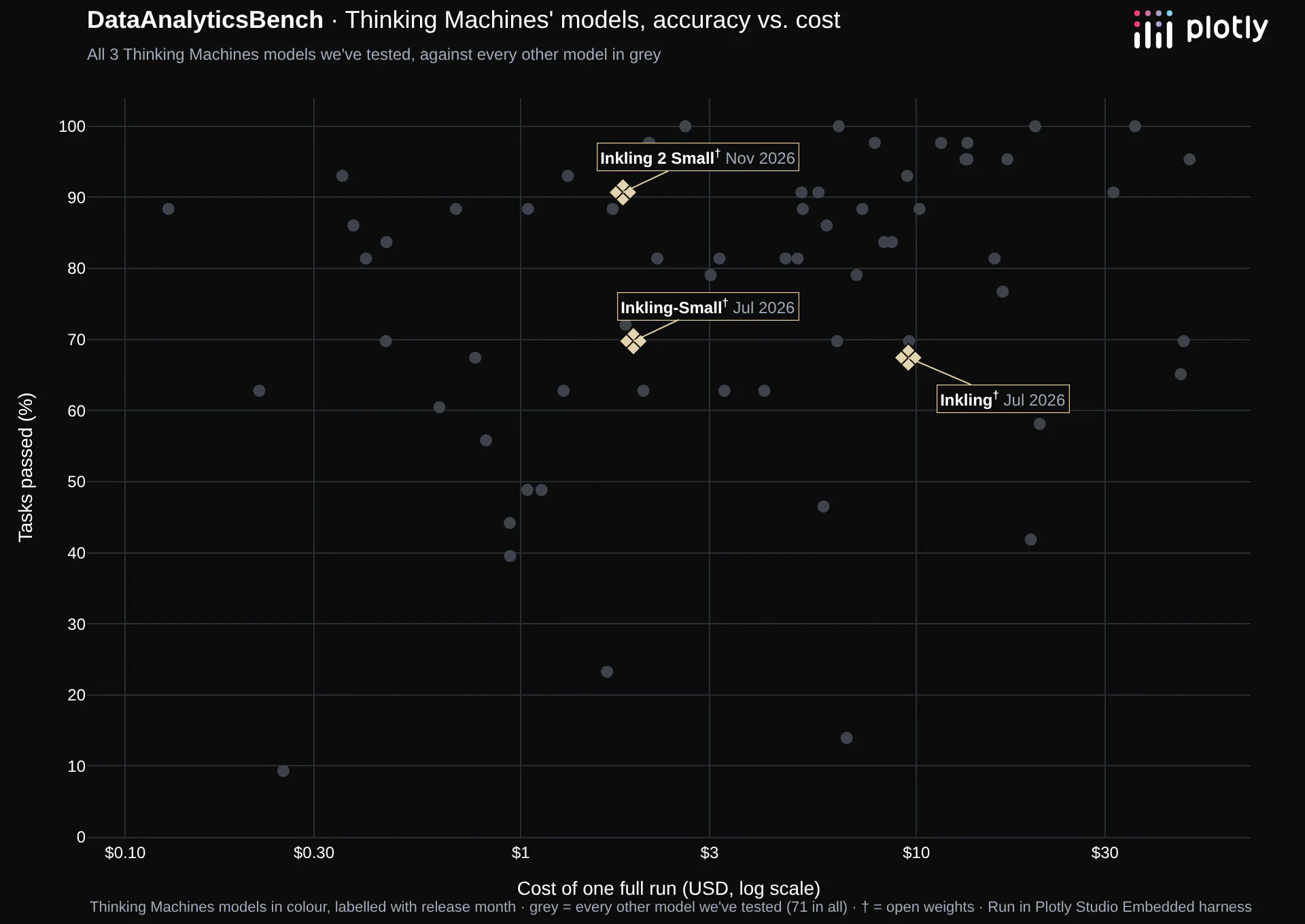
Here are all three Thinking Machines models we've tested, with every other model in grey. Inkling and Inkling-Small, released in July, scored 29 and 30. Four months later, Inkling 2 Small scores 39 for about the same cost as Inkling-Small and a fifth of Inkling's, and it's the fastest of the three, at 13 seconds a question against 25 and 38.
The Test Harness
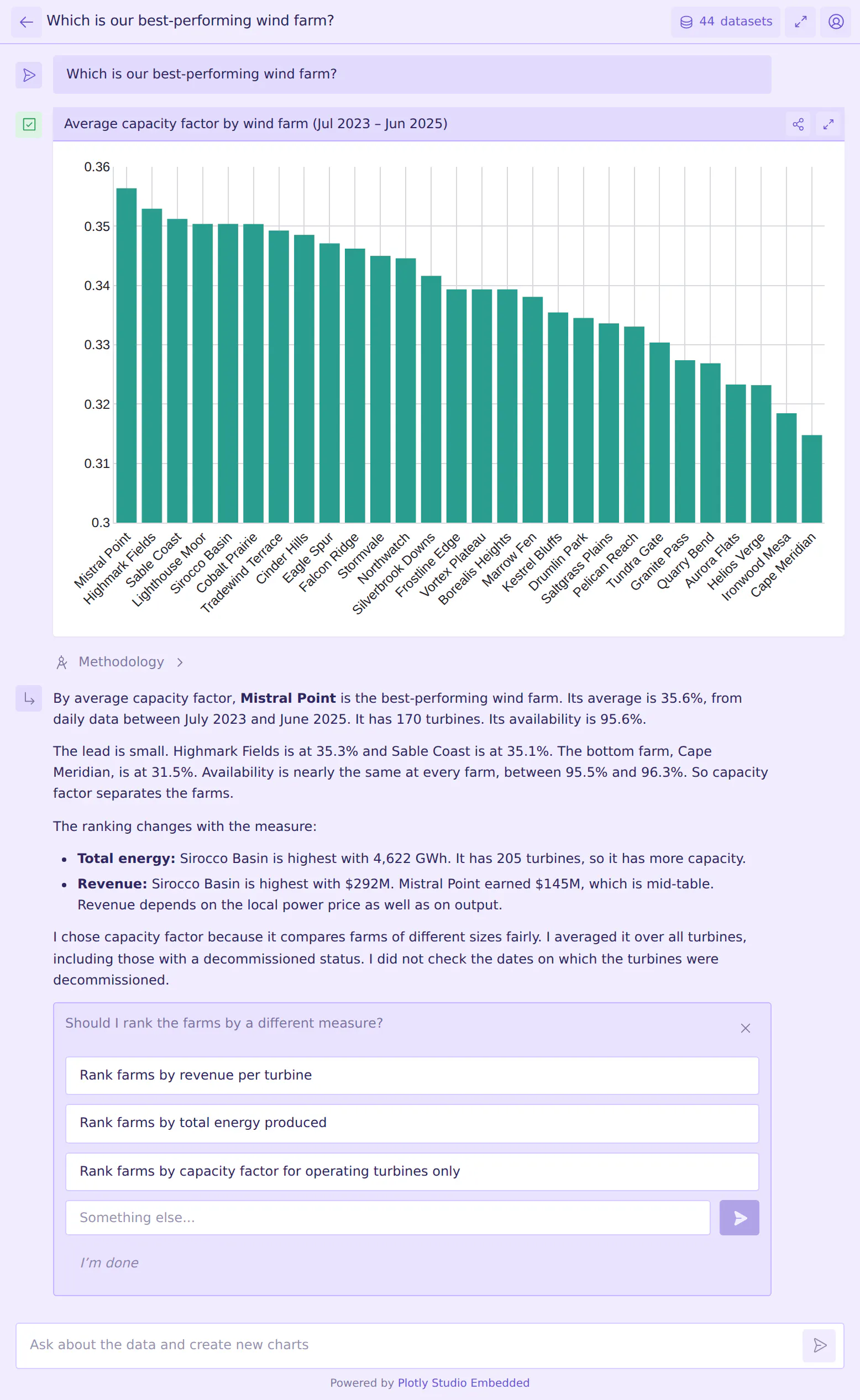
We run every model in Plotly Studio Embedded, a drop-in analytics agent that runs on Dash apps. This harness is tuned to run data analytics queries and make charts with multi-turn tool calling, with less emphasis on writing text. It's meant to put the data front and center.
Frequently asked questions
How good is Inkling 2 Small at data analysis?
On PlotlyDataAnalyticsBench it passed 39 of 43 questions (91%), the best score from a U.S. open-weight model and the third best of any open-weight model, after Kimi K3.1 Pro and MiniMax M3.1 Flash. It was perfect on ambiguous questions, impossible requests, data quality problems and statistics traps.
Is Inkling 2 Small better than Inkling-Small?
On our exam, yes, by nine points: 39 against 30, for about the same cost per run ($1.81 against $1.93) and twice as fast (13 seconds a question against 25).
Is Inkling 2 Small open source?
Its weights are open. Thinking Machines released them on November 12 under the Apache 2.0 license on Hugging Face, along with an MXFP8 version.
How much does Inkling 2 Small cost?
On OpenRouter, Together and Cloudflare serve it at $0.30 per million input tokens and $1.00 per million output tokens. Our whole exam cost $1.81, or about $105 per person per year at 10 questions a day.
Can I run Inkling 2 Small locally?
At 594 billion parameters, it needs about 356 GB of memory at 4-bit, which fits on a 512 GB Mac Studio. Only 17 billion parameters are active for each token, so it generates faster than a dense model of that size would. See our guide to the best local LLMs.
What's the best U.S. open-weight model for data analysis?
On our exam, Inkling 2 Small, at 39 of 43, ahead of Meta's Muse Spark Open at 38. We compare all 13 in our U.S. open-weight models post.
About the benchmark
We run new models through the same exam as they're released, and we'll keep sharing what we find. We ran Inkling 2 Small through OpenRouter, with the same harness and grading as every other model.
To see all 49 models on one chart and in a full results table, along with cost, speed and how the exam works, see Introducing DataAnalyticsBench.
The exam is private and we're sharing it with researchers. We're keeping it private so that the answer key doesn't make its way into the training set. For the same reason, the data is fabricated: the warehouse is a synthetic wind-energy fleet, built to look like a real operator's data, so its answers don't exist anywhere else.
If you'd like access, reach out to Chris Parmer at Plotly.