RadixArk DaisyRose-27B Benchmark Results for Data Analysis
Nov 21, 2026: RadixArk's open-weight model, post-trained from Qwen 3.8 27B, tested on real-world data analysis.
At Plotly, we keep a close eye on model releases. Our agentic analytics products, Plotly Studio Desktop and Plotly Studio Embedded, and our open source libraries Plotly and Dash work with any model, and our customers look to us for recommendations.
We're glad to see more companies post-training open models. Qwen 3.8 27B does far better on our exam than its size suggests, and at 27B it's small enough to run on a Mac mini or a MacBook Pro.
We've now tested three models that companies post-trained from open ones. Fireworks' Ember-1, built on Kimi K3, scored about 10% higher than its base. Particle AI's Particle-1, built on DeepSeek V4.1 Flash, also gained about 10%, and was a bit cheaper and faster.
Nex AGI's Nex-N2.6, built on GLM 5.3 Flash, didn't improve, and a couple of runaway loops made it expensive. With Thinking Machines' Inkling Small out a few weeks ago, we expect to see more of this, especially from western companies.
On November 18, RadixArk released DaisyRose-27B, the fourth example we've tested. Its model card calls it "a multimodal reasoning model built on Qwen3.8-27B", "trained from Qwen3.8-27B with reinforcement learning only, without any supervised fine-tuning or distillation".
RadixArk's blog says it trained the model "on long-horizon agent tasks with sessions up to 1M tokens, with just 1,200 curated tasks in 18 days on 144 H200 GPUs", using its own RL framework, Miles. It thanks the Qwen team for "the foundation of our work".
It's a dense model with 27.8 billion parameters and a context window of 262K tokens. The weights are out under the Apache 2.0 license. On OpenRouter, DeepInfra serves it for $0.15 per million input tokens and $1.875 per million output tokens.
RadixArk's own reported gains are on coding and agent benchmarks, such as Terminal-Bench and SWE-Bench Pro. It doesn't report any data analysis benchmark, so we ran one.
We ran it through our data analytics exam. DaisyRose-27B passed 34 of 43 questions (79%), four fewer than Qwen 3.8 27B, the model it's built on, which scored 38. Of the four post-trained models we've tested, it's the first to score below its base model.
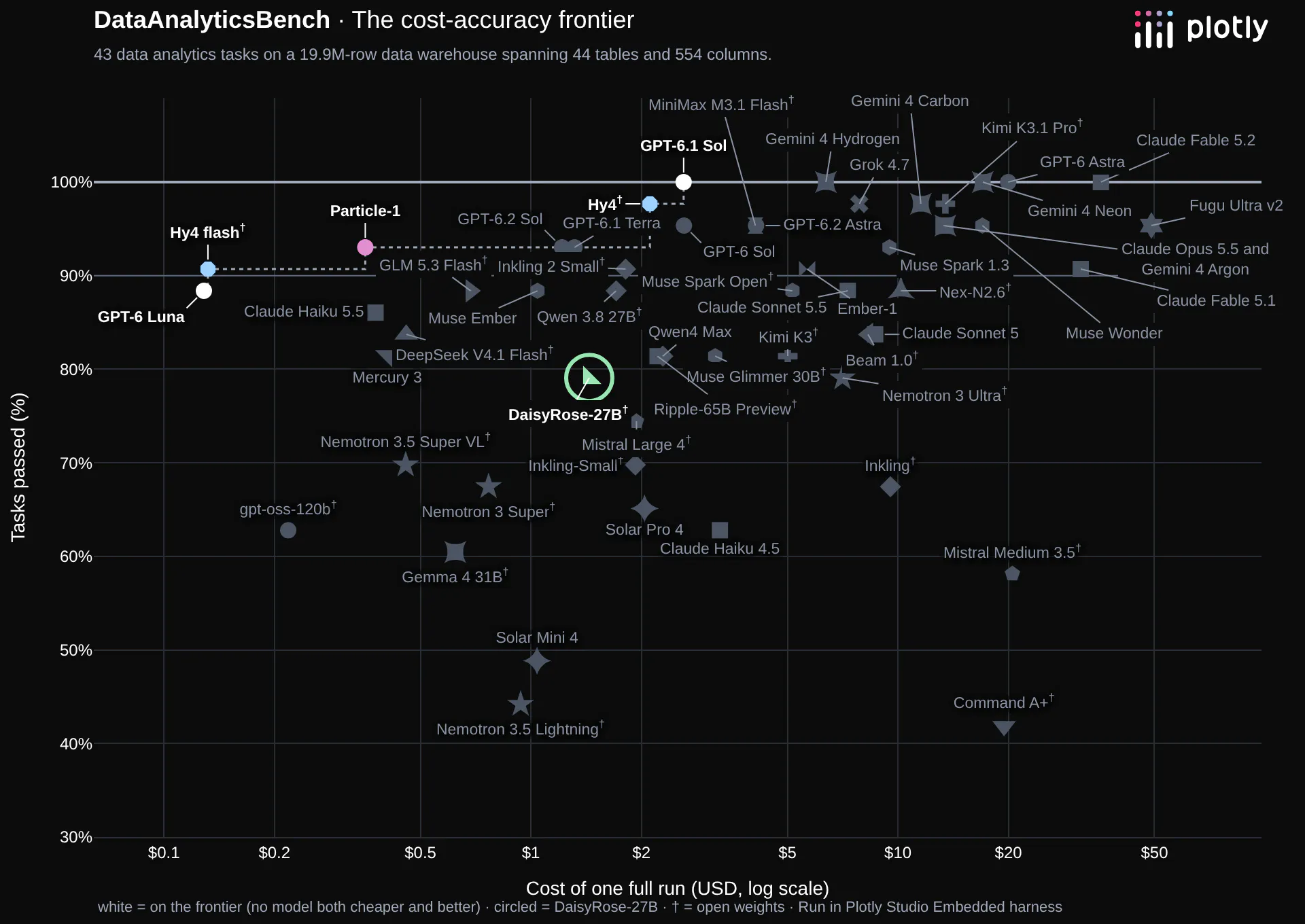
Its run cost $1.44, against $1.71 for Qwen 3.8 27B. On the chart below, DaisyRose-27B sits off the cost-accuracy frontier.
DaisyRose-27B vs. Qwen 3.8 27B
DaisyRose-27B
Qwen 3.8 27B
Score
34 / 43
38 / 43
Analytics questions
20 / 20
19 / 20
Ambiguous questions
5 / 5
5 / 5
Impossible requests
5 / 5
5 / 5
Data quality
1 / 3
3 / 3
Statistics traps
2 / 5
4 / 5
Hidden needles
1 / 5
2 / 5
Open weights
Yes
Yes
Cost of one full run
$1.44
$1.71
Per person per year*
$84
$99
Median time per question
62 seconds
53 seconds
Mean time per question
131 seconds
163 seconds
Tokens
14.1M
12.7M
Wall time for the exam
104 minutes
118 minutes
*1,000 people each asking 10 questions a day, 250 working days a year, at OpenRouter's prices when each model ran.
One run per model is a single sample. In our repeat runs of other models, scores moved by up to three points between runs. So we read a four-point drop as no gain, and likely a small loss, not as proof that the extra training hurt.
DaisyRose-27B among open-weight models
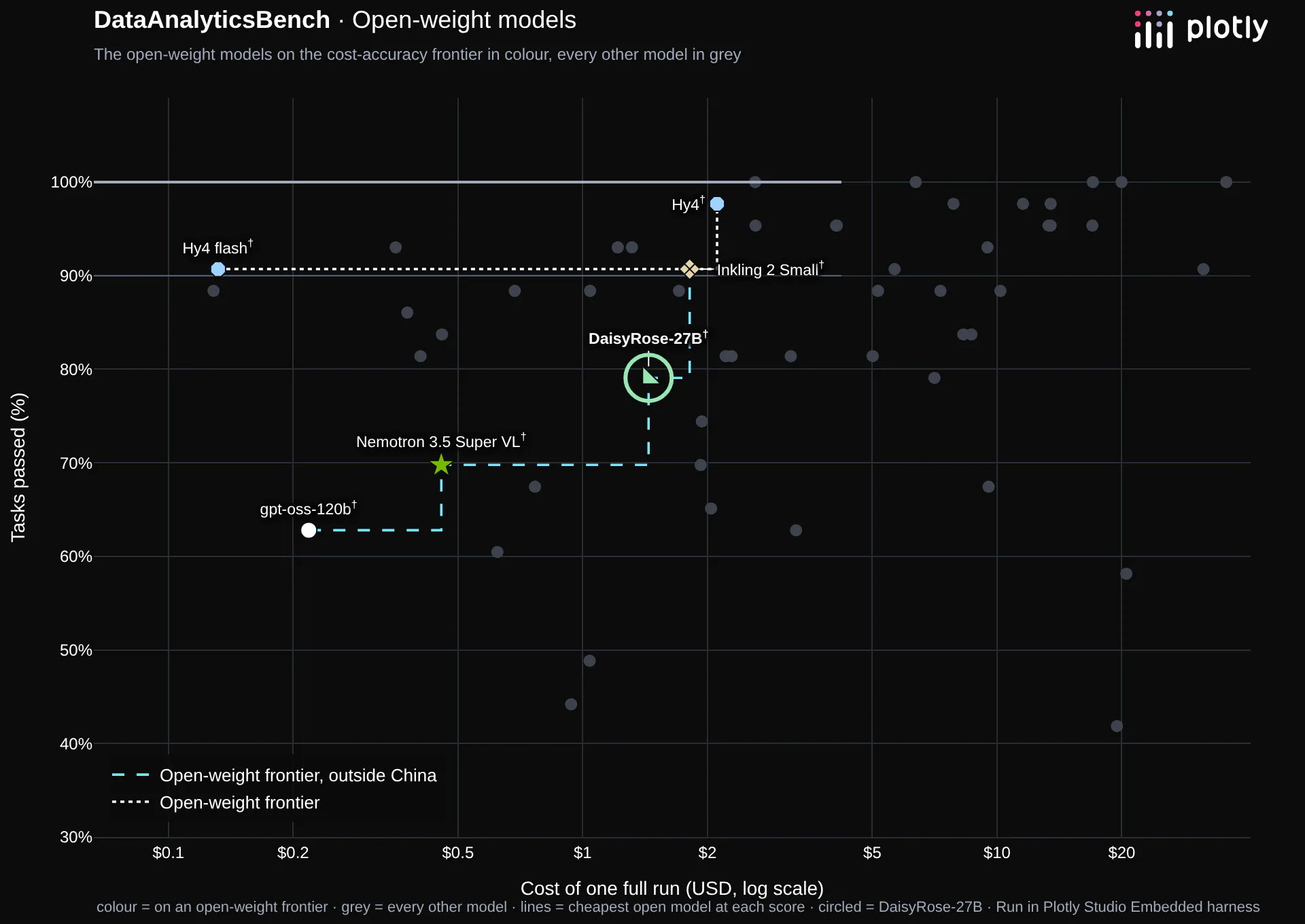
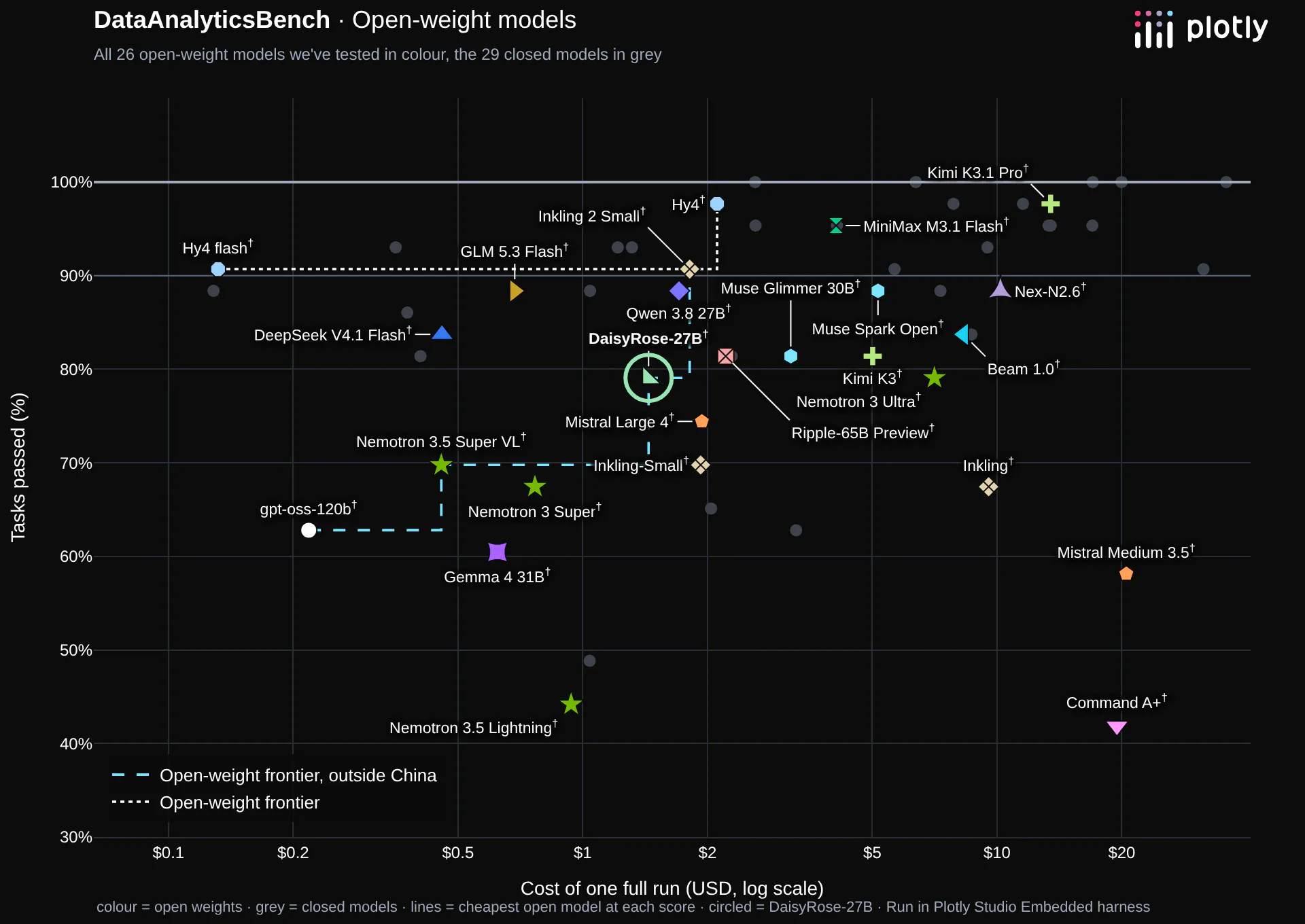
We've tested 26 open-weight models. DaisyRose-27B doesn't join the open-weight frontier, which now runs from Hy4 flash to Hy4. Hy4 flash scored 39 for $0.13, more than DaisyRose-27B for about a tenth of the cost.
It does join the open-weight frontier for labs outside China. That line runs from gpt-oss-120b (27 for $0.22) to Nemotron 3.5 Super VL (30 for $0.46), DaisyRose-27B (34 for $1.44) and Inkling 2 Small (39 for $1.81).
Its base model, though, comes from Alibaba's Qwen team. Qwen 3.8 27B scored four more for about 27 cents more a run.
What it got right
DaisyRose-27B got all 20 straightforward analytics questions, one more than Qwen 3.8 27B. It asked about or stated its assumptions on all five ambiguous questions, and it turned down all five impossible requests instead of inventing an answer.
The run was clean. There were no runaway loops, and every answer was complete and in English. Some of its chart and table tool calls were malformed and had to be retried, which cost effort but didn't change any answers.
Where it lost points
It missed nine questions: two of three data quality problems, three of five statistics traps and four of five hidden patterns. We checked all nine by hand against the transcripts and the answer key, and every verdict stands.
One was close. On a statistics question, its answer missed our tolerance by 0.0003.
The misses had a few things in common. It often stopped at the first level of aggregation and didn't slice the data by other dimensions. A few times it said something wasn't there without running a query to check.
It also noticed warning signs, such as a contradiction or a rate that looked implausible, and didn't follow them up. And several answers ended by asking "want me to...?" instead of running the step that would have settled the question.
Our interpretation, and it's only that: this fits a model tuned for coding and agent tasks, which does exactly what it's asked. Data analysis often rewards going one step further than the question.
Cost and speed
At $1.44 a run, DaisyRose-27B comes to about $84 per person per year at our rollout numbers, against $99 for Qwen 3.8 27B. It used more tokens, 14.1 million against 12.7 million, and its run still cost less.
Its median question took 62 seconds, against 53 for Qwen 3.8 27B. But its mean was lower, 131 seconds against 163, and the whole exam took 104 minutes against 118.
Four post-trained models so far
Here are the four post-trained models we've tested, each next to the model it's built on.
Model
Base
Score
Cost
Ember-1 (Fireworks)
Kimi K3
35 → 39
$5.01 → $5.66
Particle-1
DeepSeek V4.1 Flash
36 → 40
$0.46 → $0.35
Nex-N2.6
GLM 5.3 Flash
38 → 38
$0.69 → $10.19
DaisyRose-27B
Qwen 3.8 27B
38 → 34
$1.71 → $1.44
Two gained four points. Ember-1 cost a little more than Kimi K3, and Particle-1 cost less than DeepSeek V4.1 Flash and cut the median question from 20 seconds to 16.
Nex-N2.6 matched GLM 5.3 Flash, but runaway loops pushed its run to $10.19. DaisyRose-27B is cheaper than its base and four points lower.
Post-training aims a model at particular work. RadixArk aimed DaisyRose-27B at long agent tasks and reports gains there. On data analysis, we didn't see a gain.
Can you run it locally?
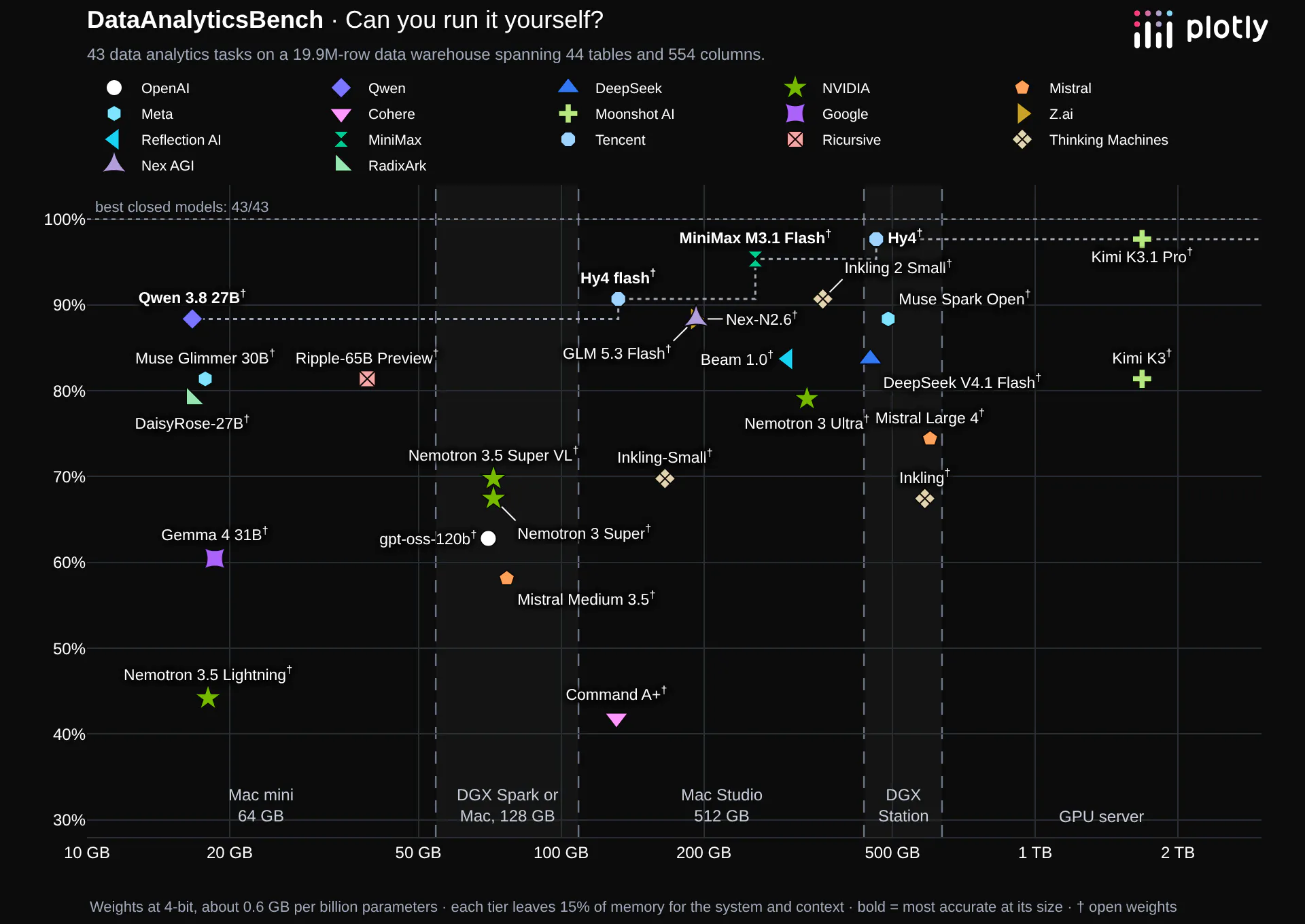
At 4-bit, about 0.6 GB per billion parameters, DaisyRose-27B needs about 17 GB for its weights. That fits a Mac mini with 64 GB of memory.
So does Qwen 3.8 27B, which is still the most accurate model we've tested at that size. For more, see our best local LLMs post.
The Test Harness
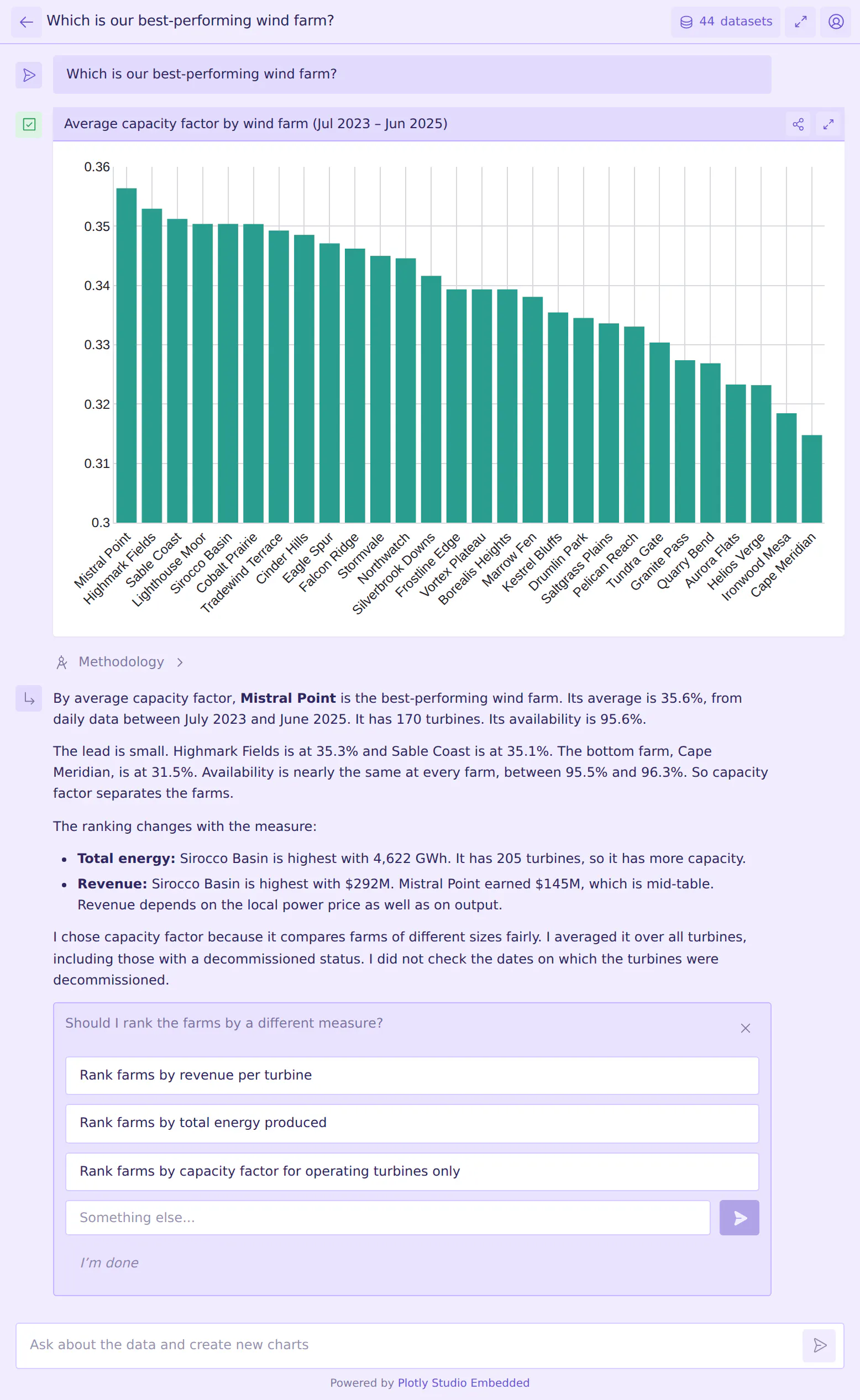
We run every model in Plotly Studio Embedded, a drop-in analytics agent that runs on Dash apps. This harness is tuned to run data analytics queries and make charts with multi-turn tool calling, with less emphasis on writing text. It's meant to put the data front and center.
Frequently asked questions
Is DaisyRose-27B better than Qwen 3.8 27B for data analysis?
Not on our exam. DaisyRose-27B scored 34 of 43 and Qwen 3.8 27B scored 38. Scores can move by up to three points between runs, so we read that as no gain and likely a small loss.
How much does DaisyRose-27B cost?
On OpenRouter, DeepInfra serves it for $0.15 per million input tokens and $1.875 per million output tokens. Our whole exam cost $1.44, or about $84 per person per year at 10 questions a day.
Can I run it on a Mac?
Yes. At 4-bit it needs about 17 GB for its weights, so it fits a Mac mini with 64 GB of memory. Qwen 3.8 27B fits the same machine and scored higher.
Is DaisyRose-27B open source?
Its weights are open, under the Apache 2.0 license, on Hugging Face. RadixArk built it on Qwen 3.8 27B, whose weights are open too.
How does it compare to other post-trained models?
Of the four we've tested, Ember-1 and Particle-1 each scored four more than their base models, and Nex-N2.6 matched its base. DaisyRose-27B is the only one that scored lower than its base.
About the benchmark
We run new models through the same exam as they're released, and we'll keep sharing what we find. We ran DaisyRose-27B through OpenRouter, where DeepInfra serves it, with the same harness and grading as every other model.
To see every model on one chart and in a full results table, along with cost, speed and how the exam works, see Introducing DataAnalyticsBench.
The exam is private and we're sharing it with researchers. We're keeping it private so that the answer key doesn't make its way into the training set. For the same reason, the data is fabricated: the warehouse is a synthetic wind-energy fleet, built to look like a real operator's data, so its answers don't exist anywhere else.
If you'd like access, reach out to Chris Parmer at Plotly.