Particle-1 Benchmark Results for Data Analysis
Oct 31, 2026: a startup's fine-tune of DeepSeek V4.1 Flash, tested on real-world data analysis.
At Plotly, we keep a close eye on model releases. Our agentic analytics products, Plotly Studio Desktop and Plotly Studio Embedded, and our open source libraries Plotly and Dash work with any model, and our customers look to us for recommendations.
On October 28, Particle AI, a San Francisco startup, released Particle-1. It isn't trained from scratch: it's DeepSeek V4.1 Flash with extra reinforcement learning, applied through a small adapter that covers about 1.25% of the model's parameters. Particle trained it to spend fewer tokens on software engineering, and reports 28% to 52% fewer output tokens than DeepSeek V4.1 Flash on four coding and data engineering benchmarks, with accuracy within the base model's confidence intervals. On OpenRouter it costs $0.05 per million input tokens, $0.50 per million output tokens and $0.003 per million cached input tokens.
We ran it through our data analytics exam. Particle-1 passed 40 of 43 questions (93%), up from 36 for DeepSeek V4.1 Flash, for $0.35 for the whole exam. That ties GPT-6.1 Terra's score for about a quarter of the cost, and makes Particle-1 the cheapest model on our leaderboard of 36 to score 40 or more. It joins the cost-accuracy frontier, between GPT-6 Luna and GPT-6.1 Sol: no model we've tested is both cheaper and more accurate.
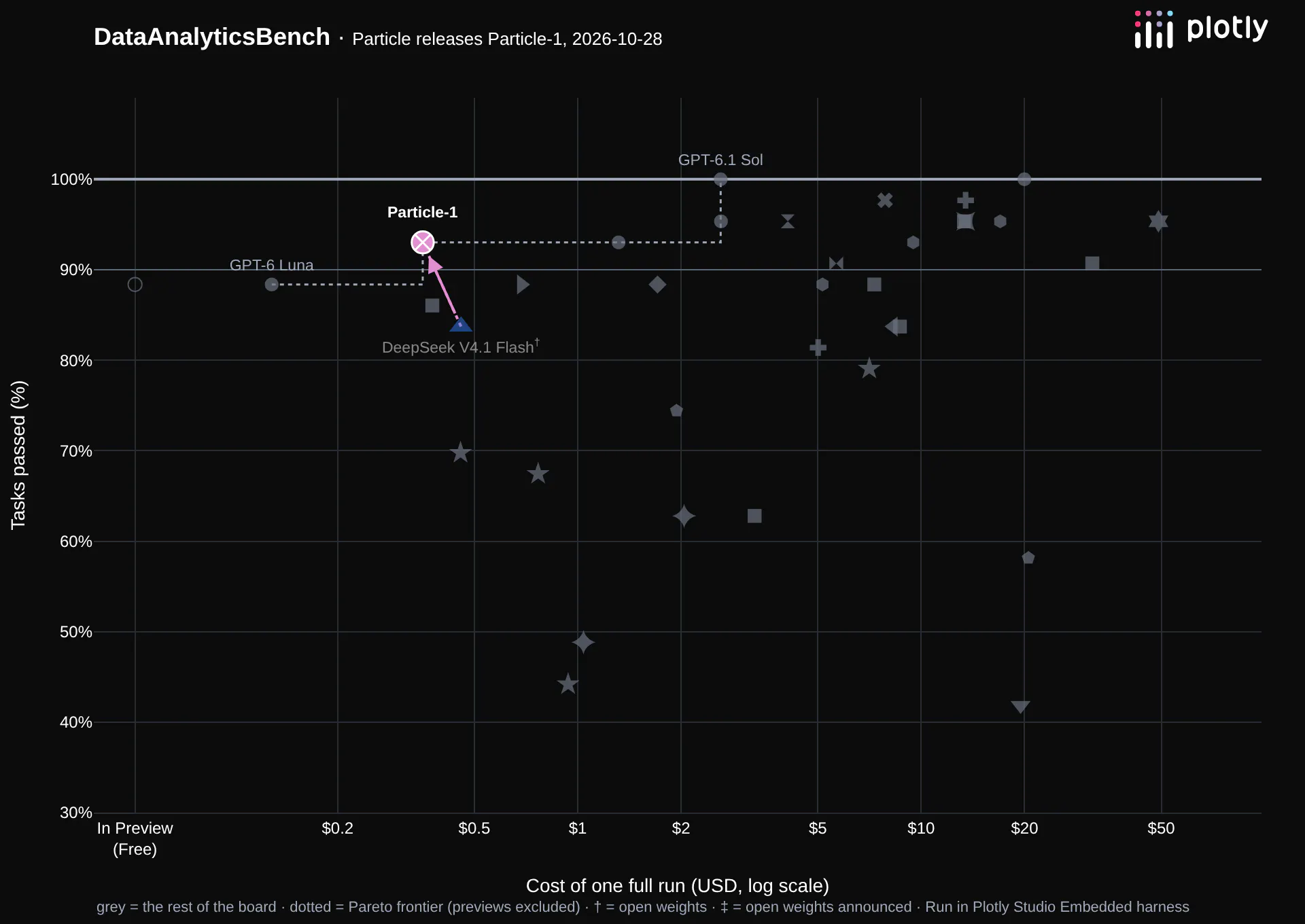
Particle-1 vs. DeepSeek V4.1 Flash and GPT-6.1 Terra
DeepSeek V4.1 Flash
Particle-1
GPT-6.1 Terra
Score
36 / 43
40 / 43
40 / 43
Analytics questions
20 / 20
20 / 20
20 / 20
Ambiguous questions
5 / 5
5 / 5
5 / 5
Impossible requests
5 / 5
5 / 5
5 / 5
Data quality
2 / 3
2 / 3
3 / 3
Statistics traps
3 / 5
5 / 5
4 / 5
Hidden needles
1 / 5
3 / 5
3 / 5
Open weights
Yes
No
No
Cost of one full run
$0.46
$0.35
$1.31
Per person per year*
$27
$21
$76
Median time per question
21 seconds
16 seconds
15 seconds
*1,000 people each asking 10 questions a day, 250 working days a year, at OpenRouter's prices when each model ran. We ran DeepSeek V4.1 Flash in September.
All four extra points came from the hardest questions. Like DeepSeek V4.1 Flash, Particle-1 aced the analytics, ambiguous and impossible questions. It also aced the statistics traps, where the base model got 3 of 5, and found 3 of the 5 patterns we hid in the data, where the base model found 1. Particle's training targeted software and data engineering tasks and using fewer tokens, not judgment on analysis questions like these.
One run per model is a single sample. In our repeat runs of other models, scores moved by up to three points between runs, so treat the size of the gain as approximate. The direction is consistent, though: the gains came on the two kinds of question where the base model scored lowest.
Fewer tokens? Not on our exam
Particle's pitch is efficiency, and on its coding benchmarks Particle-1 writes far less than DeepSeek V4.1 Flash. That didn't carry over to data analysis. On our exam it wrote about 6,900 output tokens per question, against about 6,200 for the base model, and made about 10 model calls per question, against 7. It also read more: about 380,000 tokens per question, 80% of them cached, against about 280,000.
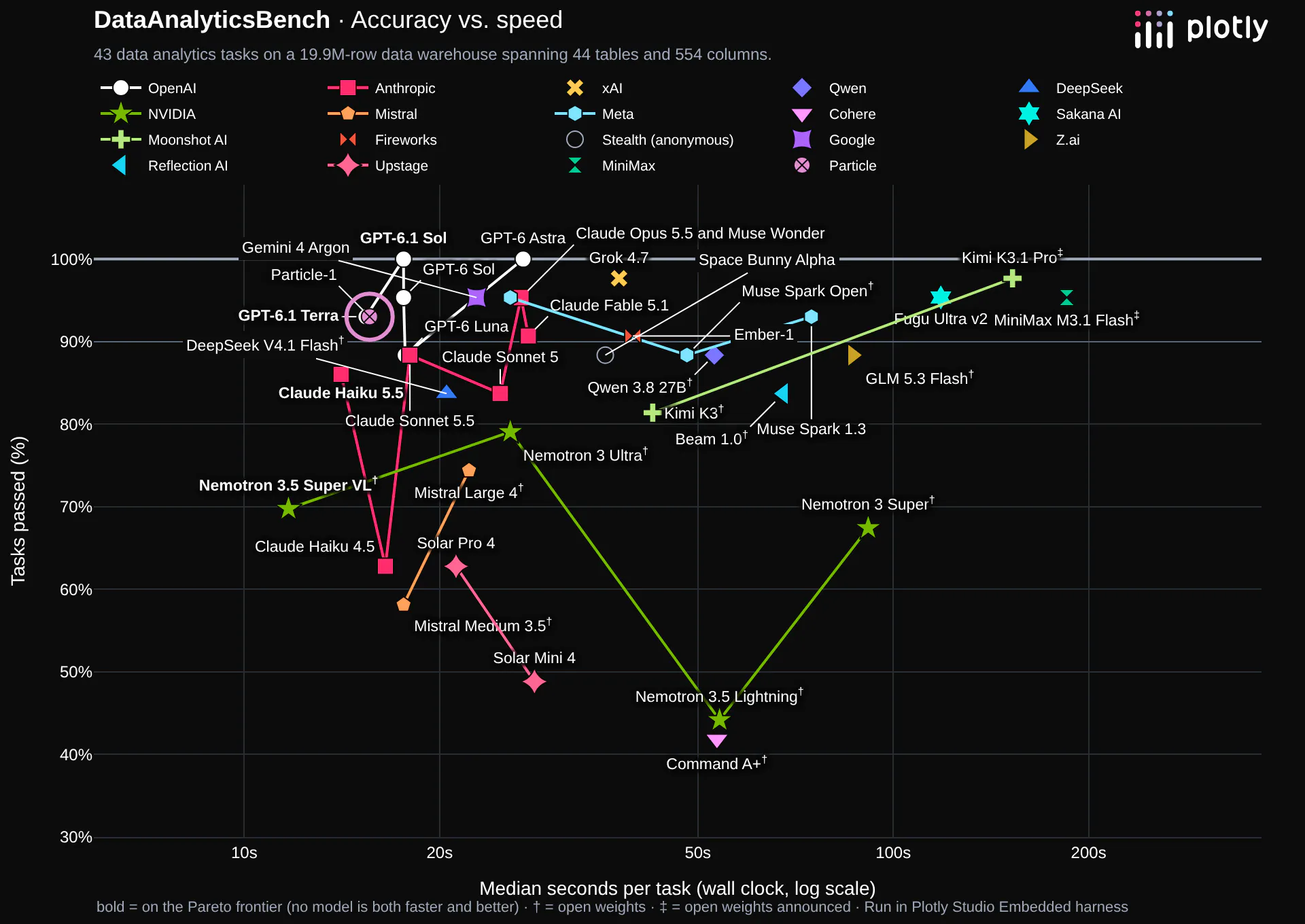
So the gain came from better answers, not shorter ones. It still finished faster, at a median of 16 seconds per question against 21, which puts it next to GPT-6.1 Terra at 15 seconds. And it cost less, because OpenRouter's price for Particle-1 is lower than what DeepSeek V4.1 Flash cost when we ran it in September. DeepSeek V4.1 Flash has since dropped to almost the same price per token, and at today's prices our DeepSeek V4.1 Flash run would have cost about $0.24, less than Particle-1's $0.35, because it used fewer tokens.
Where it got things right
- Statistics traps (5 of 5). Nine of the 36 models on our board aced these, and apart from a free preview, Particle-1 is by far the cheapest of them. It broke aggregate numbers down before drawing conclusions from them, and stated the rule it used whenever it called something unusual.
- Hidden patterns (3 of 5). Among them was the pattern behind component failures that GPT-6.1 Terra missed.
- Analytics (20 of 20), ambiguous questions (5 of 5) and impossible requests (5 of 5).
Where it got things wrong
Particle-1 missed 3 of the 43 questions:
- A false alarm in a data quality audit. Asked to audit a table before board reporting, it did a thorough job, and checked duplicates, nulls, date ranges and units. But it flagged one pattern as a contradiction that the rest of the data explains, and told us not to trust those rows. DeepSeek V4.1 Flash got this one right.
- Two of the five hidden patterns. Asked for anything anomalous in the alarm logs, it found several real oddities but not the one we planted. Asked why some wind farms underperform, it noticed the relevant signal, then dismissed it as a reporting artifact.
Fine-tuning is becoming a way to compete
Particle-1 is the second fine-tune on our board. The first, Fireworks' Ember-1, took Kimi K3 from 35 to 39. Particle-1 takes DeepSeek V4.1 Flash from 36 to 40. Both start from open weights, both were trained mainly to be more efficient, and both scored higher than their base model on our exam. We wrote more about what that means for companies choosing between open and closed models in Open Models vs. Closed Models in 2026.
One difference from its base model: DeepSeek V4.1 Flash's weights are public, and Particle hasn't released Particle-1's. For now, it's available only through Particle's API and OpenRouter.
Frequently asked questions
How good is Particle-1 at data analysis?
On PlotlyDataAnalyticsBench it passed 40 of 43 questions, the same as GPT-6.1 Terra and four more than DeepSeek V4.1 Flash, the model it's built on. It aced the analytics, ambiguous, impossible and statistics questions, and found three of the five hidden patterns.
What is Particle-1 based on?
DeepSeek V4.1 Flash. Particle trained an adapter covering about 1.25% of the model's parameters with reinforcement learning, aimed at using fewer tokens on software engineering tasks.
How much does Particle-1 cost?
On OpenRouter, $0.05 per million input tokens, $0.50 per million output tokens and $0.003 per million cached input tokens. Particle's own announcement lists $0.30 and $1.20. Our whole exam cost $0.35 at OpenRouter's prices.
Is Particle-1 open source?
No. DeepSeek V4.1 Flash, its base model, has open weights, but Particle hasn't released Particle-1's weights or adapter.
About the benchmark
We run new models through the same exam as they're released, and we'll keep sharing what we find. We ran Particle-1 through OpenRouter at its default settings, with the same harness and grading as every other model.
To see all 36 models on one chart and in a full results table, along with cost, speed and how the exam works, see Introducing DataAnalyticsBench.
The exam is private and we're sharing it with researchers. We're keeping it private so that the answer key doesn't make its way into the training set. For the same reason, the data is fabricated: the warehouse is a synthetic wind-energy fleet, built to look like a real operator's data, so its answers don't exist anywhere else.
If you'd like access, reach out to Chris Parmer at Plotly.