Inkling 2 Mini Benchmark Results for Data Analysis
Nov 21, 2026: Thinking Machines' small open-weight model, tested on real-world data analysis.
At Plotly, we keep a close eye on model releases. Our agentic analytics products, Plotly Studio Desktop and Plotly Studio Embedded, and our open source libraries Plotly and Dash work with any model, and our customers look to us for recommendations.
On November 20, Thinking Machines released Inkling 2 Mini, a much smaller sibling of Inkling 2 Small, which we tested last week. It's a mixture-of-experts model with 26.4 billion parameters, 3.4 billion of them active for each token.
It's also a looped transformer: its middle layers run three times for every token. Counting those extra passes, Thinking Machines puts it at 5.4 billion weight activations per token.
Thinking Machines says the model is "derived from our mainline predictive scaling ladder". The main changes were "pruning two-thirds of the experts to reduce the model's size" and adding looping. In its words, "After pruning, the model trained on 1T tokens distilled from a larger internal Inkling model."
The weights are out under the Apache 2.0 license on Hugging Face, with a context window of 1 million tokens. On OpenRouter, Prime Intellect serves it at $0.10 per million input tokens and $0.40 per million output tokens.
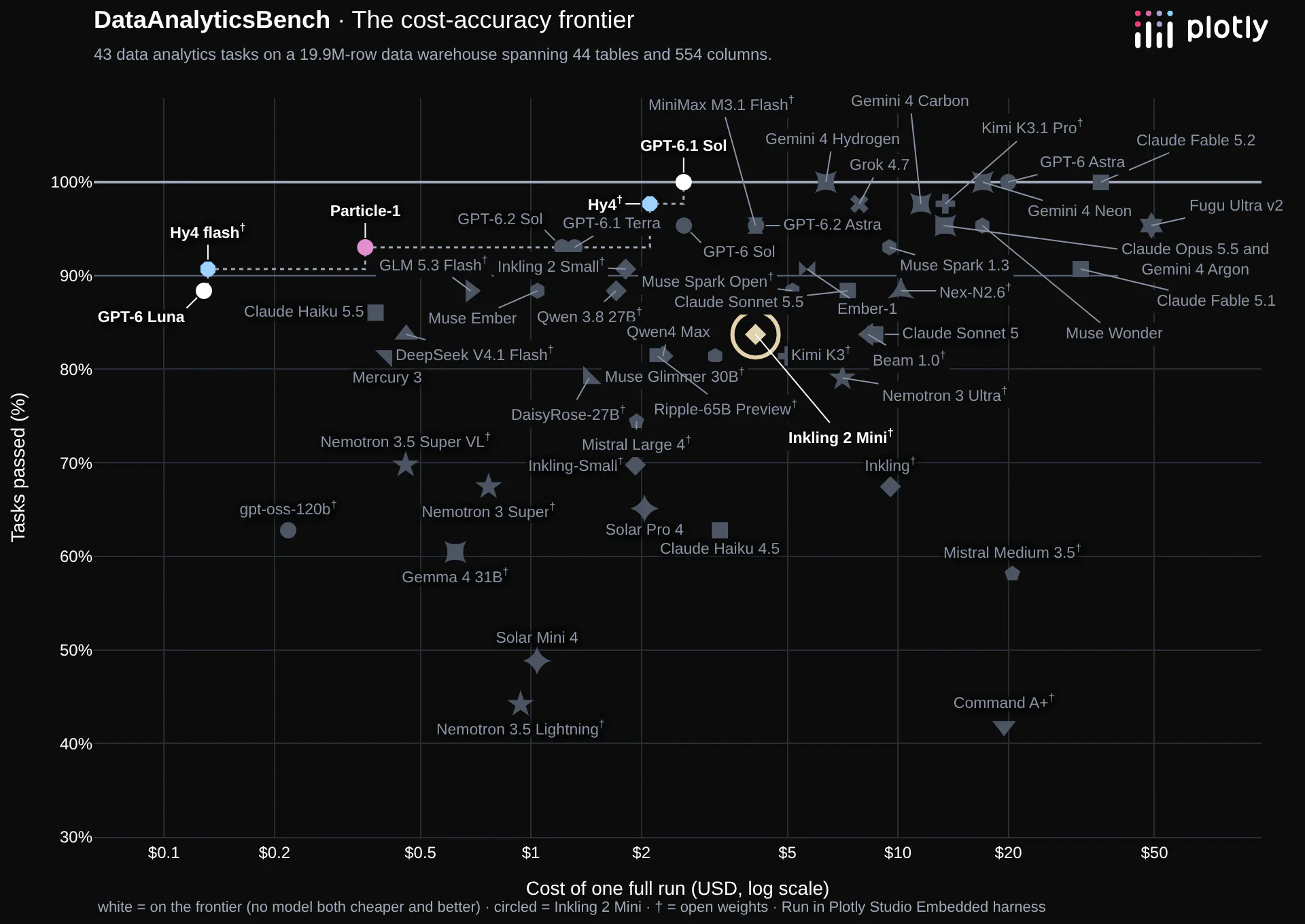
We ran it through our data analytics exam. Inkling 2 Mini passed 36 of 43 questions (84%, a B), three fewer than Inkling 2 Small. That's the most of any U.S. open-weight model small enough to run on a Mac mini.
Its token prices are some of the lowest on our board, yet its run cost $4.09, more than twice Inkling 2 Small's $1.81. One runaway loop explains the gap. On the chart below, it sits off the cost-accuracy frontier.
Inkling 2 Mini vs. Inkling 2 Small
Inkling 2 Mini
Inkling 2 Small
Score
36 / 43
39 / 43
Analytics questions
20 / 20
19 / 20
Ambiguous questions
5 / 5
5 / 5
Impossible requests
5 / 5
5 / 5
Data quality
2 / 3
3 / 3
Statistics traps
3 / 5
5 / 5
Hidden needles
1 / 5
2 / 5
Open weights
Yes
Yes
Cost of one full run
$4.09
$1.81
Per person per year*
$238
$105
Median time per question
69 seconds
13 seconds
Tokens
179M
22M
*1,000 people each asking 10 questions a day, 250 working days a year, at OpenRouter's prices when each model ran.
Inkling 2 Mini got every analytics question, ambiguous question and impossible request right, one more analytics question than Inkling 2 Small. It lost its points on the harder categories: data quality, statistics traps and hidden needles.
One run per model is a single sample. In our repeat runs of other models, scores moved by up to three points between runs, so treat a one- or two-point gap as close to a tie.
Inkling 2 Mini among open-weight models
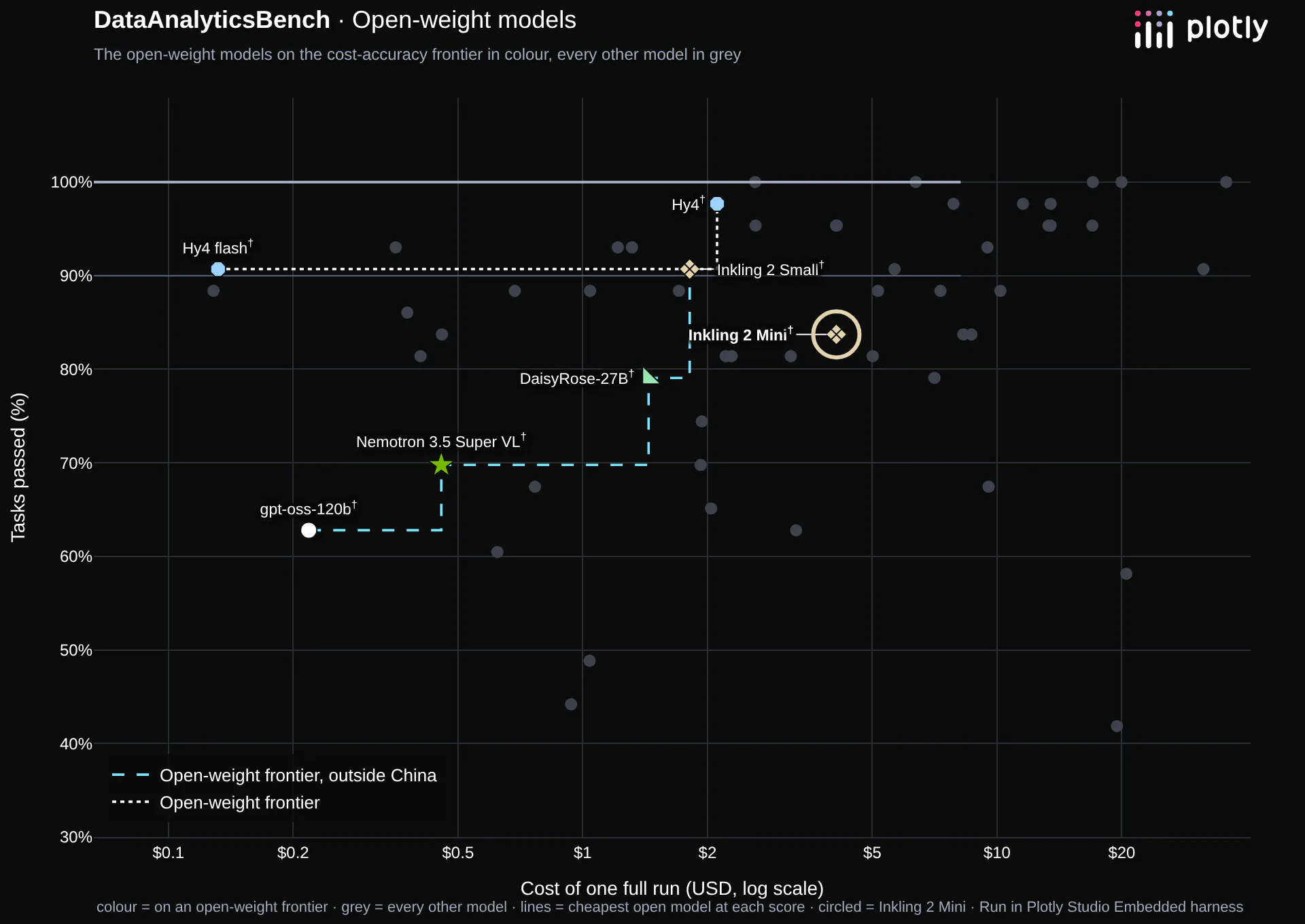
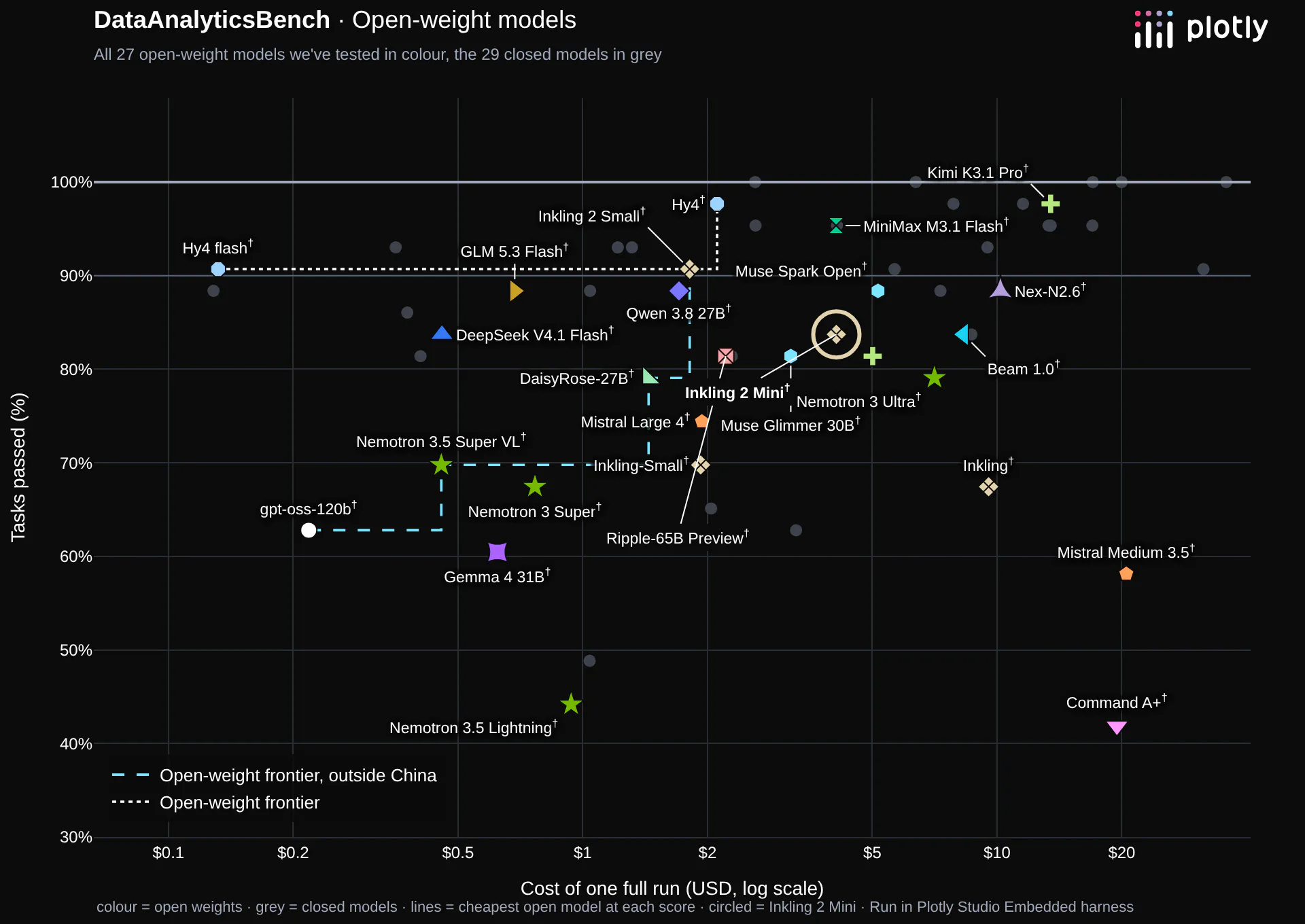
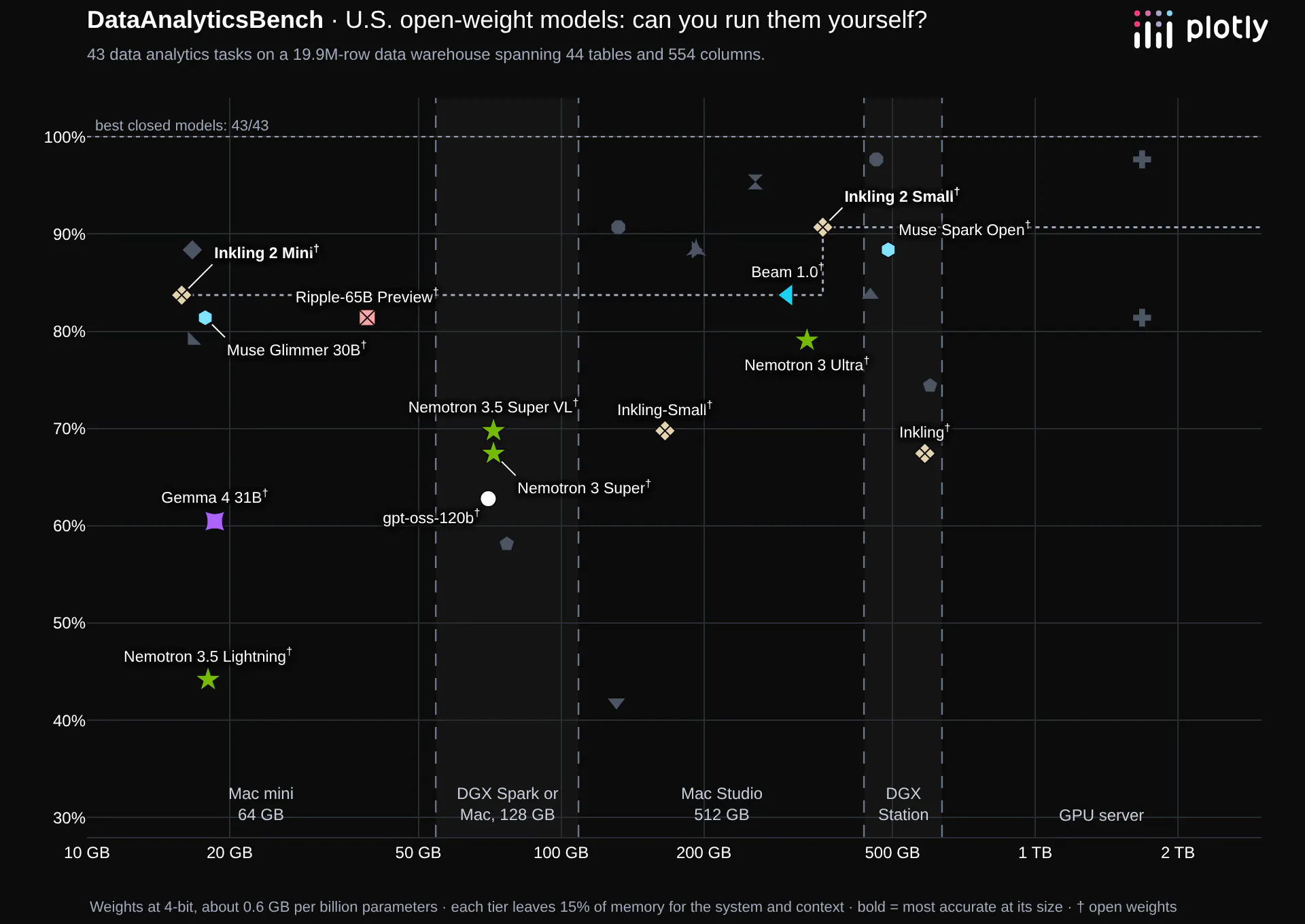
We've tested 27 open-weight models, and Inkling 2 Mini joins neither open-weight frontier. The open-weight frontier runs from Hy4 flash to Hy4, and Hy4 flash scored 39 for $0.13.
The frontier for labs outside China runs from gpt-oss-120b to Nemotron 3.5 Super VL, DaisyRose-27B and Inkling 2 Small. Inkling 2 Small scored three more than Inkling 2 Mini for less than half the cost.
The runaway loop is what pushes Inkling 2 Mini to the right on the cost axis. The first chart shows both frontiers, and the second labels every open-weight model.
Cheap tokens, expensive run
At $0.10 per million input tokens and $0.40 per million output tokens, Inkling 2 Mini has some of the lowest token prices on our board. Its run still cost $4.09, more than twice Inkling 2 Small's $1.81.
The reason is one runaway loop. On one hidden-pattern question, it made 585 queries over about 48 minutes, rerunning the same few queries dozens of times, and it still missed the pattern.
That one question accounts for 46% of all its tool calls across the exam. Its context grew huge, and the run used 179 million tokens in total, 8 times as many as Inkling 2 Small. Almost all of them were cached input.
Without that loop, Inkling 2 Mini would be a cheap model. We saw the same thing with Nex-N2.6, where runaway loops pushed its run to $10.19.
What it got right
Inkling 2 Mini got all 20 straightforward analytics questions, one more than Inkling 2 Small. It asked about or stated its assumptions on all five ambiguous questions, and it turned down all five impossible requests instead of inventing an answer.
It also caught two of three planted data quality problems and three of five statistics traps. Every final answer was complete and in English.
Where it lost points
It missed seven questions: one data quality problem, two statistics traps and four of five hidden patterns. We checked all seven by hand against the transcripts and the answer key, and every verdict stands.
On hidden-pattern questions, it often added up the biggest totals and stopped. It didn't slice the data by the dimension that would isolate a localized cause, and it accepted the first plausible coarse explanation.
It also skipped tables and columns that held the decisive evidence. In one case, it said the data doesn't record a signal that it does record.
In a clean-data audit, it flagged a harmless quirk as a defect. On a statistics trap, it reported a correlation as a cause and only offered the confounder check as a follow-up, asking "Should I...?" instead of running it.
A few final answers also corrected themselves partway through the text, which makes them harder to read.
Can you run it locally?
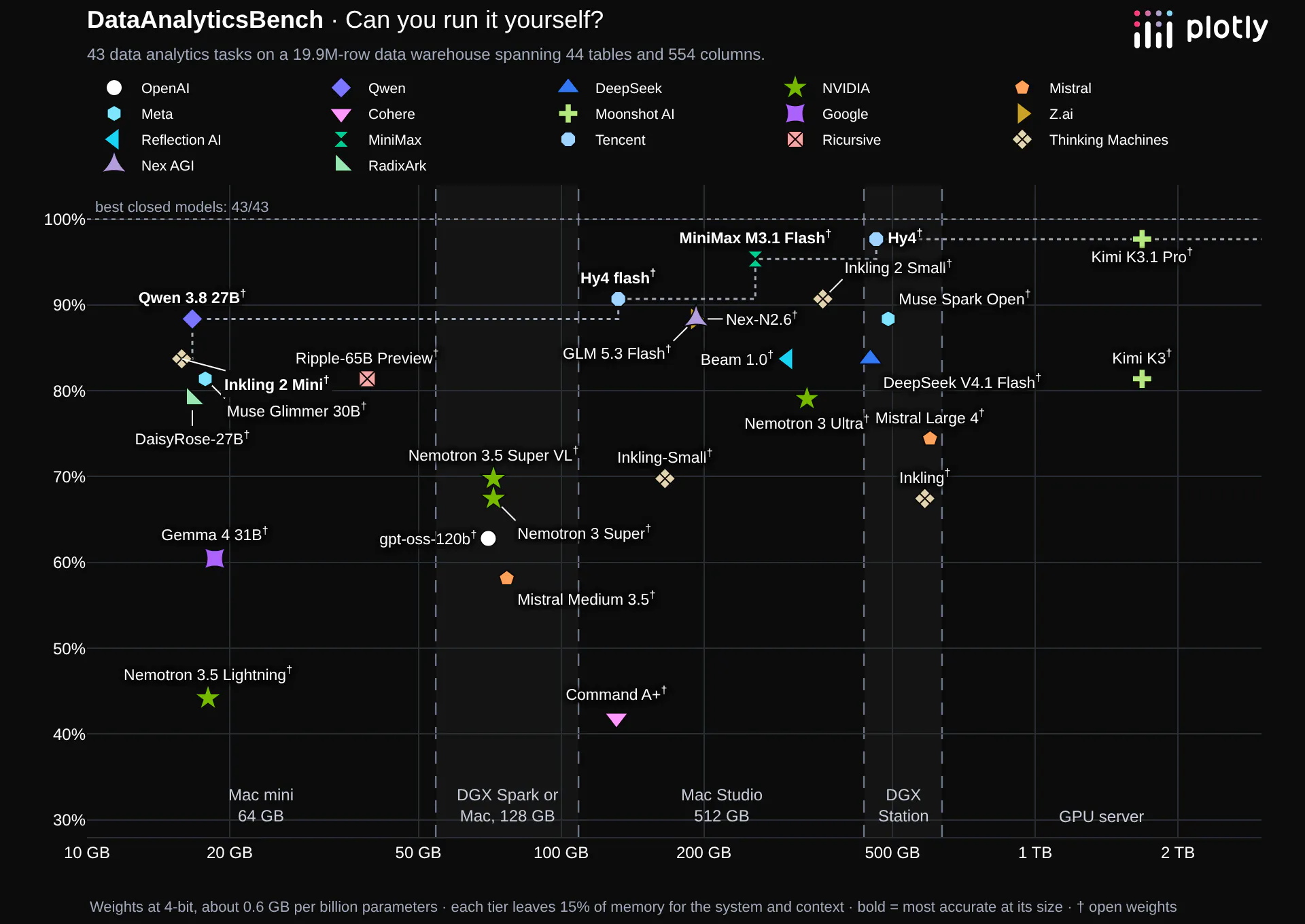
At 4-bit, about 0.6 GB per billion parameters, Inkling 2 Mini needs about 16 GB for its weights. That fits a Mac mini with 64 GB of memory.
It's the most accurate U.S. open-weight model that fits a Mac mini: 36, against 35 for Muse Glimmer 30B and 26 for Gemma 4 31B. Across all labs, Qwen 3.8 27B, at 38, is still the most accurate model in that tier.
On the first chart, Inkling 2 Mini is in bold, meaning most accurate at its size, because it's a bit smaller than Qwen 3.8 27B. With only 3.4 billion active parameters, it should run fast on local hardware, though we haven't measured that.
For more, see our posts on the best local LLMs and the best U.S. open-weight models.
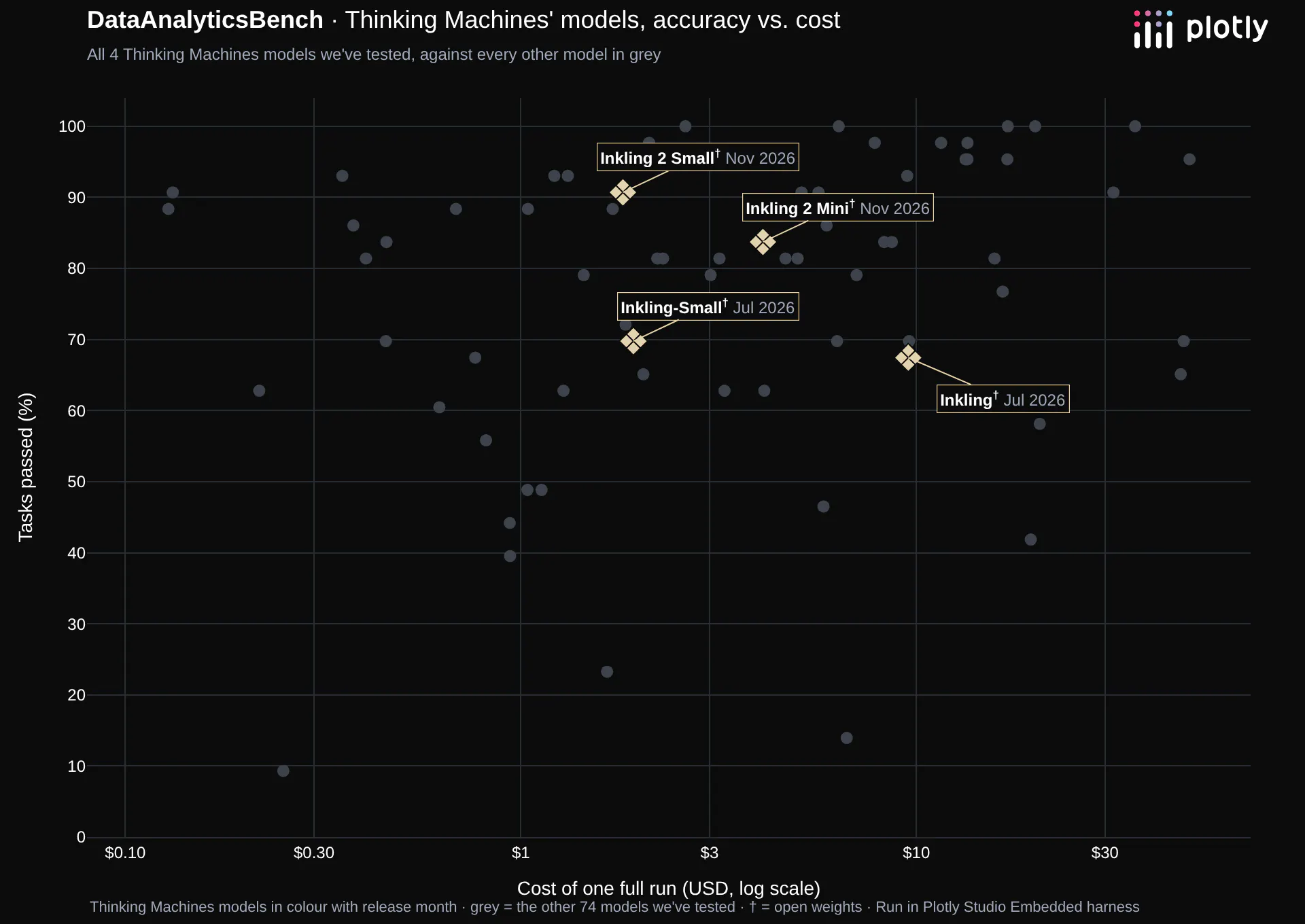
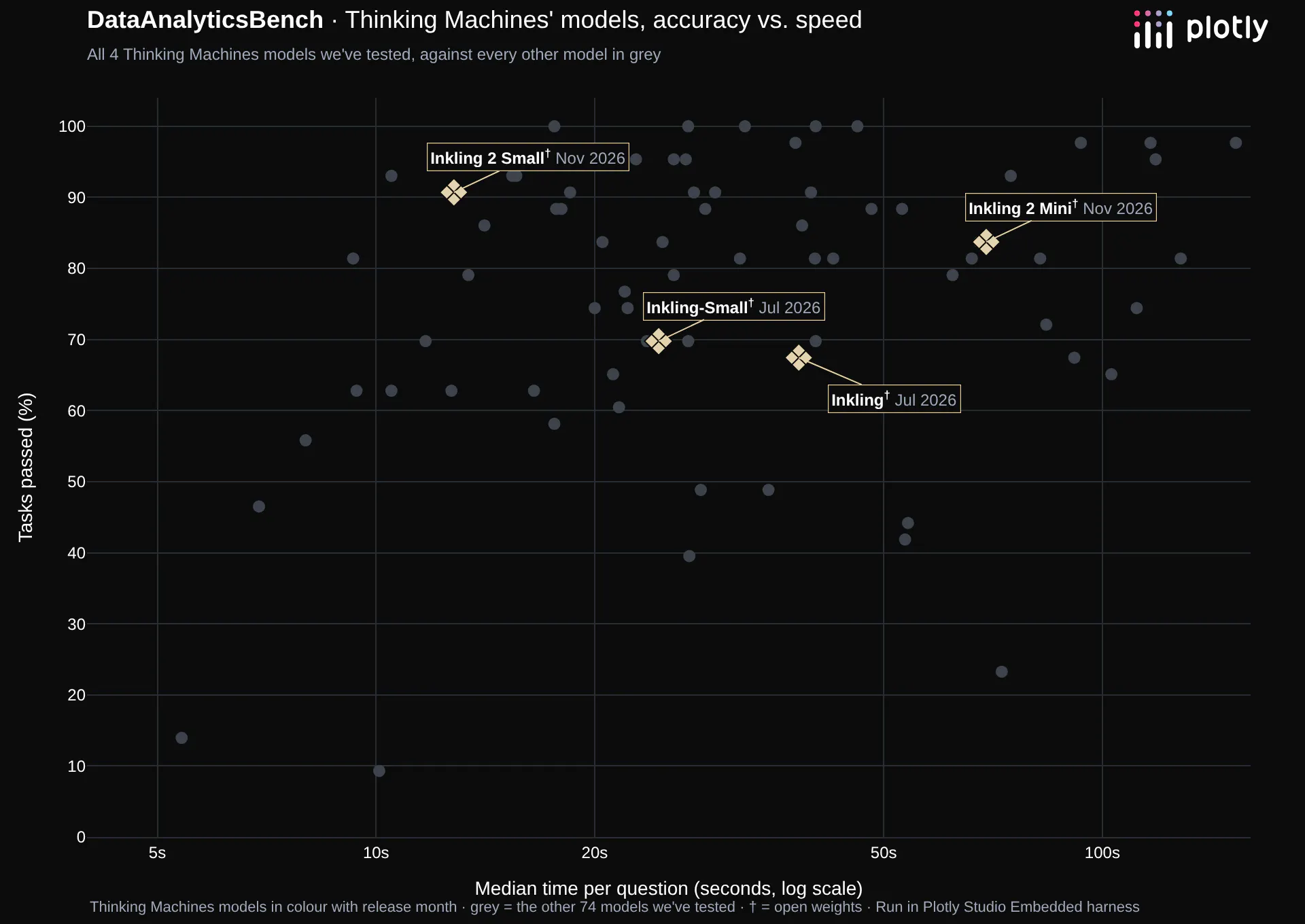
Thinking Machines' models over time
Here are all four Thinking Machines models we've tested, with every other model in grey. Inkling and Inkling-Small, released in July, scored 29 and 30, for $9.54 and $1.93.
The second generation is a big step up. Inkling 2 Small scored 39 for $1.81, and Inkling 2 Mini scored 36 for $4.09, though it's much slower at the median, 69 seconds a question against 13.
The Test Harness
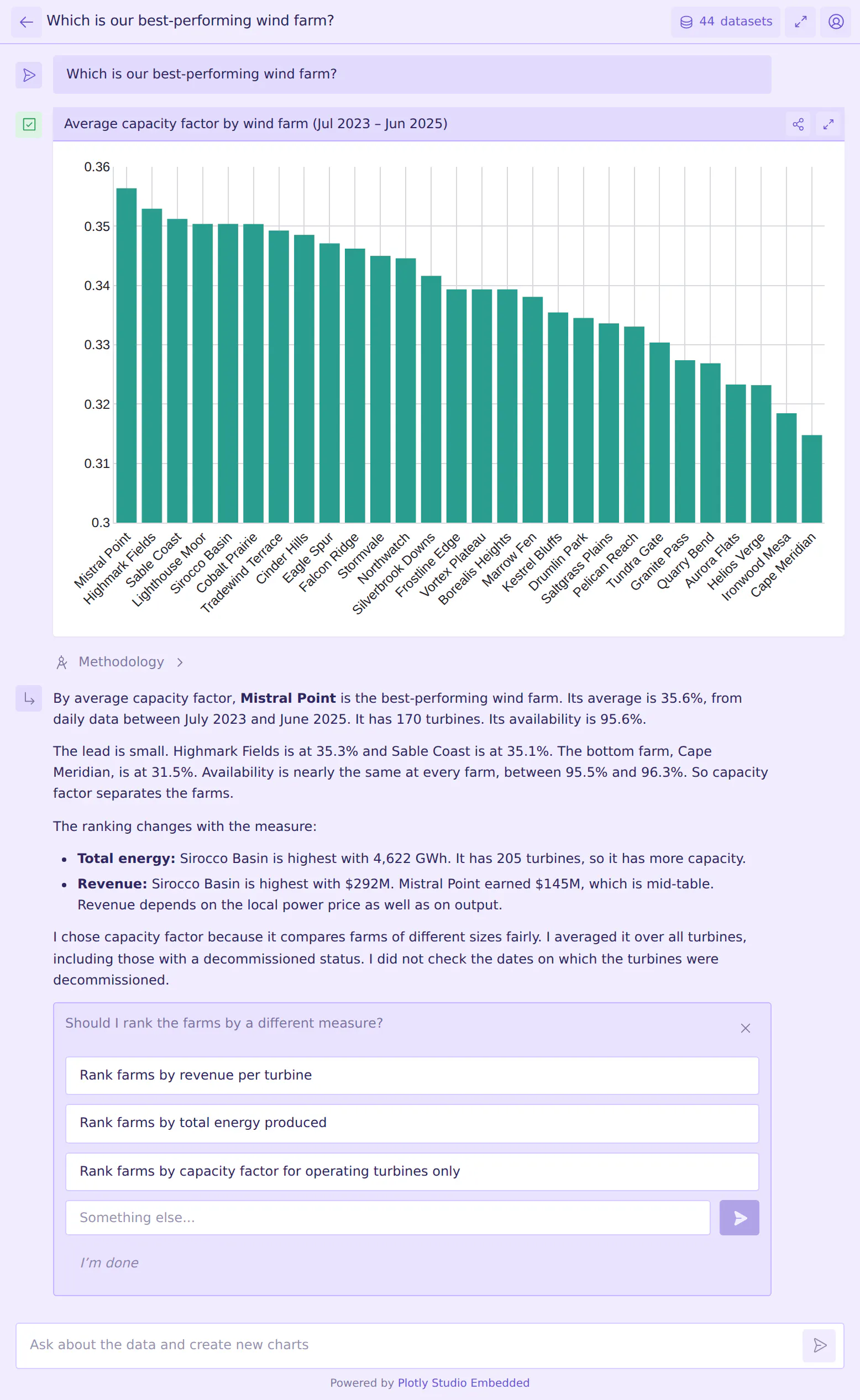
We run every model in Plotly Studio Embedded, a drop-in analytics agent that runs on Dash apps. This harness is tuned to run data analytics queries and make charts with multi-turn tool calling, with less emphasis on writing text. It's meant to put the data front and center.
Frequently asked questions
Can I run Inkling 2 Mini on a Mac mini?
Yes. At 4-bit it needs about 16 GB for its weights, so it fits a Mac mini with 64 GB of memory. It's the most accurate U.S. open-weight model that fits there, though Qwen 3.8 27B scored two more.
Is Inkling 2 Mini better than Inkling 2 Small for data analysis?
No. Inkling 2 Small scored 39 of 43 against 36, cost $1.81 a run against $4.09, and took 13 seconds a question at the median against 69. Inkling 2 Mini's advantage is size: it fits a Mac mini, where Inkling 2 Small needs about 356 GB of memory.
Why did it cost more than its token prices suggest?
One runaway loop. On a single hidden-pattern question it made 585 queries over about 48 minutes, 46% of its tool calls on the whole exam. Its context grew huge, and the run used 179 million tokens, 8 times as many as Inkling 2 Small.
How much does Inkling 2 Mini cost?
On OpenRouter, Prime Intellect serves it at $0.10 per million input tokens and $0.40 per million output tokens. Our whole exam cost $4.09, or about $238 per person per year at 10 questions a day.
Is Inkling 2 Mini open source?
Its weights are open. Thinking Machines released them on November 20 under the Apache 2.0 license on Hugging Face.
About the benchmark
We run new models through the same exam as they're released, and we'll keep sharing what we find. We ran Inkling 2 Mini through OpenRouter, where Prime Intellect serves it, with the same harness and grading as every other model.
On the first pass, 16 questions errored during a provider outage, so we reran them cleanly. The score combines both passes, and the cost is the sum of both.
To see every model on one chart and in a full results table, along with cost, speed and how the exam works, see Introducing DataAnalyticsBench.
The exam is private and we're sharing it with researchers. We're keeping it private so that the answer key doesn't make its way into the training set. For the same reason, the data is fabricated: the warehouse is a synthetic wind-energy fleet, built to look like a real operator's data, so its answers don't exist anywhere else.
If you'd like access, reach out to Chris Parmer at Plotly.