Nex-N2.6 Benchmark Results for Data Analysis
Nov 11, 2026: An open-weight agentic model from Nex AGI, tested on real-world data analysis.
At Plotly, we keep a close eye on model releases. Our agentic analytics products, Plotly Studio Desktop and Plotly Studio Embedded, and our open source libraries Plotly and Dash work with any model, and our customers look to us for recommendations.
On November 10, Nex AGI, an agentic AI team in Shanghai, released Nex-N2.6, a multimodal model built for computer use, coding and long tasks with tools. It's post-trained on Z.ai's GLM-5.3-Flash, with about 321 billion parameters, and the weights are out under the Apache 2.0 license. Nex AGI says this release cuts repetitive reasoning by 90% compared with Nex-N2.5-Pro, and that in its own tests every tool call used a tool that was actually available. On OpenRouter it costs $0.12 per million input tokens and $0.40 per million output tokens, a 20% launch discount on a list price of $0.15 and $0.50, with a context window of 262,144 tokens.
We ran it through our data analytics exam. Nex-N2.6 passed 38 of 43 questions (88%), the same score as GLM 5.3 Flash, the model it's built on. It was perfect on the straightforward analytics, the ambiguous questions, the impossible requests and the statistics traps, where GLM 5.3 Flash dropped three points between them. But it found only one of the five hidden patterns, against four for GLM 5.3 Flash. On two of those questions it got stuck in a loop that ran for more than an hour, which pushed the cost of our run to $10.19, fifteen times GLM 5.3 Flash's $0.69. On the chart below, Nex-N2.6 sits far from the frontier.
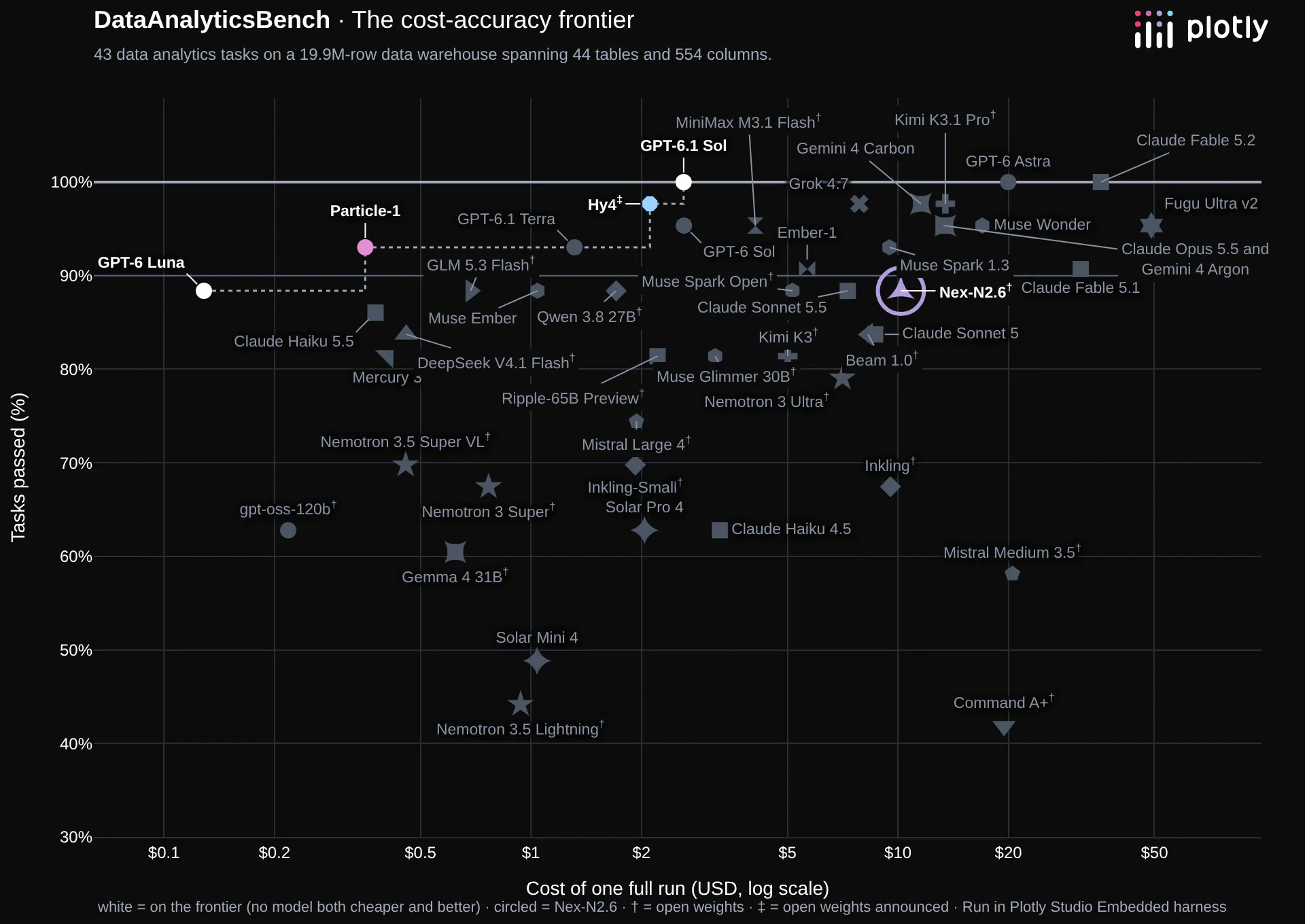
Nex-N2.6 vs. GLM 5.3 Flash, GPT-6 Luna and Kimi K3.1 Pro
Nex-N2.6
GLM 5.3 Flash
GPT-6 Luna
Kimi K3.1 Pro
Score
38 / 43
38 / 43
38 / 43
42 / 43
Analytics questions
20 / 20
20 / 20
20 / 20
20 / 20
Ambiguous questions
5 / 5
4 / 5
5 / 5
5 / 5
Impossible requests
5 / 5
4 / 5
5 / 5
5 / 5
Data quality
2 / 3
2 / 3
3 / 3
3 / 3
Statistics traps
5 / 5
4 / 5
3 / 5
4 / 5
Hidden needles
1 / 5
4 / 5
2 / 5
5 / 5
Open weights
Yes
Yes
No
Yes
Cost of one full run
$10.19
$0.69
$0.13
$13.47
Per person per year*
$592
$40
$7.50
$783
Median time per question
68 seconds
87 seconds
18 seconds
153 seconds
*1,000 people each asking 10 questions a day, 250 working days a year, at OpenRouter's prices when each model ran. Nex-N2.6 is at its list price: during the launch discount, OpenRouter billed us $8.15 for the run.
One run per model is a single sample. In our repeat runs of other models, scores moved by up to three points between runs, so treat a one- or two-point gap as close to a tie.
Two runaway loops
Two of the five hidden-pattern questions didn't end on their own. On the first, Nex-N2.6 made about 1,670 model calls over 2 hours and 20 minutes, most of them small counting queries that sliced the same table one filter combination at a time. On the second it made about 650 calls over 70 minutes. Each attempt stopped only when the conversation grew past the 262,144-token context window and the provider returned an error. Our harness retries a question once after an error, and both retries finished in under five minutes, with answers that missed the pattern.
Those two loops cost about $9.80 of the $10.19 run, even with more than 99% of the 327 million input tokens served from the cache. The other 41 questions cost about 39 cents together, which would put Nex-N2.6 close to GLM 5.3 Flash. We report the whole run, because a user would have paid for the loops too, and nothing in the model stopped them. Nex AGI measured repetition in the model's reasoning. What we saw was a different kind of repetition: the same query, over and over, with small changes.
Where it got things wrong
Outside the hidden patterns, Nex-N2.6 missed one question, a data quality check. Asked to summarize a sensor's readings, it reported that every turbine had a complete quarter of hourly records. It counted the rows but didn't check whether the readings in them were filled in, and part of the series was missing.
On the hidden patterns, it found one of five. Its answers were confident and well organized, and on several it settled on a plausible explanation and stopped. Outside the two loops, its final attempts averaged about 23 queries per hidden-pattern question, close to the board median of 25, so it wasn't a lack of effort.
Where it was strong is what most people will use it for. It got all 20 straightforward analytics questions, asked about or stated its assumptions on every ambiguous question, turned down every impossible request and caught all five statistics traps, two more than GPT-6 Luna.
The Test Harness
We run every model in Plotly Studio Embedded, a drop-in analytics agent that runs on Dash apps. This harness is tuned to run data analytics queries and make charts with multi-turn tool calling, with less emphasis on writing text. It's meant to put the data front and center.
Frequently asked questions
How good is Nex-N2.6 at data analysis?
On PlotlyDataAnalyticsBench it passed 38 of 43 questions, tied with GLM 5.3 Flash, GPT-6 Luna, Qwen 3.8 27B, Claude Sonnet 5.5, Muse Spark Open and Muse Ember. It was perfect on analytics, ambiguity, impossible requests and statistics, but found only one of five hidden patterns.
Is Nex-N2.6 better than GLM 5.3 Flash?
Not on our exam. Both scored 38, by different routes: Nex-N2.6 caught more of the traps, and GLM 5.3 Flash found more of the hidden patterns. GLM 5.3 Flash's run cost $0.69 against $10.19, though most of Nex-N2.6's cost came from two runaway loops.
How much does Nex-N2.6 cost?
Its list price on OpenRouter is $0.15 per million input tokens and $0.50 per million output tokens, and it's 20% off during the launch. Our whole exam cost $10.19 at list price, about $9.80 of it in two loops.
How fast is Nex-N2.6?
Its median question took 68 seconds, faster than GLM 5.3 Flash's 87 but slower than 36 of the other 46 models on our board. Two questions ran for more than an hour before their retries.
Is Nex-N2.6 open source?
Its weights are open, under the Apache 2.0 license, on Hugging Face. At about 321 billion parameters it's the same size as GLM 5.3 Flash, so see our best local LLMs post for what it takes to run a model that size yourself.
About the benchmark
We run new models through the same exam as they're released, and we'll keep sharing what we find. We ran Nex-N2.6 through OpenRouter, where Nex AGI is the only provider, with the same harness and grading as every other model. Nex AGI's endpoint allows responses of up to 235,929 tokens, more than fits beside a long conversation in its context window, so we capped each response at 32,768 tokens.
To see all 47 models on one chart and in a full results table, along with cost, speed and how the exam works, see Introducing DataAnalyticsBench.
The exam is private and we're sharing it with researchers. We're keeping it private so that the answer key doesn't make its way into the training set. For the same reason, the data is fabricated: the warehouse is a synthetic wind-energy fleet, built to look like a real operator's data, so its answers don't exist anywhere else.
If you'd like access, reach out to Chris Parmer at Plotly.