The Best U.S. Open-Weight Models for Data Analysis in 2026
Nov 6, 2026: every open-weight model from a U.S. lab we could run, tested on the same data analysis exam.
At Plotly, we keep a close eye on model releases. Our agentic analytics products, Plotly Studio Desktop and Plotly Studio Embedded, and our open source libraries Plotly and Dash work with any model, and many of our customers want one they can run themselves, from a lab in the United States.
This week Ricursive Intelligence released Ripple-65B Preview and called it the new U.S. open-weight state of the art on agentic coding, ahead of "significantly larger US open-weight models": Reflection's Beam 1.0, Meta's Muse Spark Open, Thinking Machines' Inkling and NVIDIA's Nemotron 3 Ultra. That's a coding benchmark. We wanted to know how the same models rank on data analysis, so we ran every U.S. open-weight model we could reach through OpenRouter through DataAnalyticsBench, our 43-question exam on a 20M-row data warehouse.
Key takeaways
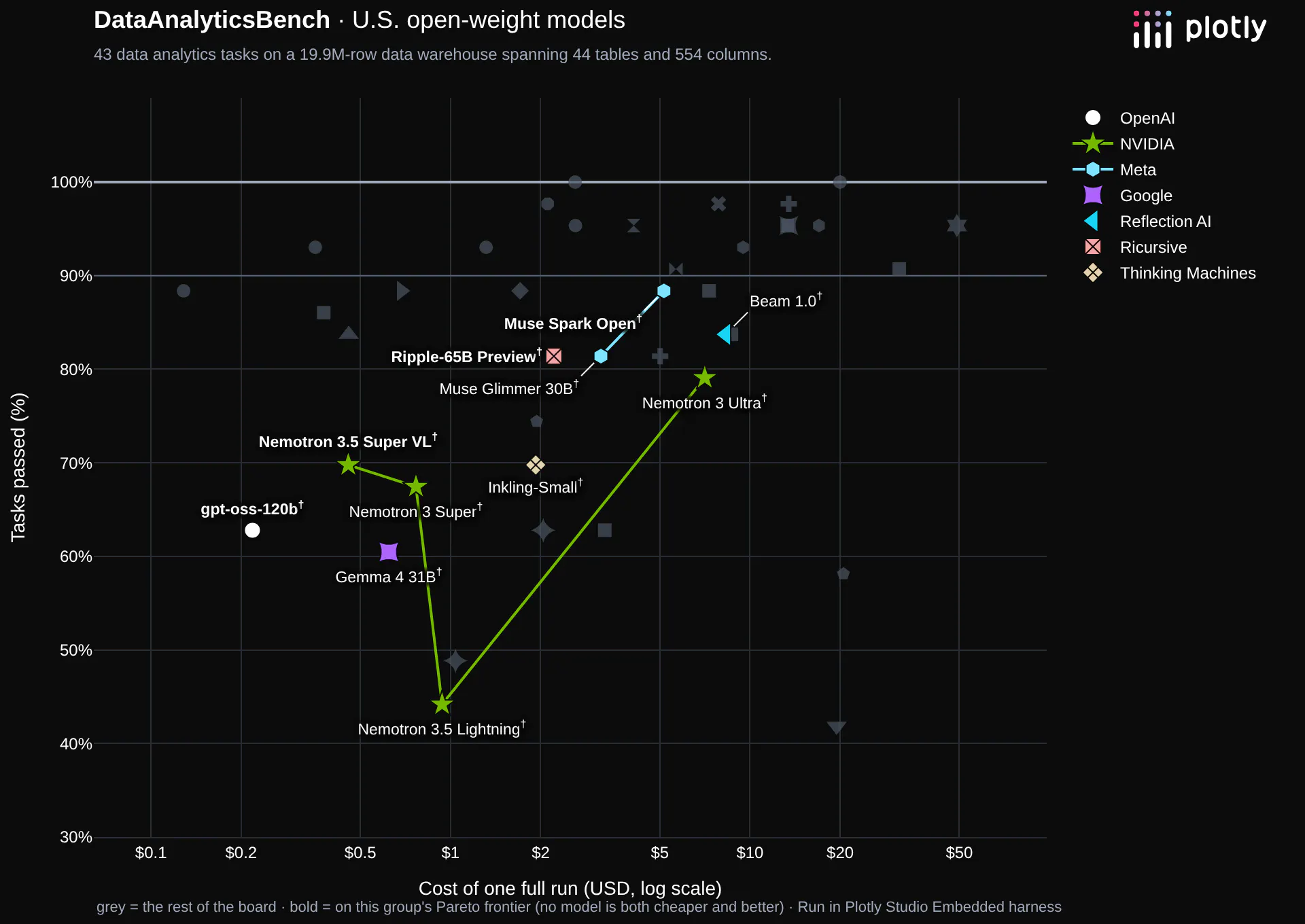
- Meta's Muse Spark Open is the best U.S. open-weight model for data analysis, at 38 of 43. Reflection's Beam 1.0 (36), Ricursive's Ripple-65B Preview (35) and Meta's Muse Glimmer 30B (35) follow.
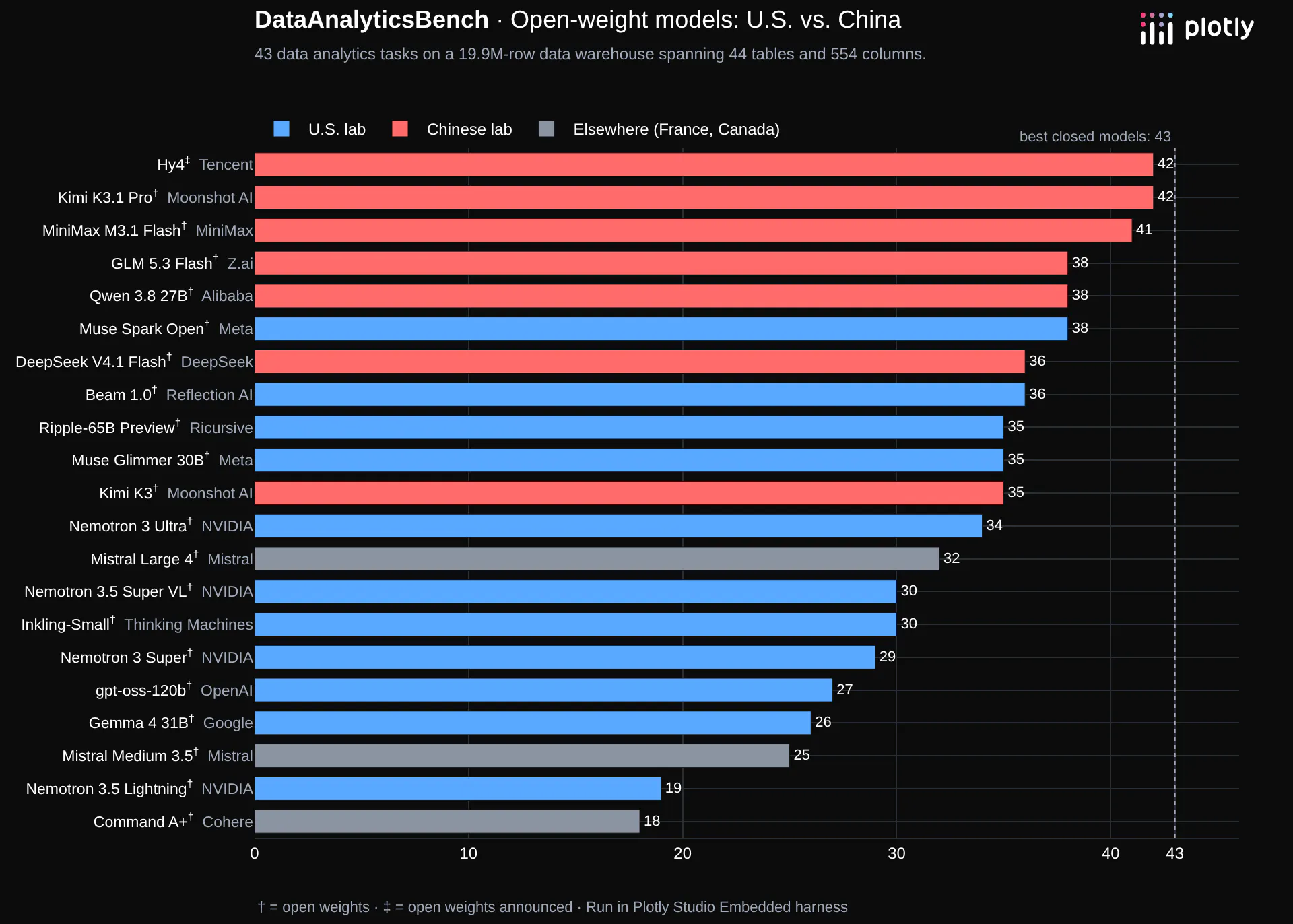
- U.S. open-weight models trail Chinese ones. Moonshot's Kimi K3.1 Pro scores 42 and MiniMax M3.1 Flash 41. Two Chinese models, GLM 5.3 Flash and Qwen 3.8 27B, match Muse Spark Open's 38 for a fraction of the cost.
- The cheapest and fastest is OpenAI's gpt-oss-120b: $0.22 for the whole exam at 9 seconds a question, but it scores 27.
- Muse Glimmer 30B is the best U.S. model that fits on a desktop. At about 30 billion parameters it ties Ripple-65B.
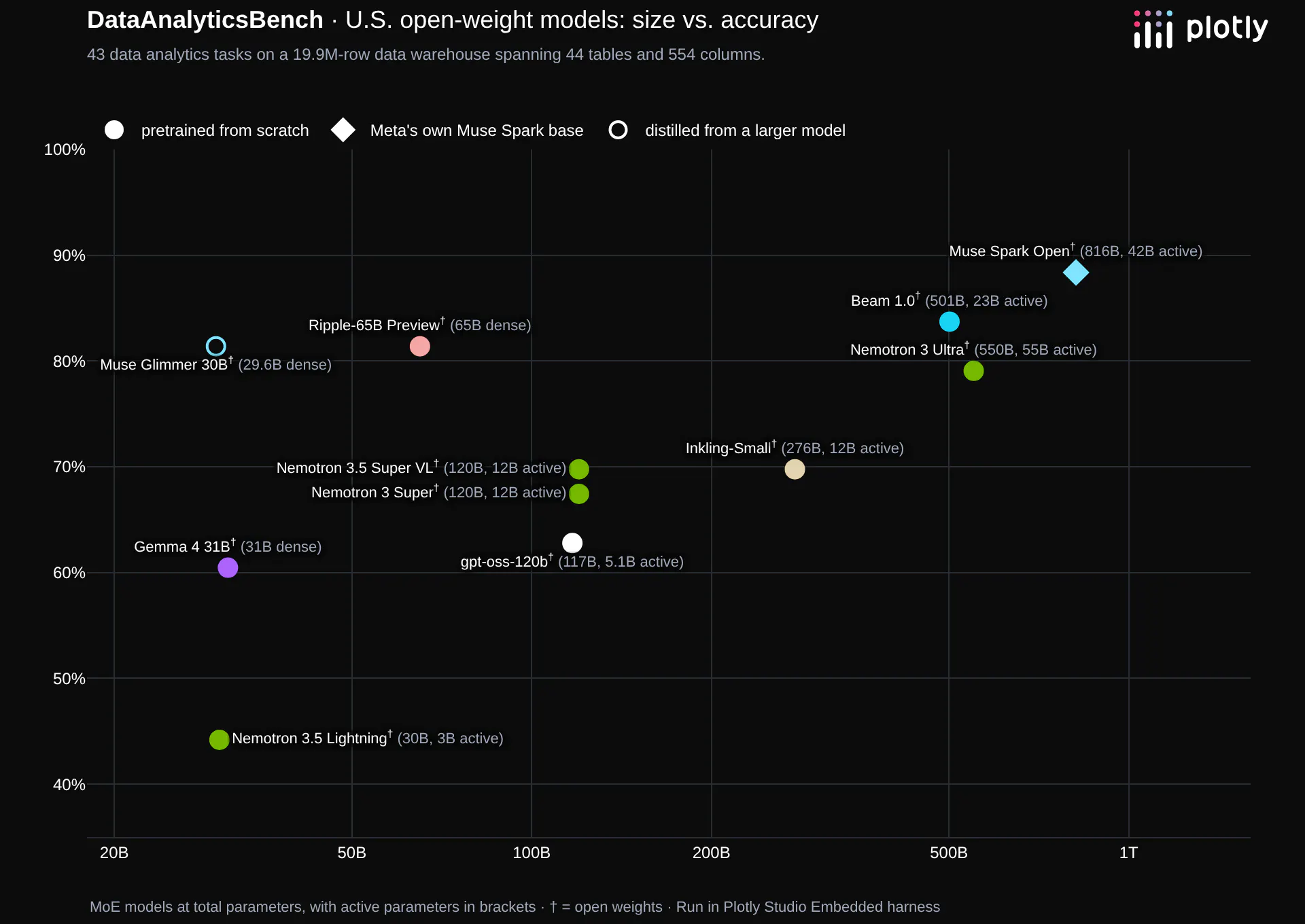
- Almost all of them were trained from scratch. Every model here was pretrained by its own lab except Muse Glimmer, which Meta distilled from its larger Muse Spark. Ripple stands out: a team that grew from one person to five pretrained it for $32 million in total R&D.
- Coding rank isn't analysis rank. Ripple leads Ricursive's coding comparison; on our exam it's third.
The ranking
Here's every U.S. open-weight model we've tested, sorted by score. Cost is for one run of the whole 43-question exam at OpenRouter's prices, and time is the median per question. Sizes are total parameters; for mixture-of-experts models, the active parameters per token are in brackets.
Model (lab)
Score
Cost of one run
Median time
Size
How it was made
License
Muse Spark Open (Meta)
38 / 43
$5.16
48 s
816B (42B active)
Meta's own Muse Spark model, released open
Muse Model License
Beam 1.0 (Reflection AI)
36 / 43
$8.29
68 s
501B (23B active)
Pretrained from scratch
Apache 2.0
Ripple-65B Preview (Ricursive)
35 / 43
$2.21
128 s
65B dense
Pretrained from scratch
Apache 2.0
Muse Glimmer 30B (Meta)
35 / 43
$3.18
66 s
30B dense
Distilled from Muse Spark
Apache 2.0
Nemotron 3 Ultra (NVIDIA)
34 / 43
$7.06
26 s
550B (55B active)
Pretrained from scratch
OpenMDW 1.1
Nemotron 3.5 Super VL (NVIDIA)
30 / 43
$0.46
12 s
120B (12B active)
Pretrained from scratch
OpenMDW 1.1
Inkling-Small (Thinking Machines)
30 / 43
$1.93
25 s
276B (12B active)
Pretrained from scratch, then distilled from Inkling
Apache 2.0
Nemotron 3 Super (NVIDIA)
29 / 43
$0.77
92 s
120B (12B active)
Pretrained from scratch
NVIDIA Nemotron Open Model License
gpt-oss-120b (OpenAI)
27 / 43
$0.22
9 s
117B (5.1B active)
Pretrained from scratch
Apache 2.0
Gemma 4 31B (Google)
26 / 43
$0.62
22 s
31B dense
Pretrained from scratch
Apache 2.0
Nemotron 3.5 Lightning (NVIDIA)
19 / 43
$0.94
54 s
30B (3B active)
Pretrained from scratch
OpenMDW 1.1
For comparison, the best closed models, OpenAI's GPT-6.1 Sol and GPT-6 Astra, score 43 of 43, and GPT-6.1 Sol costs $2.61 a run. One run per model is a single sample, and in our repeat runs scores moved by up to three points, so treat gaps of a point or two as close to a tie.
How the U.S. models compare to Chinese open-weight models
On our exam, the best open-weight models come from China. Moonshot's Kimi K3.1 Pro scores 42, MiniMax M3.1 Flash scores 41, and Tencent's Hy4, whose weights Tencent says are coming soon, also scores 42. The best U.S. model, Muse Spark Open, scores 38, the same as Z.ai's GLM 5.3 Flash and Alibaba's Qwen 3.8 27B. Those two cost $0.69 and $1.71 a run against Muse Spark Open's $5.16, and Qwen 3.8 27B is small enough for a 64 GB desktop.
The gap is widest on the hardest part of the exam. We hid five patterns in the data, things an analyst would want flagged, and asked plain questions that should lead a careful model to them. Kimi K3.1 Pro and MiniMax M3.1 Flash found all five and GLM 5.3 Flash found four. No U.S. open-weight model found more than two, and six of the eleven found none. On the straightforward analytics questions, the U.S. models do much better: Muse Spark Open and Muse Glimmer got all 20 right.
Trained from scratch, or built on another model?
An open-weight model can be pretrained from scratch by its lab, or built on top of someone else's model by fine-tuning, extra reinforcement learning or distillation. We checked each lab's own model card or announcement:
- Ripple-65B Preview was pretrained from scratch on 12 trillion tokens. Ricursive says the work started from the open training recipe of AI2's Olmo 3 and improved every part of it, from scaling laws to data to post-training, with a team that grew from one person to five and $32 million in total R&D (Ricursive's announcement). Olmo 3 itself isn't on OpenRouter, so we couldn't test it.
- Inkling was trained from scratch on 45 trillion tokens of text, images, audio and video (Thinking Machines' announcement). Inkling-Small was pretrained on the same data mix, then post-trained partly by distillation from Inkling (announcement).
- Beam 1.0, gpt-oss-120b, Gemma 4 31B and NVIDIA's four Nemotron models were all pretrained by their own labs. NVIDIA also publishes much of the Nemotron pretraining data.
- Muse Spark Open is Meta's own model: the open-weight release of the Muse Spark line Meta launched as a closed model in April. Muse Glimmer 30B was distilled from Muse Spark.
Two other U.S. companies on our board went the other way and built on Chinese open models. Fireworks' Ember-1 is a fine-tune of Moonshot's Kimi K3, and Particle AI's Particle-1 is DeepSeek V4.1 Flash with extra reinforcement learning. Both scored four points higher than their base models on our exam, but neither has released its weights, so they aren't U.S. open-weight models.
Coding benchmarks vs. data analysis
Ricursive's comparison ranks these models on Terminal-Bench 2.1, an agentic coding benchmark: Ripple-65B Preview 80.5, Beam 1.0 80.1, Muse Spark Open 76.4, Inkling 63.8 and Nemotron 3 Ultra 56.4. On our exam the order is Muse Spark Open (38), Beam 1.0 (36), Ripple-65B Preview (35) and Nemotron 3 Ultra (34). Data analysis rewards different habits from coding: checking the data before trusting it, breaking an average down before drawing a conclusion, and noticing what looks odd. A model that writes good code can still skip those steps.
The models, one by one
- Muse Spark Open (Meta), 38. The most accurate U.S. open-weight model, with a median of 48 seconds a question. Its license has limited commercial terms, and at 816 billion parameters it needs two 512 GB Mac Studios or a server to run (our first look).
- Beam 1.0 (Reflection AI), 36. One of only three open-weight models to catch all three data problems we planted, and Apache 2.0 licensed (our Beam post).
- Ripple-65B Preview (Ricursive), 35. Aced the statistics traps, the only U.S. open-weight model to do so, but found none of the hidden patterns and is slow, at 128 seconds a question. Ricursive says it runs on a single NVIDIA DGX Spark (our Ripple post).
- Muse Glimmer 30B (Meta), 35. Perfect on the straightforward analytics and ambiguous questions. It's thorough, at about 21 queries a question, and small enough for a desktop, but it often offers the decisive check as a follow-up question instead of running it.
- Nemotron 3 Ultra (NVIDIA), 34. Quick for its size at 26 seconds a question. NVIDIA's smaller Nemotron 3.5 Super VL scores 30 for $0.46 a run at 12 seconds, the second-fastest model we've tested (our Super VL post).
- Inkling-Small (Thinking Machines), 30. Handled every ambiguous question and impossible request well, but its SQL slipped on several multi-step calculations and it found none of the hidden patterns.
- gpt-oss-120b (OpenAI), 27. The cheapest model here, at $0.22 for the whole exam, and at 9 seconds a question the fastest model we've tested, open or closed. It usually answers after one to three queries, which is why it's fast and why it misses anything that takes digging. OpenAI says it runs on a single 80 GB GPU (OpenAI's announcement).
- Gemma 4 31B (Google), 26. Like gpt-oss-120b, it answers quickly after very few queries. Several of its misses were small SQL slips, such as date windows that were off by a day.
Licenses
Most U.S. open-weight models now use Apache 2.0, which allows commercial use with few conditions: Beam 1.0, Ripple-65B Preview, Muse Glimmer 30B, Inkling, Inkling-Small, gpt-oss-120b and Gemma 4. NVIDIA uses the permissive OpenMDW license for its newest Nemotrons and its own Nemotron Open Model License for Nemotron 3 Super. Muse Spark Open is the exception: Meta's Muse Model License has limited commercial terms, so check it before you deploy.
Which ones can you run on your own hardware?
Muse Glimmer 30B and Gemma 4 31B are about 30 billion parameters, small enough for a desktop with 64 GB of memory at 4-bit precision. gpt-oss-120b fits on one 80 GB GPU, and Ricursive says Ripple-65B runs on a DGX Spark. The large mixture-of-experts models, Muse Spark Open, Beam 1.0, Nemotron 3 Ultra and Inkling, need multiple high-memory machines or a GPU server. We cover hardware costs in Open Models vs. Closed Models in 2026.
Coming soon
- Inkling (Thinking Machines). We started a run, but its only provider on OpenRouter was failing most requests, so we stopped it rather than score an outage. We'll add it when the provider recovers.
- Inkling 2 Small (Thinking Machines). Released on November 5 with 594 billion parameters, 17 billion active. Thinking Machines says the weights will follow under Apache 2.0 after safety testing (announcement). It isn't on OpenRouter yet.
The Test Harness
We run every model in Plotly Studio Embedded, a drop-in analytics agent that runs on Dash apps. This harness is tuned to run data analytics queries and make charts with multi-turn tool calling, with less emphasis on writing text. It's meant to put the data front and center.
Frequently asked questions
What is the best U.S. open-weight model?
For data analysis, Meta's Muse Spark Open, which passed 38 of our 43 questions. Reflection's Beam 1.0 (36) and Ricursive's Ripple-65B Preview and Meta's Muse Glimmer 30B (35 each) are next. For coding, Ricursive reports that Ripple-65B Preview leads on Terminal-Bench 2.1.
Are U.S. open-weight models as good as Chinese ones?
Not yet, on our exam. The best Chinese open-weight models score 41 and 42, against 38 for the best U.S. model, and the gap is widest on finding problems hidden in the data.
What is the cheapest U.S. open-weight model?
OpenAI's gpt-oss-120b ran our whole exam for $0.22, and NVIDIA's Nemotron 3.5 Super VL for $0.46 with a higher score (30 vs. 27).
Which U.S. open-weight models were trained from scratch?
All of the ones we tested were pretrained by their own labs, except Meta's Muse Glimmer 30B, which was distilled from Meta's larger Muse Spark. Ricursive's Ripple-65B Preview, pretrained from scratch by a team of five, is the smallest lab on the list.
What's the best U.S. open-weight model I can run on a desktop?
Meta's Muse Glimmer 30B, which scored 35 and is about 30 billion parameters. Alibaba's Qwen 3.8 27B, a Chinese model of similar size, scored 38.
What about Llama and Olmo?
Meta's newest open models come from its Muse family, and Llama 4 came out in April 2025, so we tested Muse Spark Open and Muse Glimmer instead. AI2's Olmo 3 isn't on OpenRouter, so we couldn't run it through the same setup.
About the benchmark
We ran every model through OpenRouter at its default settings, with the same harness and grading. Muse Glimmer 30B and Ripple-65B Preview were capped at 16,384 output tokens per response, the limit of their only provider; none of their responses came close. Some providers had problems during our runs: one of Gemma 4 31B's providers sometimes dropped the contents of chart requests, and Inkling-Small's provider failed one question twice, which we ran again. We checked every failed answer against its transcript, and none of the failures counted here came from the provider.
To see all 41 models on one chart and in a full results table, along with cost, speed and how the exam works, see Introducing DataAnalyticsBench.
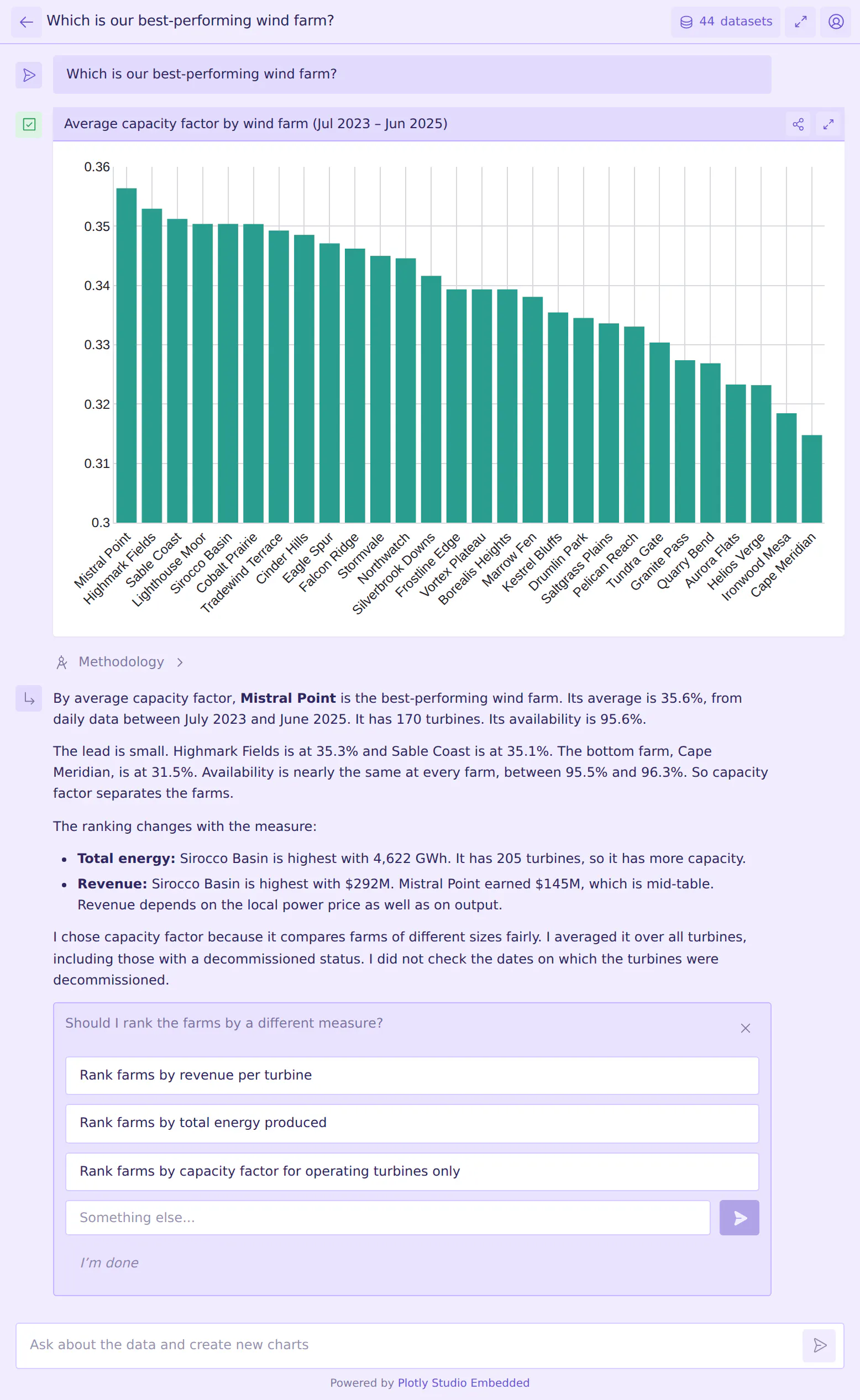
The exam is private and we're sharing it with researchers. We're keeping it private so that the answer key doesn't make its way into the training set. For the same reason, the data is fabricated: the warehouse is a synthetic wind-energy fleet, built to look like a real operator's data, so its answers don't exist anywhere else.
If you'd like access, reach out to Chris Parmer at Plotly.