inclusionAI Ling-3.2-Flash Benchmark Results for Data Analysis
Nov 28, 2026: Ant Group's new multimodal Ling model, tested on real-world data analysis.
At Plotly, we keep a close eye on model releases. Our agentic analytics products, Plotly Studio Desktop and Plotly Studio Embedded, and our open source libraries Plotly and Dash work with any model, and our customers look to us for recommendations.
On November 5, inclusionAI, the Ant Ling team at Ant Group in China, announced Ling-3.2-Flash, the newest model in its Ling series. Its developer docs describe it as a native multimodal model built for complex real-world tasks: complex visual understanding, long-horizon multimodal agents, 3D understanding and interaction, and medical imaging and reports.
It's a mixture-of-experts model with 560 billion parameters in total, 25 billion of them active, a context window of 1 million tokens, and text, image and video input. The weights haven't been released, so it's available only through APIs. The lab doesn't say whether it was trained from scratch or built on an earlier Ling model. On OpenRouter, Ant Digital is the only provider, at $0.30 per million input tokens, $0.90 per million output tokens and $0.06 per million cached input tokens.
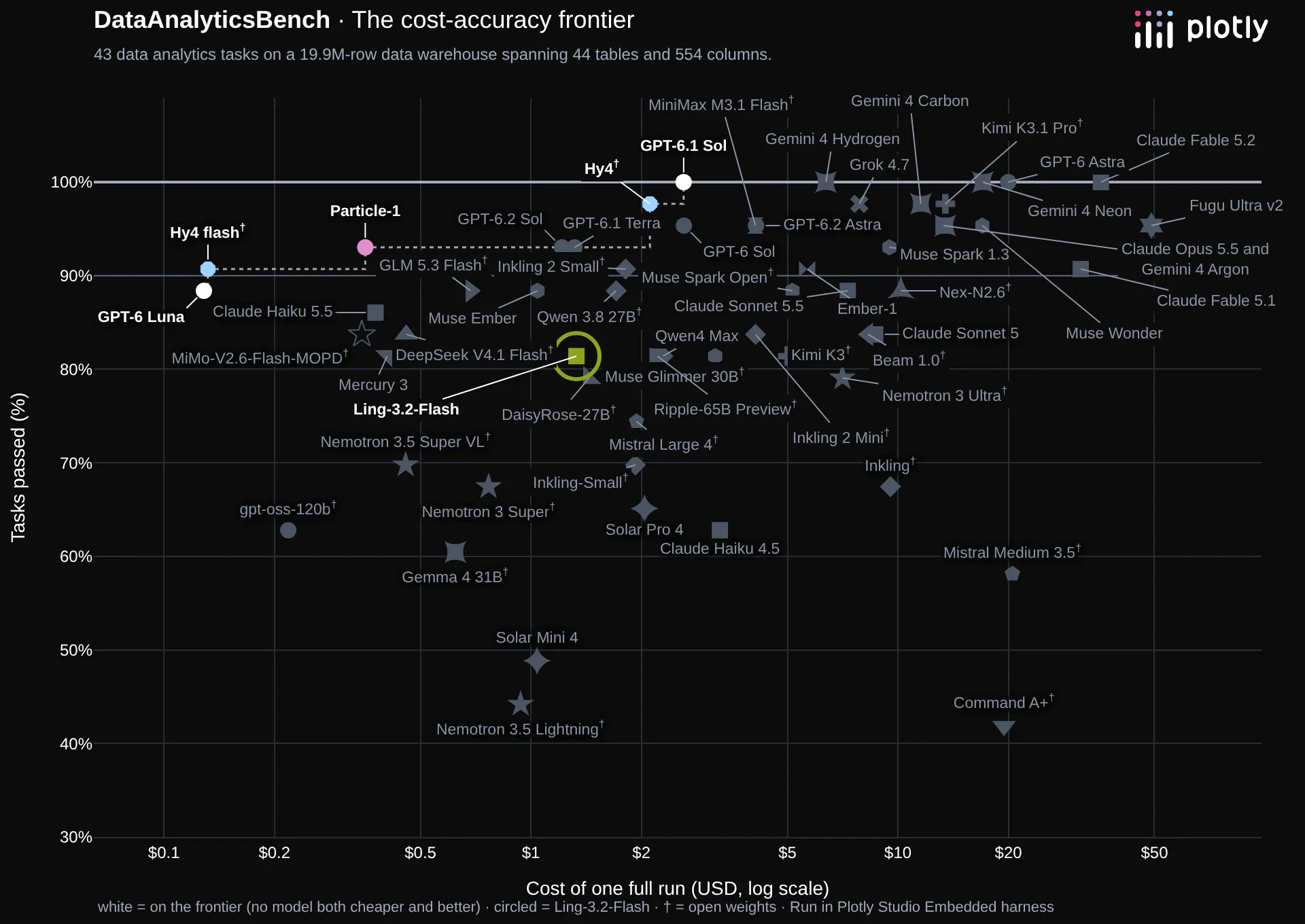
We ran it through our data analytics exam. Ling-3.2-Flash passed 35 of 43 questions (81%, a B) for $1.33, with a median of 34 seconds a question. It got all 20 straightforward analytics questions and turned down all five impossible requests, but it found only one of the five hidden patterns in the data.
It doesn't join the cost-accuracy frontier. Particle-1 scored five more for about a quarter of the price, and GPT-6.1 Terra scored five more for about the same price, in under half the time. On the chart below, Ling-3.2-Flash sits well below the frontier.
Ling-3.2-Flash vs. Mercury 3, Particle-1 and GPT-6.1 Terra
Ling-3.2-Flash
Mercury 3
Particle-1
GPT-6.1 Terra
Score
35 / 43
35 / 43
40 / 43
40 / 43
Analytics questions
20 / 20
20 / 20
20 / 20
20 / 20
Ambiguous questions
3 / 5
5 / 5
5 / 5
5 / 5
Impossible requests
5 / 5
5 / 5
5 / 5
5 / 5
Data quality
2 / 3
2 / 3
2 / 3
3 / 3
Statistics traps
4 / 5
2 / 5
5 / 5
4 / 5
Hidden needles
1 / 5
1 / 5
3 / 5
3 / 5
Cost of one full run
$1.33
$0.41
$0.35
$1.31
Per person per year*
$77
$24
$21
$76
Median time per question
34 seconds
9.3 seconds
16 seconds
15 seconds
*1,000 people each asking 10 questions a day, 250 working days a year, at OpenRouter's prices when each model ran.
Ling-3.2-Flash ties five other models at 35: Mercury 3, Ripple-65B Preview, Qwen4 Max, Muse Glimmer 30B and Kimi K3. That's the bottom of the B range, and 37 of the 58 models on our board score higher.
One run per model is a single sample. In our repeat runs of other models, scores moved by up to three points between runs, so treat a one- or two-point gap as close to a tie.
What it got right
Ling-3.2-Flash got all 20 straightforward analytics questions, and it turned down all five impossible requests instead of inventing an answer. It also got four of the five statistics traps, where the obvious calculation gives a misleading answer. That's more than Mercury 3 or Qwen4 Max, two of the models it ties.
Most of what it reads comes from the cache. Across the exam it processed 15.6 million tokens, about 360,000 per question, and 94% of them were cached input, which is billed at a fifth of the normal input price.
Where it lost points
It missed eight questions: two ambiguous questions, one data quality problem, one statistics trap and four of the five hidden patterns.
Two misses had less to do with analysis than with finishing the job. One answer stopped with a placeholder message before it rendered the charts it had planned. Another gave a flat verdict where the question called for a conditional one.
In a data quality audit, it presented an artefact of how the data works, the short histories of retired assets, as a data quality problem. On one statistics trap, it listed the top items without saying what criterion it had ranked them by.
The hidden patterns were the biggest gap. Each one points toward something unusual in the data without naming it, and the model has to go looking. Ling-3.2-Flash found one of five. In the misses, it usually explained a shortfall with a plausible general cause instead of finding the specific pattern we planted.
Cost and speed
At $1.33 a run, Ling-3.2-Flash comes to about $77 per person per year at our rollout numbers. That's cheaper than most of our board: it's the 18th cheapest of 58 models, and the median run costs $2.90.
But other models score more at about the same price. GPT-6.2 Sol scored 40 for $1.22, with a 10.5-second median, and GPT-6.1 Terra scored 40 for $1.31, at 15 seconds. Muse Ember scored 38 for $1.04, and Qwen 3.8 27B scored 38 for $1.71. DaisyRose-27B, at $1.44, scored one fewer and took 62 seconds at the median.
Among the models it ties, Mercury 3 got the same 35 for $0.41 with a 9.3-second median. Qwen4 Max ($2.29), Ripple-65B Preview ($2.21), Muse Glimmer 30B ($3.18) and Kimi K3 ($5.01) all cost more.
The cost-accuracy frontier is unchanged. Near Ling-3.2-Flash's price, the frontier point is Particle-1 (40 for $0.35), and the next steps up are Hy4 (42 for $2.11) and GPT-6.1 Sol (43 for $2.61).
Its median question took 34 seconds, a little slower than the board median of 28 seconds, and 32 of the 58 models have a faster median. Its mean was 62 seconds, pulled up by a handful of long questions.
The Test Harness
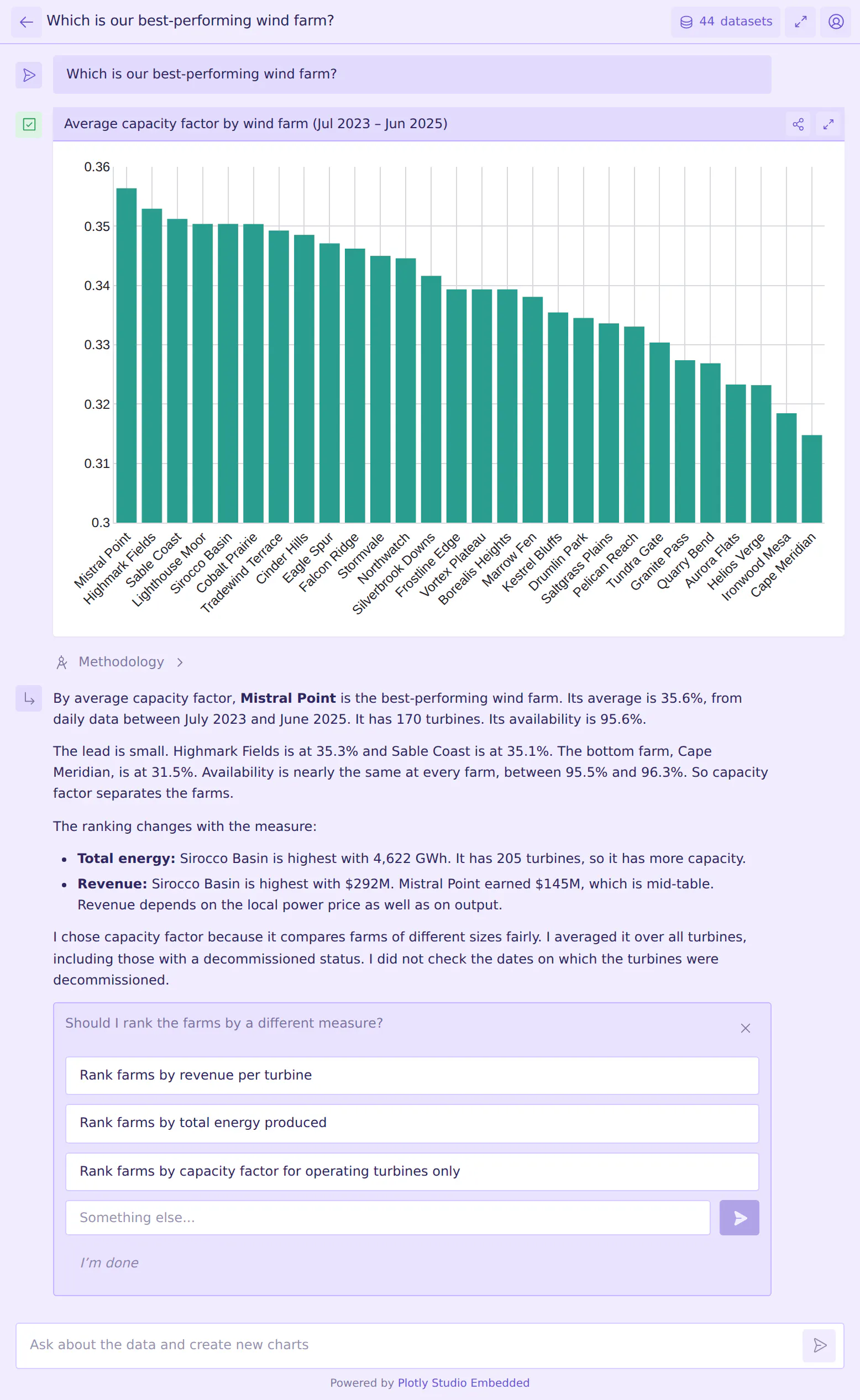
We run every model in Plotly Studio Embedded, a drop-in analytics agent that runs on Dash apps. This harness is tuned to run data analytics queries and make charts with multi-turn tool calling, with less emphasis on writing text. It's meant to put the data front and center.
Frequently asked questions
How good is Ling-3.2-Flash at data analysis?
On PlotlyDataAnalyticsBench it passed 35 of 43 questions (81%, a B), tied with Mercury 3, Ripple-65B Preview, Qwen4 Max, Muse Glimmer 30B and Kimi K3. It was perfect on analytics questions and impossible requests, and lost most of its points on hidden patterns and ambiguous questions.
How much does Ling-3.2-Flash cost?
On OpenRouter, Ant Digital serves it for $0.30 per million input tokens, $0.90 per million output tokens and $0.06 per million cached input tokens. Our whole exam cost $1.33, or about $77 per person per year at 10 questions a day.
Is Ling-3.2-Flash open source?
No. The weights haven't been released, so you can use it only through an API, and you can't run it locally. If you need open weights, Hy4 flash scored 39 for $0.13 and Hy4 scored 42 for $2.11 (more in our open vs. closed models post).
Is Ling-3.2-Flash fast?
It's mid-pack. Its median question took 34 seconds, against a board median of 28 seconds. Mercury 3 got the same score with a 9.3-second median, and GPT-6.2 Sol scored 40 at 10.5 seconds.
What should I use instead at this price?
On our exam, GPT-6.1 Terra and GPT-6.2 Sol each scored 40 for about the same cost and answered faster. If cost matters most, Particle-1 scored 40 for $0.35.
What is Ling-3.2-Flash designed for?
inclusionAI aims it at complex visual understanding, long-horizon multimodal agents, 3D understanding and medical tasks. Our exam asks questions of a data warehouse through tool calls, so it doesn't test those multimodal strengths.
About the benchmark
We run new models through the same exam as they're released, and we'll keep sharing what we find. We ran Ling-3.2-Flash through OpenRouter, where Ant Digital serves it, with the same harness and grading as every other model. Availability was patchy at launch: our first three attempts were blocked by rate limiting at the provider, and the fourth ran cleanly.
To see every model on one chart and in a full results table, along with cost, speed and how the exam works, see Introducing DataAnalyticsBench.
The exam is private and we're sharing it with researchers. We're keeping it private so that the answer key doesn't make its way into the training set. For the same reason, the data is fabricated: the warehouse is a synthetic wind-energy fleet, built to look like a real operator's data, so its answers don't exist anywhere else.
If you'd like access, reach out to Chris Parmer at Plotly.