Ricursive Ripple-65B Preview Benchmark Results for Data Analysis
Nov 5, 2026: a new US open-weight model, tested on real-world data analysis.
At Plotly, we keep a close eye on model releases. Our agentic analytics products, Plotly Studio Desktop and Plotly Studio Embedded, and our open source libraries Plotly and Dash work with any model, and our customers look to us for recommendations.
On November 4, Ricursive Intelligence, a lab that builds AI for chip design, released Ripple-65B Preview, a general-purpose version of the model behind its chip design platform. It's a 65-billion-parameter dense model trained from scratch, with a context window of about a million tokens, and Ricursive says it's the best US open-weight model at agentic coding. The weights are on Hugging Face under the Apache 2.0 license. On OpenRouter it costs $0.20 per million input tokens, $0.60 per million output tokens and $0.05 per million cached input tokens.
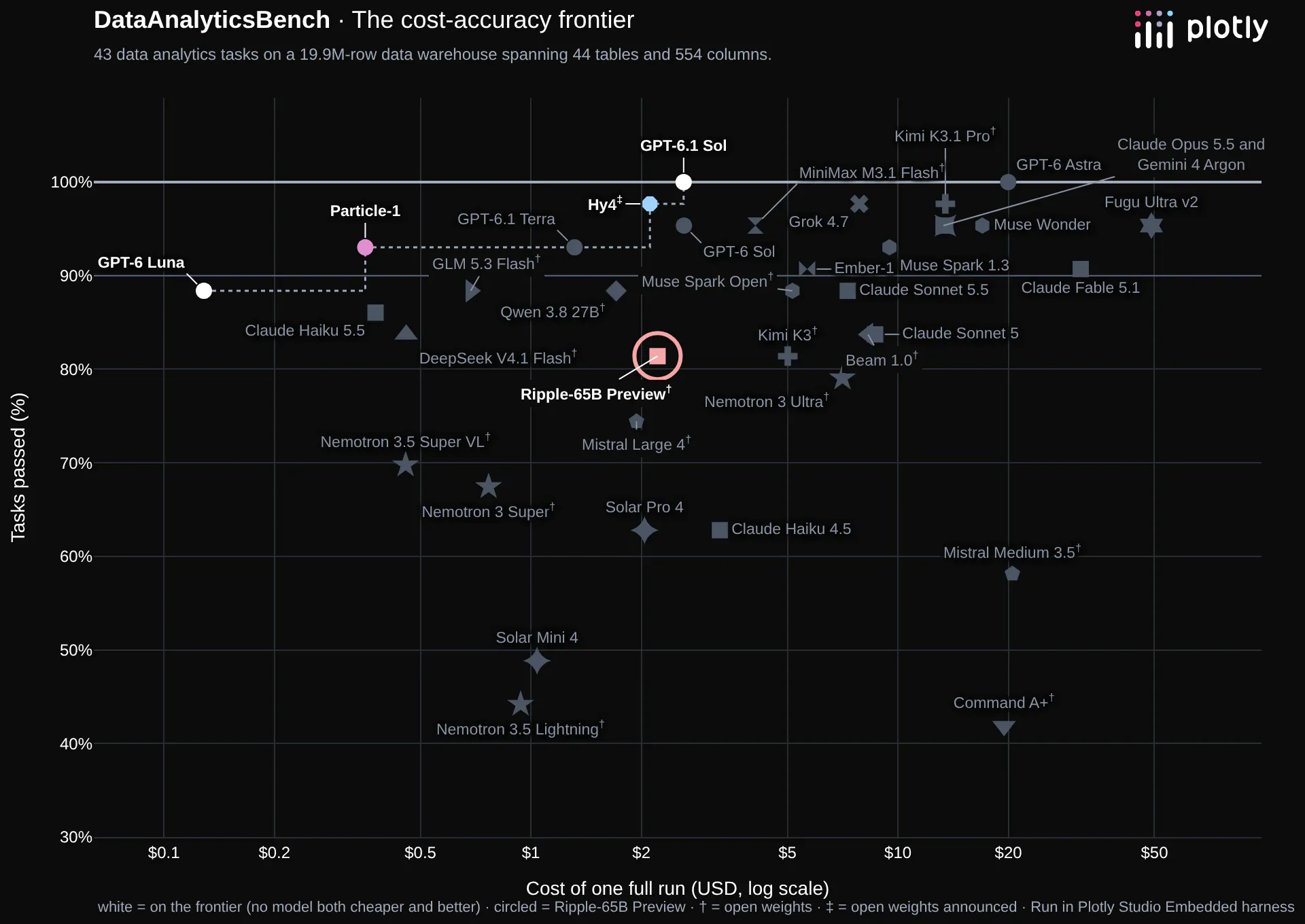
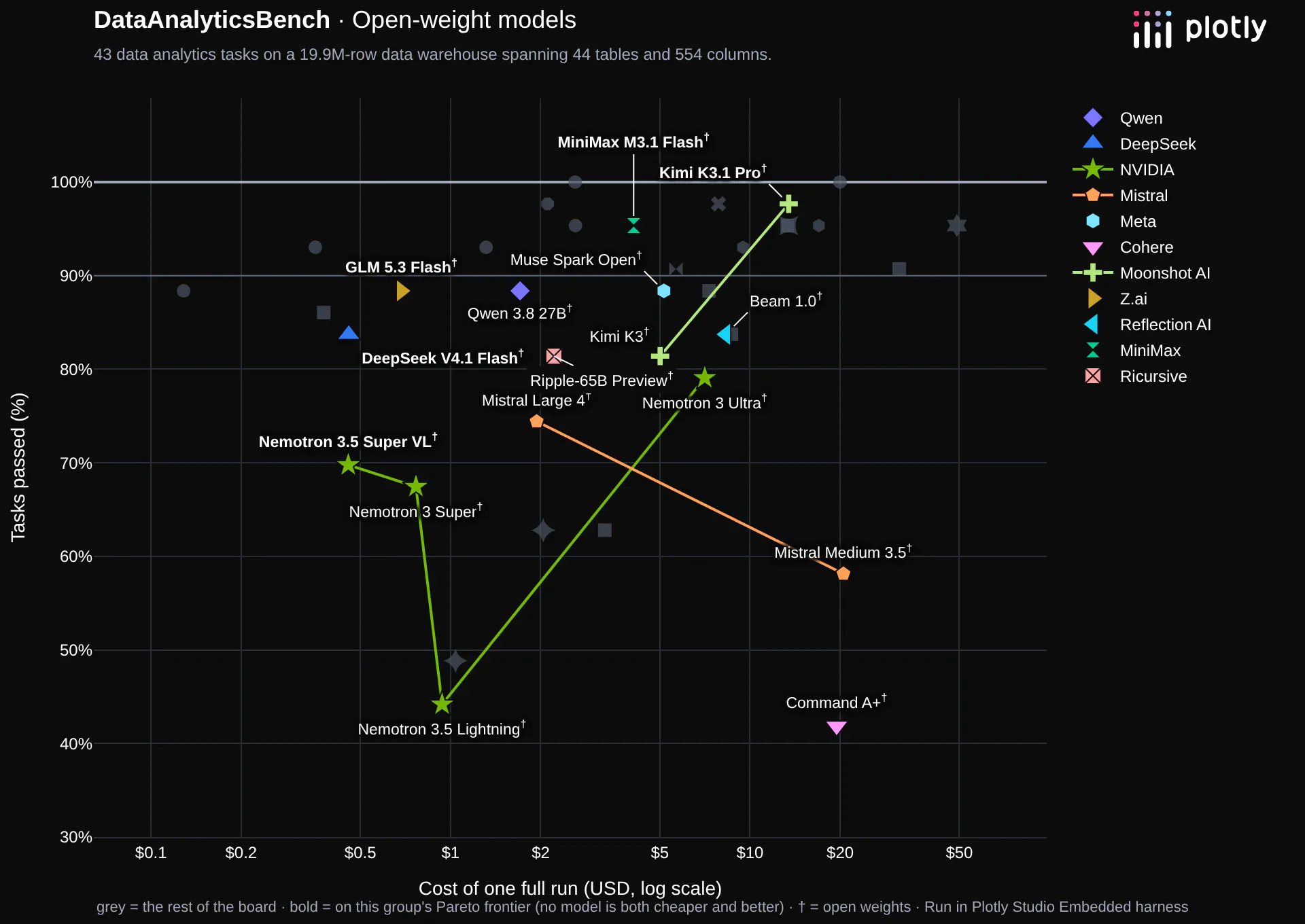
We ran it through our data analytics exam. Ripple passed 35 of 43 questions (81%) for $2.21 for the whole exam. That ties it with Kimi K3 and puts it third among US open-weight models, behind Meta's Muse Spark Open (38) and Reflection AI's Beam 1.0 (36), at less than half the cost of either. It aced the statistics traps and the impossible requests, but it found none of the five patterns we hid in the data.
Ripple-65B Preview vs. Muse Spark Open and Beam 1.0
Ripple-65B Preview
Muse Spark Open
Beam 1.0
Score
35 / 43
38 / 43
36 / 43
Analytics questions
19 / 20
20 / 20
18 / 20
Ambiguous questions
4 / 5
5 / 5
5 / 5
Impossible requests
5 / 5
5 / 5
5 / 5
Data quality
2 / 3
2 / 3
3 / 3
Statistics traps
5 / 5
4 / 5
4 / 5
Hidden needles
0 / 5
2 / 5
1 / 5
Open weights
Yes
Yes
Yes
Cost of one full run
$2.21
$5.16
$8.29
Per person per year*
$129
$300
$482
Median time per question
128 seconds
48 seconds
68 seconds
*1,000 people each asking 10 questions a day, 250 working days a year, at OpenRouter's prices when each model ran.
Ripple did well on the parts of the exam that reward caution. It aced the statistics traps, which only ten of the 37 models on our board have done, and it turned down all five requests the data couldn't support. It fell short on the open-ended work, where a model has to decide for itself what's worth looking at.
One run per model is a single sample. In our repeat runs of other models, scores moved by up to three points between runs, so treat a one- or two-point gap as close to a tie.
Busy, but missing the patterns
We hid five patterns in the data, each one something an analyst would want flagged, and asked questions that should lead a careful model to them. Ripple found none. It wasn't for lack of effort: it ran about 67 queries and charts on each of those questions, the third most on our board, against a median of 26. But it searched broadly instead of narrowing in, and most of the time it reported a real but more general finding as its answer. On one of them it stopped after its investigation without writing an answer at all. Ripple is the highest-scoring model on our board to find none of the five, tied with Kimi K3.
Slow, and cheap
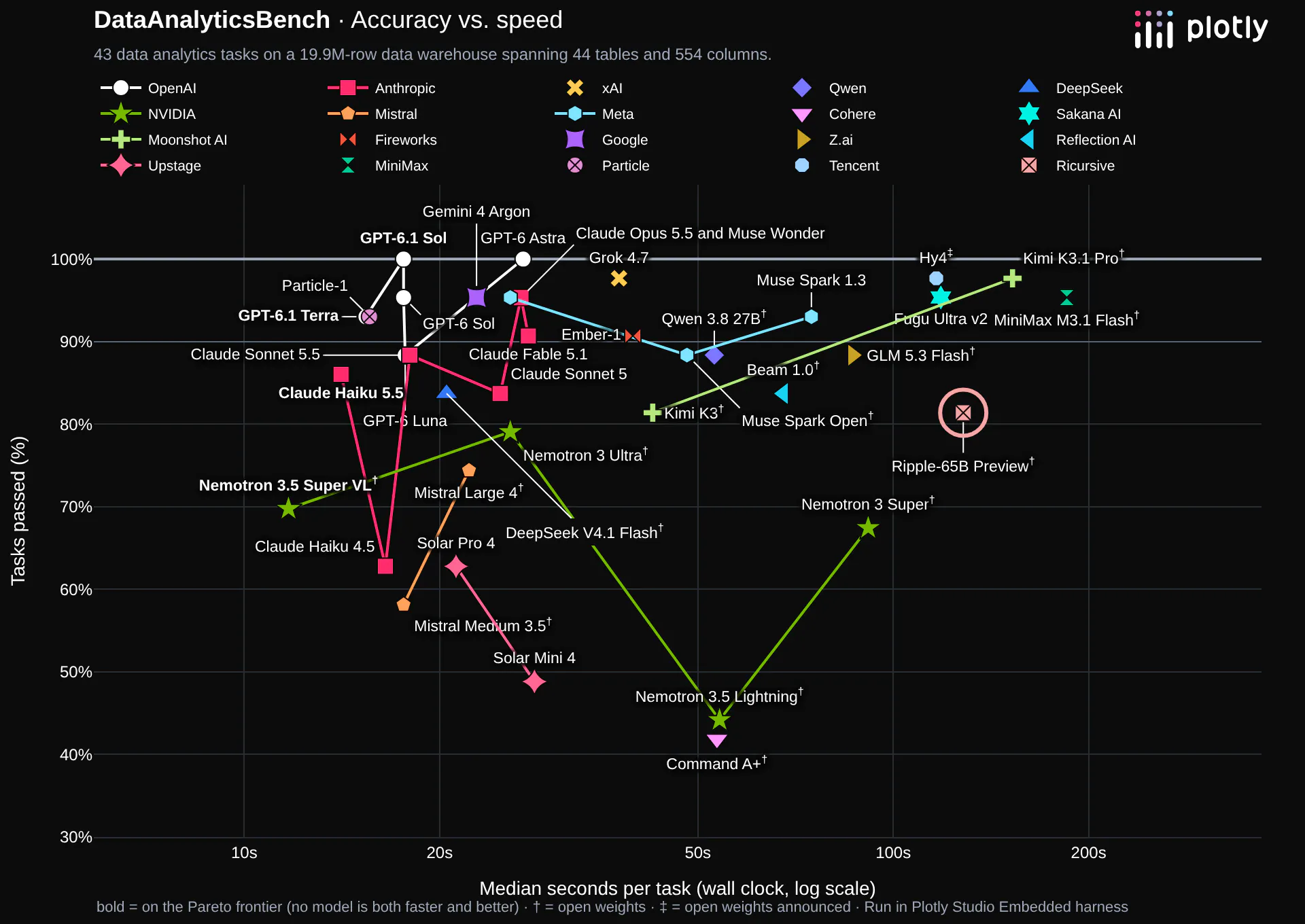
Ripple is one of the slowest models we've tested. Its median question took 128 seconds, and only Kimi K3.1 Pro and MiniMax M3.1 Flash were slower. Its time on the exam's 43 questions added up to about two and a quarter hours.
It's cheap to run anyway. Ripple read about 36 million input tokens over the exam, the fifth most on our board, but 97% of them came from the cache at $0.05 per million, so its input cost about $1.96 instead of about $7.20.
Where it got things right
- Statistics traps (5 of 5). Ten of the 37 models on our board have aced these. Among models whose weights you can download today, the only other one is MiniMax M3.1 Flash.
- Impossible requests (5 of 5). When the data couldn't answer a question, it said so.
- Analytics (19 of 20).
Where it got things wrong
Ripple missed eight questions: the five hidden patterns above, and three others.
- A made-up table. On one analytics question, the query that did the real work was rejected because it combined two statements in one. Ripple ran the smaller lookups around it, then wrote up a table of twelve figures it had never computed. They were off by a factor of two to three, and nothing in the answer suggested they were estimates. Of the eight misses, this is the one that worries us most.
- A gap it didn't see. On a data quality audit, it described a sensor's readings as complete when part of them was missing.
- An unstated assumption. On an ambiguous question about a time period, it picked one reading and didn't say which.
A note on the run
On one data quality question, Ripple wrote a query that paired every row of a large table with every row of the same table. It never finished. Our harness doesn't put a time limit on queries, so we stopped the run and ran that question and the 15 after it again. On the second try it answered that question correctly. The cost, token and time figures here leave out the abandoned attempt.
Open weights
Ricursive's pitch is a small US open-weight model that keeps up with much larger ones. On our exam it lands among the US models it named: below Muse Spark Open (38) and Beam 1.0 (36), above NVIDIA's Nemotron 3 Ultra (34), and cheaper to run than all three. Smaller doesn't always mean worse, either: Qwen 3.8 27B, less than half Ripple's size, scored 38 for $1.71. The best open-weight model you can download today is Kimi K3.1 Pro, at 42. We wrote more about that race in Open Models vs. Closed Models in 2026.
The Test Harness
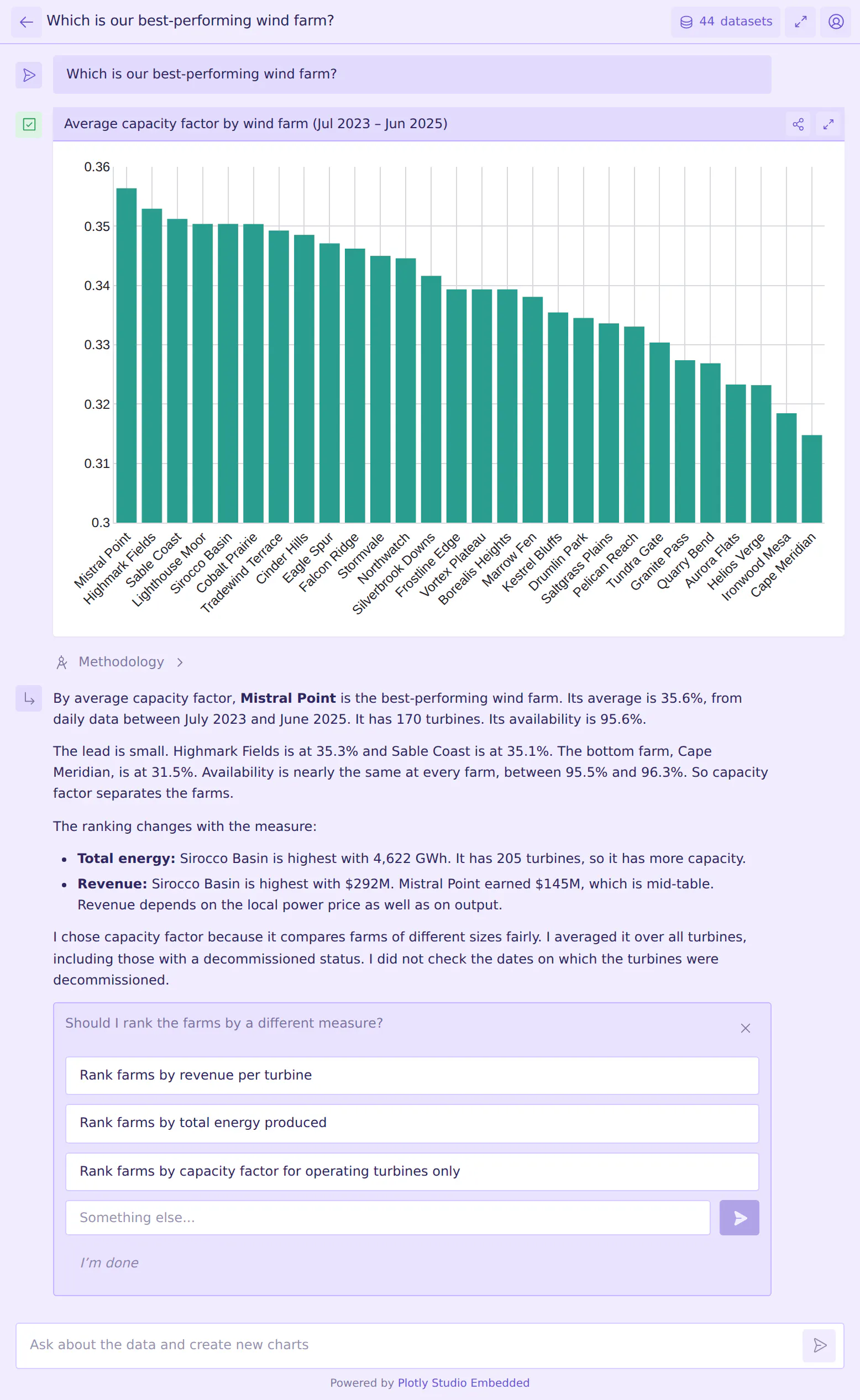
We run every model in Plotly Studio Embedded, a drop-in analytics agent that runs on Dash apps. This harness is tuned to run data analytics queries and make charts with multi-turn tool calling, with less emphasis on writing text. It's meant to put the data front and center.
Frequently asked questions
How good is Ripple-65B Preview at data analysis?
On PlotlyDataAnalyticsBench it passed 35 of 43 questions, tied with Kimi K3 and third among US open-weight models after Muse Spark Open and Beam 1.0. It aced the statistics traps and impossible requests but found none of the five hidden patterns.
How much does Ripple-65B Preview cost?
On OpenRouter, $0.20 per million input tokens, $0.60 per million output tokens and $0.05 per million cached input tokens. Our whole exam cost $2.21.
How fast is Ripple-65B Preview?
Slow. Its median question took 128 seconds, more than seven times as long as GPT-6.1 Sol.
Is Ripple-65B Preview open source?
Its weights are on Hugging Face under the Apache 2.0 license.
About the benchmark
We run new models through the same exam as they're released, and we'll keep sharing what we find. We ran Ripple through OpenRouter with the same harness and grading as every other model. The one change was a cap of 16,384 output tokens per response, because requests without a cap were rejected. None of its responses came close to it.
To see all 37 models on one chart and in a full results table, along with cost, speed and how the exam works, see Introducing DataAnalyticsBench.
The exam is private and we're sharing it with researchers. We're keeping it private so that the answer key doesn't make its way into the training set. For the same reason, the data is fabricated: the warehouse is a synthetic wind-energy fleet, built to look like a real operator's data, so its answers don't exist anywhere else.
If you'd like access, reach out to Chris Parmer at Plotly.