GPT-6.1 Terra Benchmark Results for Data Analysis
Oct 26, 2026: OpenAI's new mid-tier model, tested on real-world data analysis the day it launched.
At Plotly, we keep a close eye on model releases. Our agentic analytics products, Plotly Studio Desktop and Plotly Studio Embedded, and our open source libraries Plotly and Dash work with any model, and our customers look to us for recommendations.
Today OpenAI released GPT-6.1 Terra, the mid-tier model in its GPT-6.1 series, priced below GPT-6.1 Sol and aimed at everyday agentic, coding and writing work. It has a context window of about a million tokens. On OpenRouter it costs $1.00 per million input tokens, $5.00 per million output tokens and $0.05 per million cached input tokens, half or less of what GPT-5.6 Terra cost.
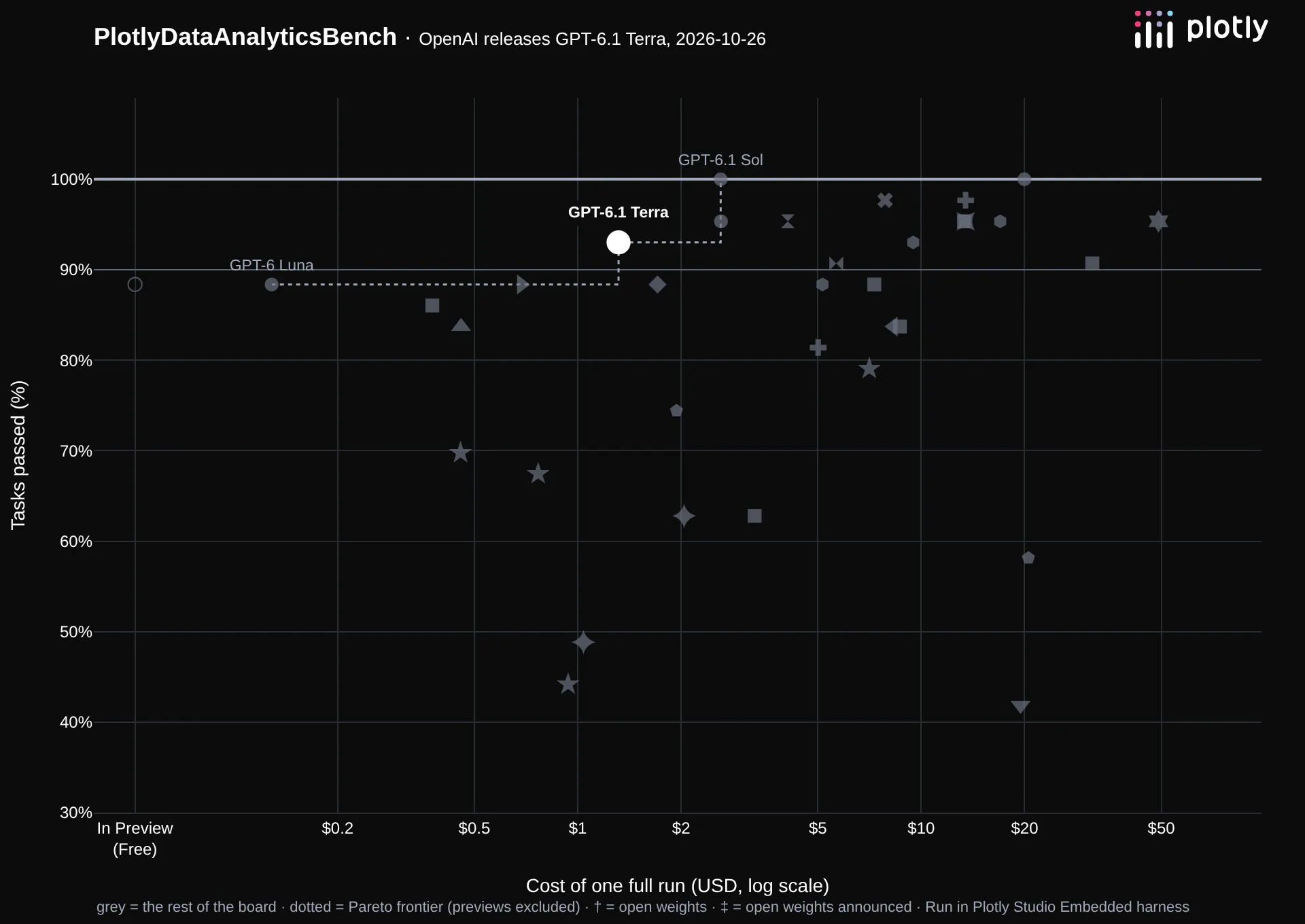
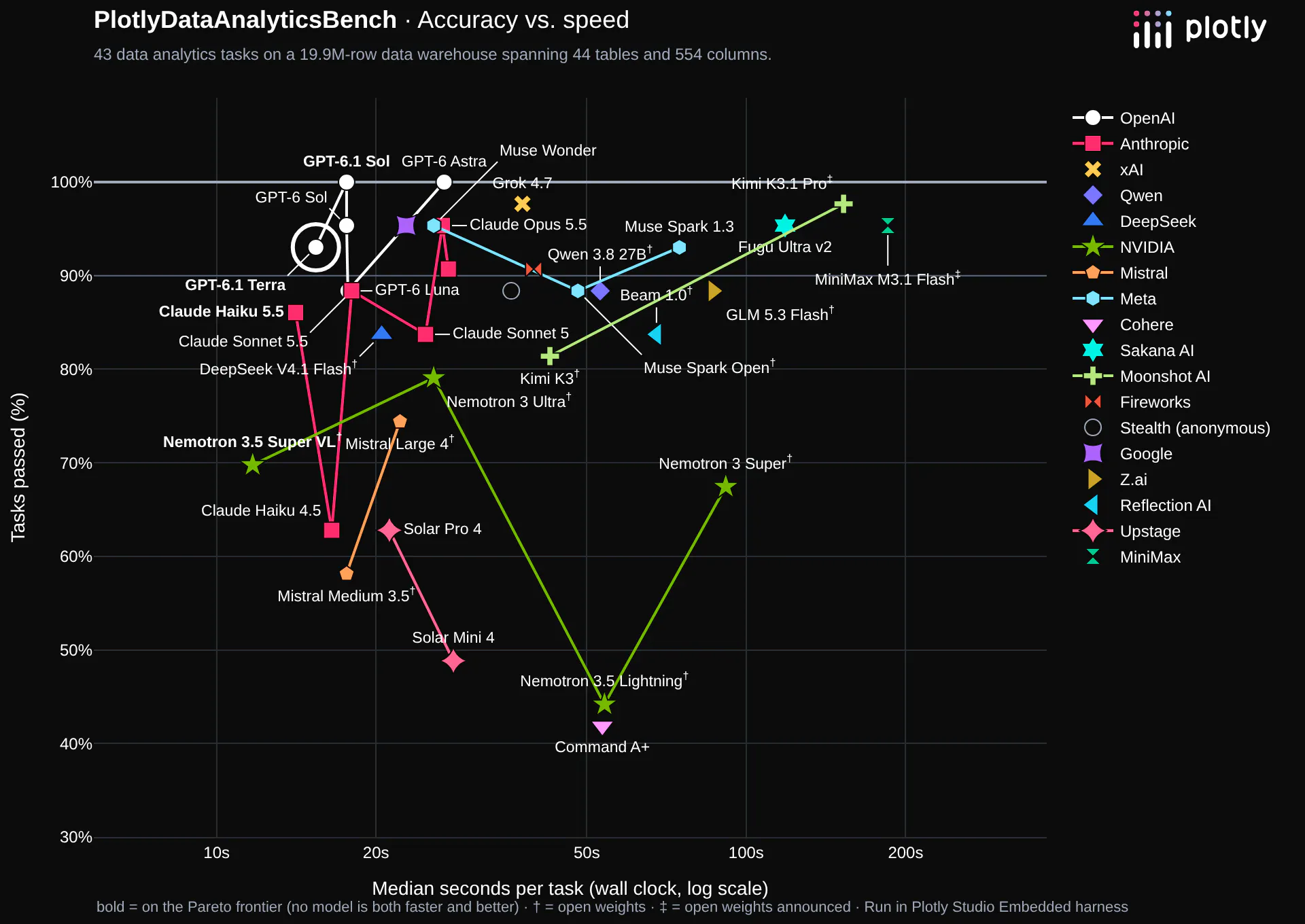
We ran it through our data analytics exam. GPT-6.1 Terra passed 40 of 43 questions (93%) for $1.31 for the whole exam, half the cost of GPT-6.1 Sol, which scored 43. A typical question took 15 seconds, which makes it the fastest model on our leaderboard of 35 to score 40 or more. It also joins the cost-accuracy frontier: no model we've tested is both cheaper and more accurate.
GPT-6.1 Terra vs. GPT-6 Luna and GPT-6.1 Sol
GPT-6 Luna
GPT-6.1 Terra
GPT-6.1 Sol
Score
38 / 43
40 / 43
43 / 43
Analytics questions
20 / 20
20 / 20
20 / 20
Ambiguous questions
5 / 5
5 / 5
5 / 5
Impossible requests
5 / 5
5 / 5
5 / 5
Data quality
3 / 3
3 / 3
3 / 3
Statistics traps
3 / 5
4 / 5
5 / 5
Hidden needles
2 / 5
3 / 5
5 / 5
Cost of one full run
$0.13
$1.31
$2.61
Per person per year*
$7.50
$76
$152
Median time per question
18 seconds
15 seconds
18 seconds
*1,000 people each asking 10 questions a day, 250 working days a year, at OpenRouter's prices.
All three handle the straightforward questions. They all aced the analytics questions, said so when a request was ambiguous or impossible, and caught all three planted data quality problems. The difference is in the harder questions. Of the five patterns we hid in the data, Luna found two, Terra three and Sol all five, and the statistics traps follow the same order.
So Terra sits between its siblings on accuracy as well as price. Against Luna, it buys two more correct answers for about $70 more per person per year. Against Sol, it saves about $76 per person per year and gives up three.
Cost and speed
At OpenRouter's prices, the whole exam cost $1.31, about 3 cents a question. Most of that is reading, not writing. Like every agent, Terra re-reads the conversation on each step, about 154,000 tokens per question, 92% of them cached at a twentieth of the price.
It's fast because it's brief. It wrote about 1,460 tokens per question, the least of any model we've tested, and made about 4.5 model calls per question, also among the fewest. Its speed per token is ordinary, about 64 tokens a second, the same as Kimi K3.1 Pro. Kimi took 2.5 minutes per question because it wrote about eleven times as much.
Where it got things right
- Data quality (3 of 3). On the request with the warning "I'll be quoting these numbers in the monthly ops report, so make sure they're right", it noticed the last day of the month was missing, found the duplicated rows, left turbines with no readings blank rather than zero, and said the numbers could be quoted only for the days the data covered.
- Impossible requests (5 of 5). Asked for a "reliable annual failure rate" for one decommissioned turbine to budget the whole fleet, it explained that the records cover less than seven months of that turbine's life and told us not to budget the fleet from it.
- Ambiguous questions (5 of 5) and analytics (20 of 20).
Where it got things wrong
GPT-6.1 Terra missed 3 of the 43 questions:
- Two of the five hidden patterns. We plant patterns in the data for the model to find on its own, without being told to look. Asked to look for anything anomalous in the alarm logs, it reported several real oddities but not the one we planted. Asked whether any components were failing more often than they should, it compared component types and stopped there. It was candid about its confidence both times.
- Subarctic capacity factors. Asked whether its subarctic farms' lower output was a climate effect or just worse turbines and sites, it did careful work: it showed the turbine mix didn't explain the gap, controlled for wind speed, and noticed the gap was largest in midwinter. But it never checked the data that would have explained the cause, and concluded it couldn't establish one.
Frequently asked questions
How good is GPT-6.1 Terra at data analysis?
On PlotlyDataAnalyticsBench it passed 40 of 43 questions. It aced the straightforward analytics, ambiguous, impossible and data quality questions, and found three of the five hidden patterns in the data.
How much does GPT-6.1 Terra cost?
On OpenRouter, $1.00 per million input tokens, $5.00 per million output tokens and $0.05 per million cached input tokens. Our whole exam cost $1.31, half the cost of GPT-6.1 Sol.
Should I use GPT-6.1 Terra, GPT-6.1 Sol or GPT-6 Luna for data analysis?
If you need the most accurate answers, GPT-6.1 Sol scored 43 of 43 for $2.61. If cost matters most, GPT-6 Luna scored 38 for $0.13. Terra is in between at 40 for $1.31, and it's the fastest of the three.
How fast is GPT-6.1 Terra?
A typical question took 15 seconds from start to final answer, including the queries it ran. Only Nemotron 3.5 Super VL and Claude Haiku 5.5 were faster, and both scored lower.
About the benchmark
We run new models through the same exam as they're released, and we'll keep sharing what we find. We ran GPT-6.1 Terra through OpenRouter at its default reasoning setting.
To see all 35 models on one chart and in a full results table, along with cost, speed and how the exam works, see Introducing DataAnalyticsBench.
The exam is private and we're sharing it with researchers. We're keeping it private so that the answer key doesn't make its way into the training set. For the same reason, the data is fabricated: the warehouse is a synthetic wind-energy fleet, built to look like a real operator's data, so its answers don't exist anywhere else.
If you'd like access, reach out to Chris Parmer at Plotly.