Meta Muse Spark Open - A First Look
Oct 15, 2026: A B+ on our data analytics exam from a model you can download and run on your own hardware.
At Plotly, we keep a close eye on model releases. Our agentic analytics products, Plotly Studio Desktop and Plotly Studio Embedded, and our open source libraries Plotly and Dash work with any model, and our customers look to us for recommendations. Today Meta released Muse Spark Open, an open-weight version of Muse Spark that Meta says is "built for coding and agentic work." It's a natively multimodal mixture-of-experts model with 816 billion parameters, 42 billion of which are active for each token, and a context window of 1 million tokens. Meta calls it "the most capable US open-weight model to date."
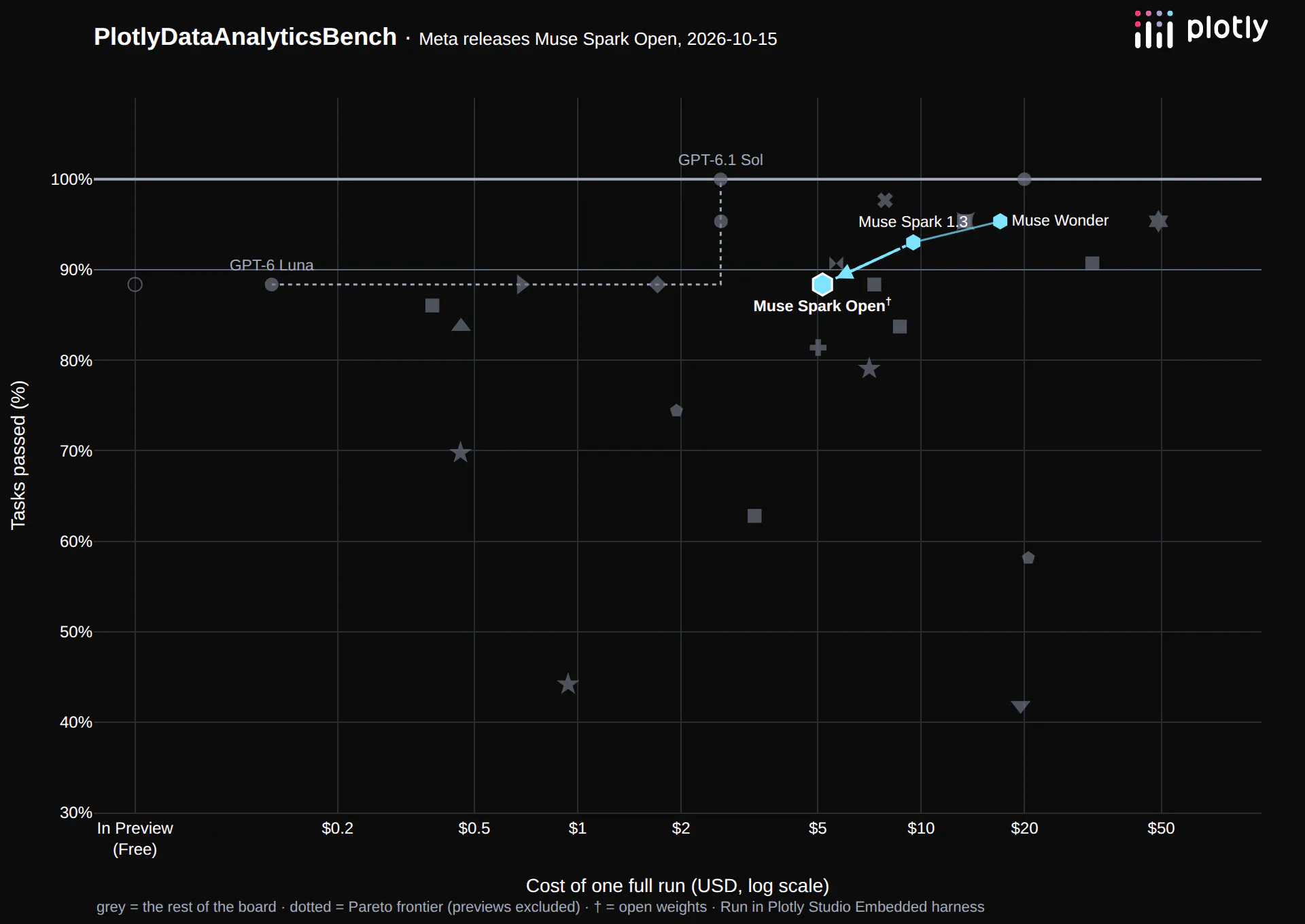
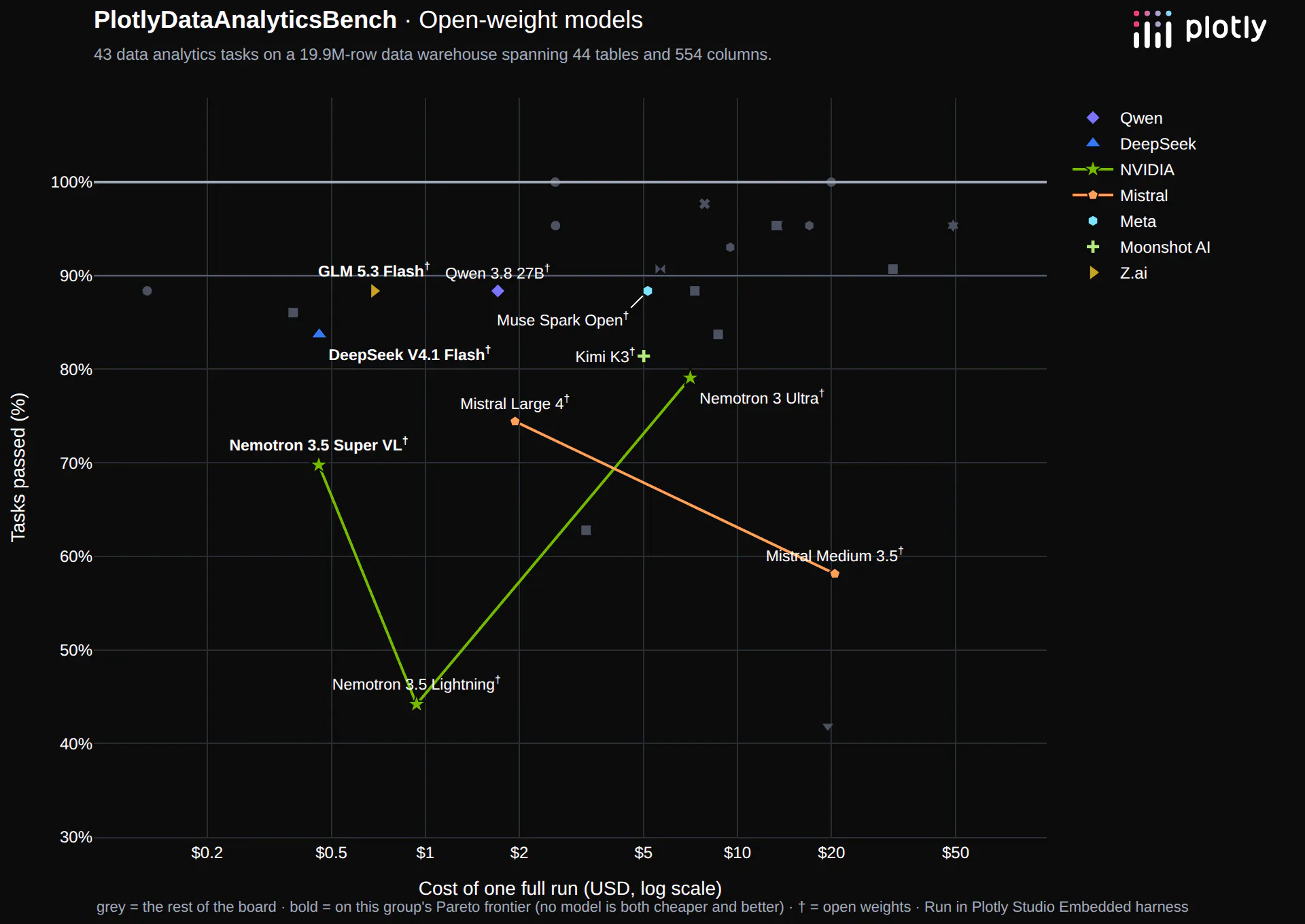
We ran it through our data analytics exam. It passed 38 of 43 questions (88%, a B+). That ties GLM 5.3 Flash and Qwen 3.8 27B for the best score from an open-weight model on our leaderboard, and it's the best score we've seen from an open-weight model made by a US lab. The previous best, NVIDIA's Nemotron 3 Ultra, scored 34.
Run it on your own hardware
This is the part we're most excited about. Meta calls Muse Spark Open "the first model in its class to run on your desktop." Working with Apple, Meta runs it on two M5 Ultra Mac Studios with MLX, Apple's open source machine learning framework. Each Mac Studio has up to 512 GB of unified memory, and connected over Thunderbolt 5 the two "behave like one supercomputer with a terabyte of unified memory." At 4-bit precision the model needs about 493 GB, and Apple measured about 25 tokens per second on two machines and about 37 on four.
Meta showed it running agents entirely on-device: fixing bugs and adding features in an open source iOS app, and reviewing video footage frame by frame in DaVinci Resolve. The weights are on Hugging Face, Amazon SageMaker, Google Cloud and Microsoft Foundry under the Muse Model License, which has limited commercial terms, and the model runs in SGLang, vLLM, llama.cpp and other common inference engines on Apple, NVIDIA, AMD and Intel hardware.
That means a model that scores a B+ on real data analysis can run entirely on hardware in your office, with no API calls and no data leaving your network. Many of the organizations we work with can't send their data to a hosted model, and some can't use models from Chinese labs, which until today held every top open-weight score on our board. Muse Spark Open gives them a US-made option at the same level.
It isn't fast on a desk. Using Apple's numbers and the tokens Muse Spark Open used on our exam, we estimate a typical question would take about 3½ minutes on two Mac Studios and a little over 2 minutes on four, against 48 seconds through OpenRouter. That's fine for analysis that runs in the background or a question you're willing to wait for. It's also not cheap: Apple hasn't priced the 512 GB configuration yet, but the 256 GB Mac Studio is $11,299, so two machines will cost well over $22,000. Through OpenRouter, our exam cost $5.16, or about $300 per person per year if 1,000 people each asked 10 questions a day.
The exam
Our data analytics exam tests how well models do at real data analysis. It runs within Plotly Studio Embedded, with the same agent, tools and prompts that app viewers use and only the model swapped, and it answers 43 questions through a series of tool calls and analysis steps. The data warehouse is representative of the real world: 20M rows across 44 tables and 554 columns. The questions cover a broad range of data analytic skills: answering questions, recognizing ambiguity, avoiding hallucinations, and finding a needle in a haystack.
The dataset is a mock wind turbine analytics dataset: 5,200 turbines across 28 wind farms over two years. It covers everything from hourly SCADA telemetry and alarms to work orders, inspections, oil samples, firmware rollouts and weather. And like real operational data it's messy, with frozen sensors, duplicated rows and turbines decommissioned mid-period, so a good analyst has to catch problems before quoting a number.
Every question has either an answer, checked against a verified key, or "a catch": an ambiguous question to raise, an impossible request to decline, a planted data defect to flag. There is no partial credit, and a confident answer that ignores the catch fails.
Here's how Muse Spark Open compares with Meta's hosted models, Muse Spark 1.3 and Muse Wonder, and with Qwen 3.8 27B, the open-weight model it ties:
Category
Muse Spark Open
Muse Spark 1.3
Muse Wonder
Qwen 3.8 27B
Analytics questions
20 / 20
20 / 20
20 / 20
19 / 20
Impossible requests
5 / 5
5 / 5
5 / 5
5 / 5
Ambiguous questions
5 / 5
5 / 5
5 / 5
5 / 5
Data quality
2 / 3
3 / 3
3 / 3
3 / 3
Hidden needles
2 / 5
3 / 5
4 / 5
2 / 5
Statistics traps
4 / 5
4 / 5
4 / 5
4 / 5
Total
38 / 43 (88%)
40 / 43 (93%)
41 / 43 (95%)
38 / 43 (88%)
Open weights
Yes
No
No
Yes
Cost of one full run
$5.16
$9.48
$16.98
$1.71
Median time per question
48 seconds
75 seconds
26 seconds
53 seconds
Cost and speed
Muse Spark Open has the same price per token on OpenRouter as Muse Spark 1.3, $1.25 per million input tokens and $4.25 per million output tokens, but our exam cost about half as much: $5.16 against $9.48. The two models read about the same number of tokens per question. The difference is caching: 94% of Muse Spark Open's input tokens were served from the provider's cache, against 68% for Muse Spark 1.3, and cached tokens cost an eighth as much.
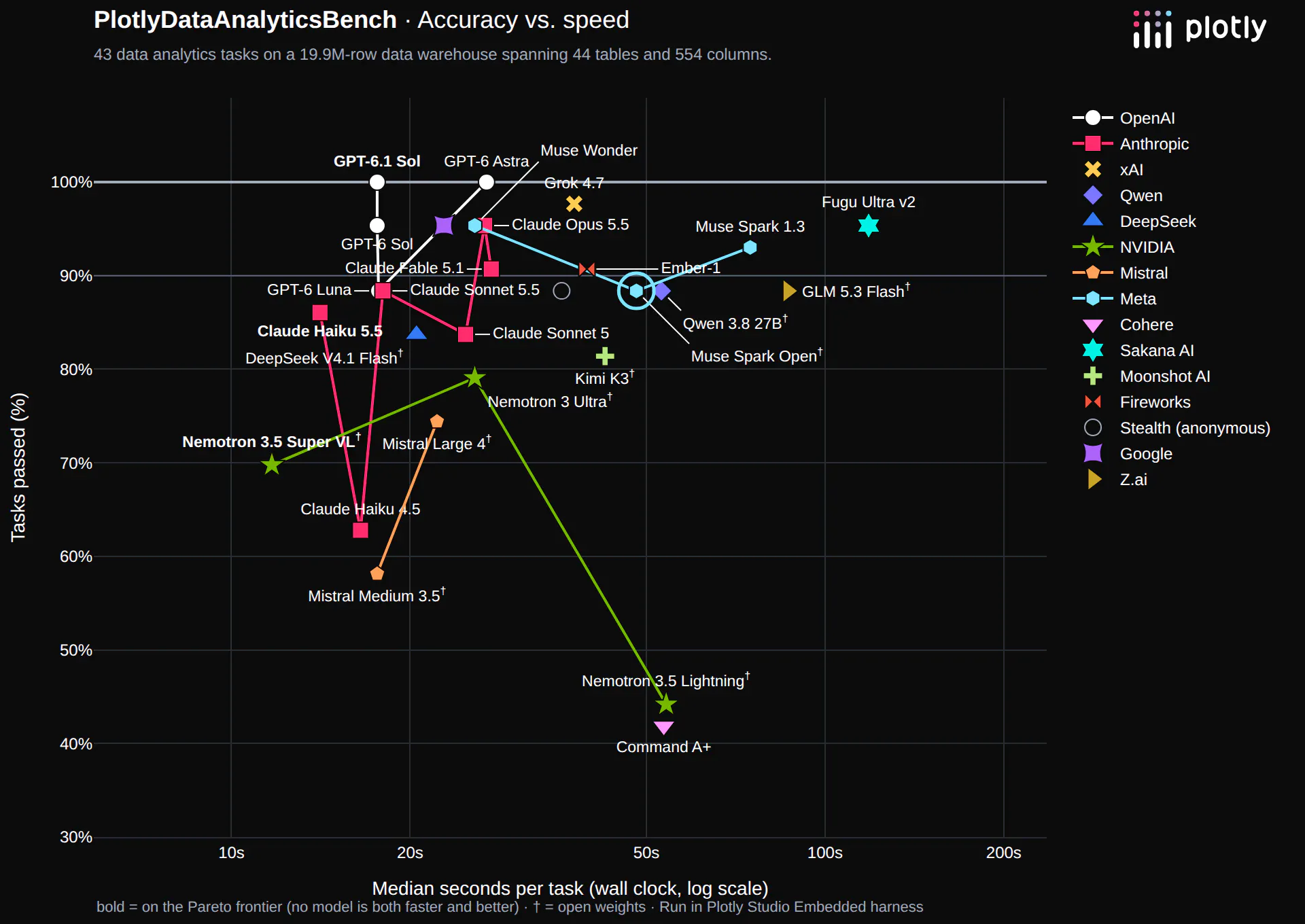
It's also faster than Muse Spark 1.3, at a median of 48 seconds per question against 75. Muse Wonder, Meta's larger hosted model, is faster again at 26 seconds.
Where it got things right
- Analytics questions (20 of 20). Every multi-step SQL question, including merging overlapping alarm intervals, which 8 of the 28 models on our leaderboard got wrong.
- Ambiguous questions and impossible requests (10 of 10). Asked "Which is our best-performing wind farm?", it said the answer depends on the measure and ranked the farms by total energy, energy per megawatt, revenue and capacity factor. Asked for a decommissioned turbine's "reliable" failure rate to set the budget for the whole fleet, it explained why one turbine's short, truncated history can't do that, and gave the fleet baseline instead.
- Catching problems before quoting a number. On the request with the warning "I'll be quoting these numbers in the monthly ops report, so make sure they're right", it found the duplicated rows, removed them, flagged the missing last day of the month, and told us not to quote zero for the turbines that had been decommissioned.
Where it got things wrong
Muse Spark Open missed 5 of the 43 questions:
- Hidden needles (2 of 5). We planted five patterns in the data for the model to find on its own, without being told to look. It found two. Muse Spark 1.3 found three and Muse Wonder four.
- Inventing a defect. Auditing a production table before board reporting, it flagged a value as physically impossible when it isn't, and recommended capping it. Telling a board a correct number is wrong is its own kind of mistake.
- Answering from one correlation. Asked whether windy days drive up SCADA alarms, it computed the overall correlation and concluded wind doesn't matter much, without checking whether something else, like the season, explains both.
About the benchmark
We run new models through the same exam as they're released, and we'll keep sharing what we find.
The exam is private and we're sharing it with researchers. We're keeping it private so that the answer key doesn't make its way into the training set. For the same reason, the data is fabricated: the warehouse is a synthetic wind-energy fleet, built to look like a real operator's data, so its answers don't exist anywhere else.
If you'd like access, reach out to Chris Parmer at Plotly.