Kimi K3.1 Pro Benchmark Results for Data Analysis
Oct 23, 2026: Moonshot's new flagship, tested on real-world data analysis the day it launched.
At Plotly, we keep a close eye on model releases. Our agentic analytics products, Plotly Studio Desktop and Plotly Studio Embedded, and our open source libraries Plotly and Dash work with any model, and our customers look to us for recommendations.
Today Moonshot AI released Kimi K3.1 Pro, a post-trained version of Kimi K3 and the first model in its K3.1 series. Moonshot calls it its "most capable 3T-class open-weight model to date." It has a 1-million-token context window, takes text, image and video input, and always reasons before it answers. On OpenRouter it costs $2.00 per million input tokens, $10.00 per million output tokens and $0.20 per million cached input tokens. Moonshot said the full weights would be out by November 4, and released them on November 2.
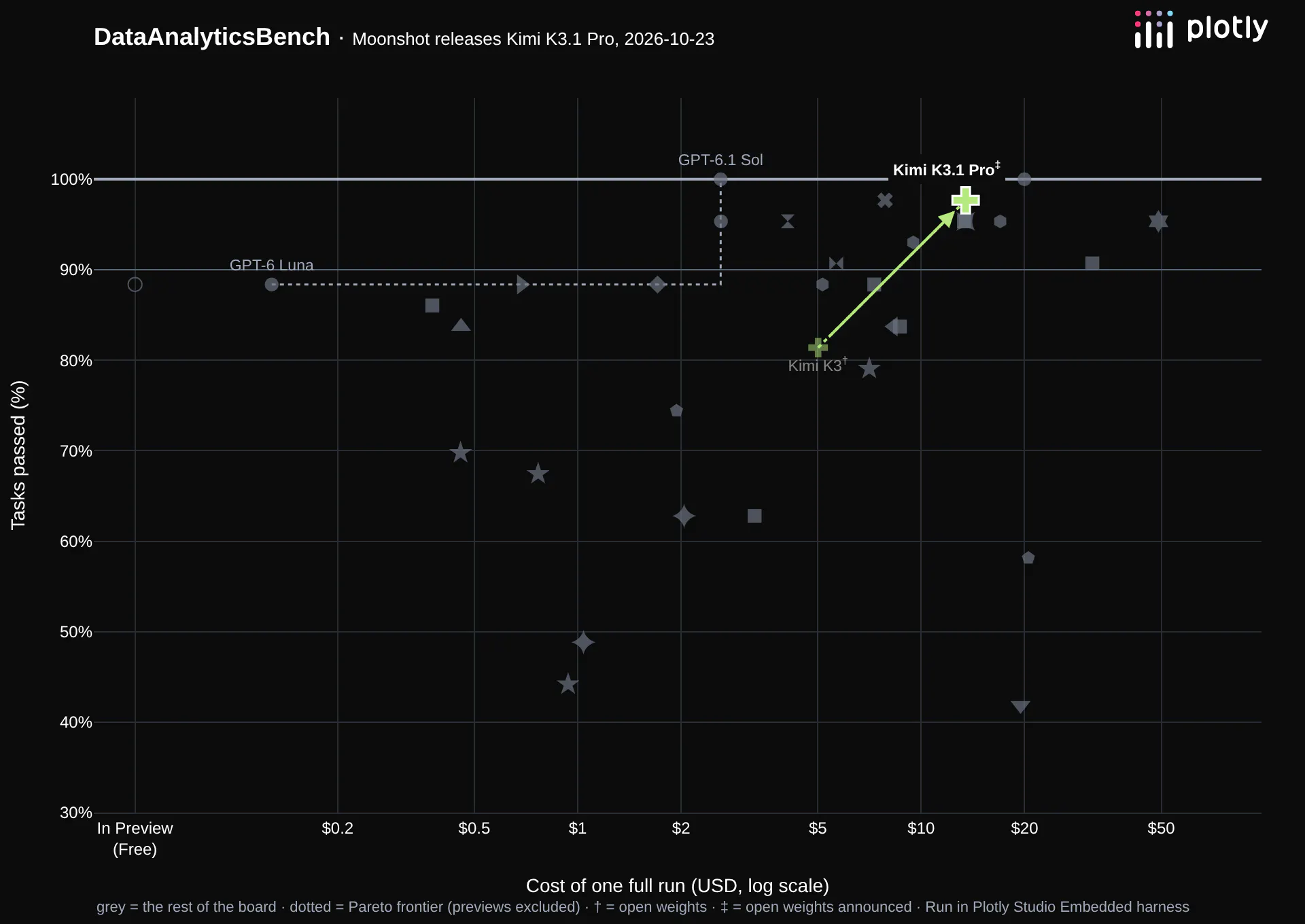
We ran it through our data analytics exam. Kimi K3.1 Pro passed 42 of 43 questions (98%, an A), up from 35 for Kimi K3, for $13.47 for the whole exam. That ties Grok 4.7 for the third-best score on our leaderboard of 34 models, behind only GPT-6.1 Sol and GPT-6 Astra, which scored 43. It's the best result we've seen from a Chinese lab, ahead of MiniMax M3.1 Flash's 41, and with the weights now out, it's the most accurate open-weight model we've tested.
Kimi K3.1 Pro vs. Kimi K3
Kimi K3 (July)
Kimi K3.1 Pro (October)
Score
35 / 43
42 / 43
Analytics questions
20 / 20
20 / 20
Ambiguous questions
5 / 5
5 / 5
Impossible requests
5 / 5
5 / 5
Statistics traps
4 / 5
4 / 5
Data quality
1 / 3
3 / 3
Hidden needles
0 / 5
5 / 5
Cost of one full run
$5.01
$13.47
Median time per question
43 seconds
2.5 minutes
Kimi K3 already handled the straightforward questions. What it lacked was initiative: it found none of the five patterns we hid in the data and caught only one of the three data quality problems. K3.1 Pro found all five patterns and caught all three problems. Only four other models have found every hidden pattern: GPT-6.1 Sol, GPT-6 Astra, Gemini 4 Argon and MiniMax M3.1 Flash.
It does this by looking at a lot of data at once. K3.1 Pro made about 7.5 model calls per question, close to the average across the models we've tested, but it often ran several queries in a single step: about 73 tool calls on each hidden-pattern question, against about 18 for GPT-6.1 Sol.
What Moonshot claims, and what we found
Moonshot's announcement leads with coding, 3D creation and finance. On its own evaluations, K3.1 Pro scores 65.7% on Terminal-Bench 4.0, against 66.4% for Claude Opus 5.5 and 58.2% for GPT-6 Astra, and a state-of-the-art 64.4 on OfficeQA Pro v2. Moonshot also says the share of hallucinated claims fell from 23.4% for K3 to 8.3% with tools.
Those are Moonshot's numbers on Moonshot's harness. On ours, K3.1 Pro said so every time the data couldn't answer the question, caught every planted data quality problem, and qualified its answers where the data was incomplete.
Cost and speed
At OpenRouter's prices, the whole exam cost $13.47, about 31 cents a question. At that rate, 1,000 people each asking 10 questions a day would cost about $780 per person per year, the same as Gemini 4 Argon, against about $290 for Kimi K3. For a top score that's on the expensive side: Grok 4.7 also scored 42 for $7.85, and GPT-6.1 Sol scored 43 for $2.61.
Most of the cost is output. K3.1 Pro read about 440,000 tokens per question, 92% of them cached at a tenth of the price, and wrote about 16,500, most of it reasoning. Output came to $7.10 of the $13.47. Its input price is about eight times Kimi K3's on OpenRouter ($2.00 against $0.24 per million), while output costs about the same ($10.00 against $10.80).
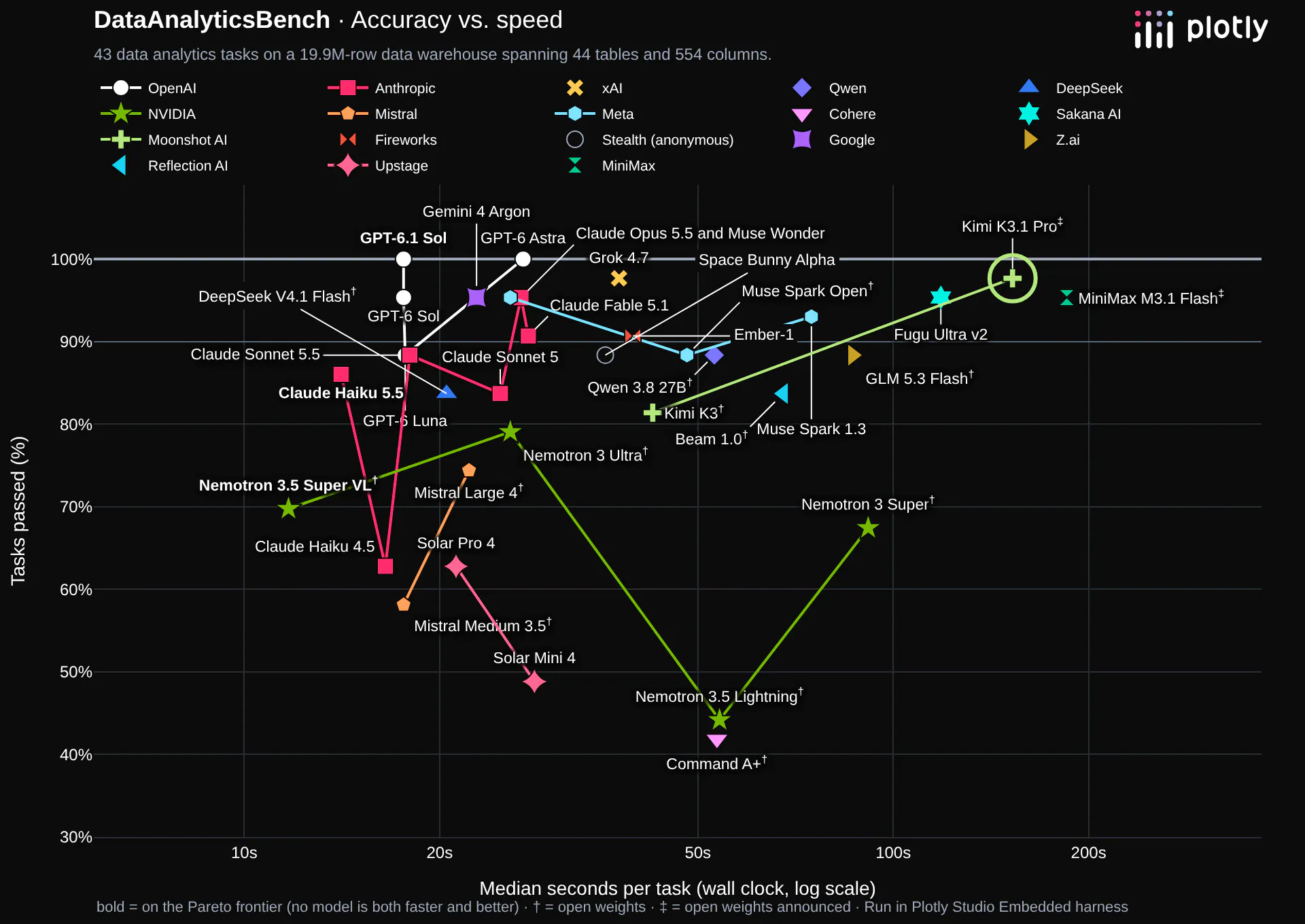
It's also slow. A typical question took 2.5 minutes, the second-slowest median on our leaderboard after MiniMax M3.1 Flash.
That time goes to thinking, not to running queries. About 90% of it was spent waiting for the model to respond and about 10% running SQL. Its speed per token is ordinary: on OpenRouter on launch day it wrote about 64 tokens a second, a little below the median of about 72 across the models we've tested, and close to Grok 4.7's 67. What's different is how much it writes. At about 16,500 output tokens per question, 62% of them reasoning, it writes about five times as much as Kimi K3 and seven times as much as GPT-6.1 Sol. Only MiniMax M3.1 Flash wrote more. GPT-6.1 Sol actually generates tokens more slowly, at about 47 a second, but it finishes in 18 seconds because it writes so little.
The queries only add up on the hidden-pattern questions, where running them took about a quarter of the time. On the straightforward analytics questions, 99% of the time went to the model.
Moonshot also offers K3.1 Pro Highspeed, which it says runs two to three times faster with the same capabilities. Since most of the time goes to generating tokens, a faster variant should help directly. We haven't tried it: we tested the standard model, through OpenRouter, the day it launched.
Where it got things right
- Hidden needles (5 of 5). We planted five patterns in the data for the model to find on its own, without being told to look. It found all five.
- Data quality (3 of 3). On the request with the warning "I'll be quoting these numbers in the monthly ops report, so make sure they're right", it found the duplicated rows and the missing last day of the month, and told decommissioned turbines with no data apart from turbines that really produced nothing.
- Impossible requests (5 of 5). Asked for a "reliable annual failure rate" for one decommissioned turbine to budget the whole fleet, it explained why that turbine's short history couldn't support it and offered the fleet-wide rate instead.
- Ambiguous questions (5 of 5) and analytics (20 of 20).
Where it got things wrong
Kimi K3.1 Pro missed 1 of the 43 questions:
- Turbine-days with no firmware. Asked to compare days on firmware FW-2.4.1 against days on any other firmware, it chose a careful test and got the FW-2.4.1 average exactly right. But it also counted 2,775 turbine-days from before those turbines had any firmware installed as "other firmware", while saying every turbine-day had firmware. That nudged the other group's average up by about 0.0003, just outside our tolerance.
Open weights
Update, November 4, 2026: Moonshot published the full weights on Hugging Face on November 2, under its own Kimi K3.1-Pro license. It's permissive, with two conditions for the largest companies: model-as-a-service providers with more than $20 million in revenue over 12 months need a separate agreement with Moonshot, and products with more than 100 million monthly users or $20 million in monthly revenue must display the model's name. The weights are about 1.6 TB, so this is a model for a GPU server, not a desktop. For how open models compare with closed ones on cost, speed and hardware, see Open Models vs. Closed Models in 2026.
Frequently asked questions
How good is Kimi K3.1 Pro at data analysis?
On PlotlyDataAnalyticsBench it passed 42 of 43 questions, tied with Grok 4.7 for third place behind GPT-6.1 Sol and GPT-6 Astra, and found all five hidden patterns in the data.
Is Kimi K3.1 Pro open source?
Its weights are open. Moonshot released them on November 2, 2026, under a permissive license that requires a separate agreement for model-as-a-service providers with more than $20 million in revenue over 12 months.
How much does Kimi K3.1 Pro cost?
On OpenRouter, $2.00 per million input tokens, $10.00 per million output tokens and $0.20 per million cached input tokens. Our whole exam cost $13.47.
What's the difference between Kimi K3.1 Pro and Kimi K3?
K3.1 Pro is K3 with much more post-training. It always reasons, defaults to maximum reasoning effort, and has a faster Highspeed variant. On our exam it scored 42 of 43 against K3's 35, at about 2.7 times the cost and 3.5 times the time per question.
What's the difference between K3.1 Pro and K3.1 Pro Highspeed?
Moonshot says Highspeed has the same capabilities at two to three times the speed. We benchmarked the standard model.
About the benchmark
We run new models through the same exam as they're released, and we'll keep sharing what we find.
To see all 34 models on one chart and in a full results table, along with cost, speed and how the exam works, see Introducing DataAnalyticsBench.
The exam is private and we're sharing it with researchers. We're keeping it private so that the answer key doesn't make its way into the training set. For the same reason, the data is fabricated: the warehouse is a synthetic wind-energy fleet, built to look like a real operator's data, so its answers don't exist anywhere else.
If you'd like access, reach out to Chris Parmer at Plotly.