Gemini 4 Neon vs Carbon vs Hydrogen, and How They Map to Claude and GPT Tiers (2026)
Nov 25, 2026: Google's three new Gemini 4 models side by side on real-world data analysis, and how Google's lineup lines up against Anthropic's and OpenAI's.
At Plotly, we keep a close eye on model releases. Our agentic analytics products, Plotly Studio Desktop and Plotly Studio Embedded, and our open source libraries Plotly and Dash work with any model, and our customers look to us for recommendations.
In three weeks, Google released three Gemini 4 models: Carbon, Hydrogen and Neon. We've tested each one on its own. The question we hear most now is which one to use, and how they compare with the Claude and GPT model you'd pick at the same tier. This post puts our results for all three in one place, adds what Google says each model is for, maps each lab's tiers against each other, and looks at what public coding-agent benchmarks show about the same tiers.
TL;DR: which should you use?
- For data analysis on Gemini, use Gemini 4 Hydrogen. It scored a perfect 43 of 43, like Neon, for $6.36 a run against Neon's $17.03 (about 37% of the cost), and its median question took 32 seconds against Neon's 46.
- Use Gemini 4 Neon for coding agents, or if Hydrogen falls short on your own evals. Google says Neon "balances depth and efficiency", and it's the top Gemini model on Artificial Analysis's Coding Agent Index: 59, against Carbon's 55 and Hydrogen's 52.
- Use Gemini 4 Carbon only for the hardest long-horizon or security work Google built it for. On our exam it was the slowest of the three (a 93-second median) and the only one to miss a question. Its price doubles on December 1.
- Across labs, the tiers are close on data analysis. Every lab's best model scored 43, and their cheapest models scored 37 or 38. GPT-6.1 Sol is still the cheapest perfect score we've seen, at $2.61.
- For coding agents, don't drop to the cheapest tier. On Artificial Analysis's index, Claude Haiku 5.5 and GPT-6 Luna score about half of their flagships, a much bigger gap than on our exam. The tiers above them stay within about seven points of the top.
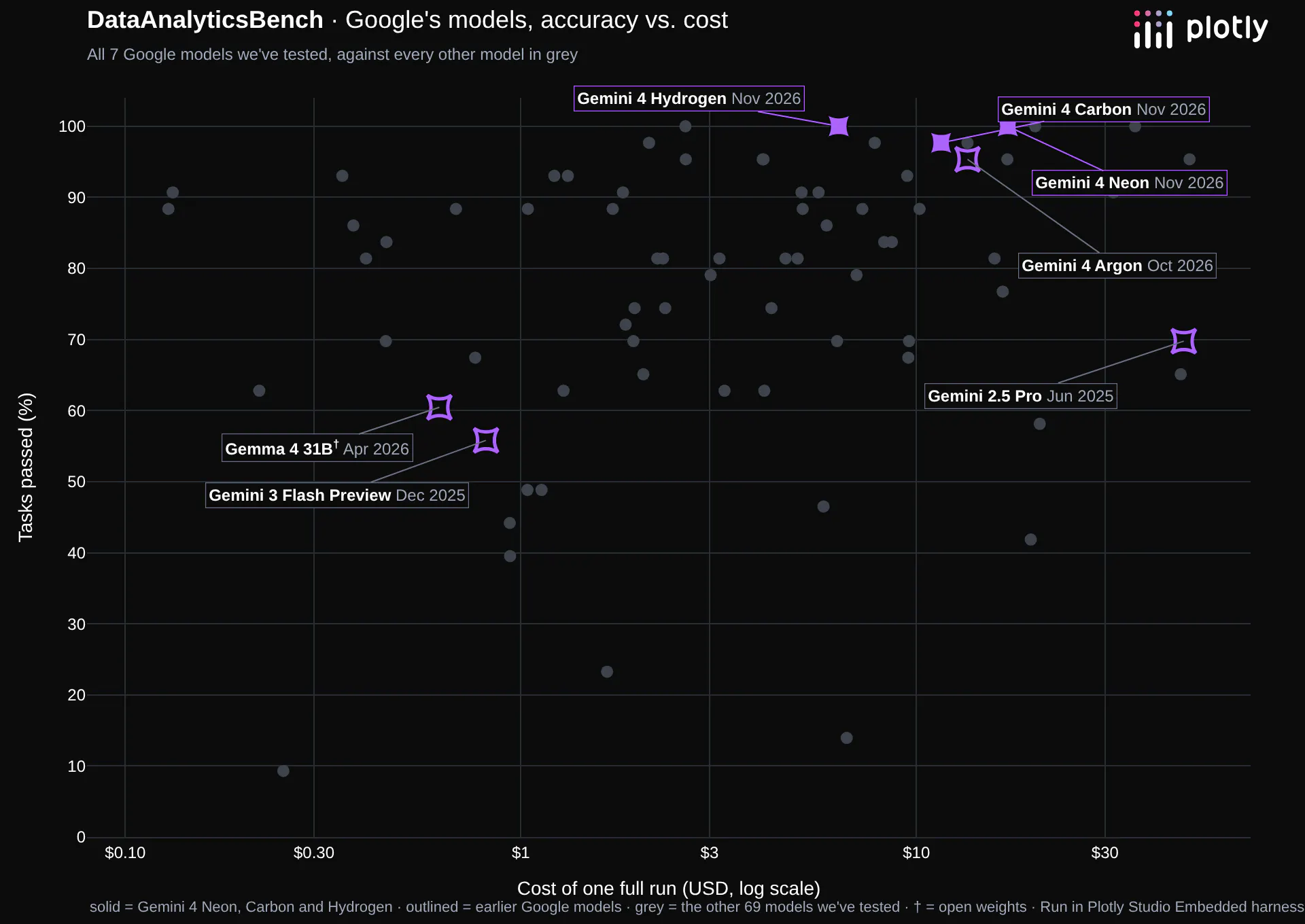
Accuracy against the cost of one full run for every Google model we've tested, with every other model in grey. Neon and Hydrogen both score 43; Hydrogen gets there for less than half the price.
Gemini 4 Neon vs. Carbon vs. Hydrogen: our results
Gemini 4 Hydrogen
Gemini 4 Neon
Gemini 4 Carbon
Score
43 / 43
43 / 43
42 / 43
Cost of one full run
$6.36
$17.03
$11.55
Per person per year*
$370
$990
$671
Median time per question
32 seconds
46 seconds
93 seconds
Slowest question
249 seconds
304 seconds
679 seconds
Whole exam, one question at a time
43 minutes
58 minutes
108 minutes
Tool calls per question
15.2
17.5
14.6
Output tokens per model call
782
904
495
Output tokens per second**
104
96
34
Total tokens
18.0 million
20.1 million
29.5 million
List price per 1M tokens (input / output)
$1.50 / $7.50
$3.00 / $15.00
$2.00 / $10.00 until Nov 30, then $4.00 / $20.00
On OpenRouter since
Nov 12, 2026
Nov 18, 2026
Nov 10, 2026
Open weights
No
No
No
*1,000 people each asking 10 questions a day, 250 working days a year, at OpenRouter's prices when each model ran.
**Output tokens divided by the total time spent waiting on model calls, including the wait for the first token. That's why it's lower than the 159 tokens per second of pure generation we reported in our Neon post.
One run per model is a single sample. In our repeat runs of other models, scores moved by up to three points between runs, so treat a one- or two-point gap as close to a tie.
Accuracy: a near tie
All three are strong data analysts. Neon and Hydrogen passed every question, and Carbon missed one, a data-quality question. All three found every hidden pattern in the warehouse and caught every statistics trap. On accuracy alone, our exam can't separate them by much: a one-point gap is within the run-to-run noise we've seen.
Cost: Hydrogen is about a third of Neon
Hydrogen and Neon read and wrote about the same number of tokens, 18.0 million against 20.1 million. Neon costs more because its list price is twice Hydrogen's. Carbon used the most tokens, 29.5 million, but its introductory price kept its run at $11.55. Google's pricing page shows Carbon's input, output and cached input prices all doubling on December 1, 2026. At those rates, the same run would have cost about $23.10, more than Neon.
Google says Neon has a "32% lower cost per task than Carbon" at its default high thinking level. On our exam, at Carbon's introductory price, it was the other way around.
Speed: Carbon is the slow one
Hydrogen had the fastest median question, 32 seconds, and finished the whole exam in 43 minutes. Neon took 58 minutes and Carbon 108. Carbon doesn't write more; it writes less per call. It's slower because each call takes longer to start and it works in more, smaller steps. We dug into why in our Carbon post.
What Google says each model is for
Google's own descriptions line up with a three-tier family. In its Neon announcement Google puts it this way: "While Carbon tackles your hardest, long-horizon projects, Neon balances depth and efficiency, and Hydrogen handles fast everyday execution."
- Gemini 4 Carbon is Google's "strongest reasoning model for complex software engineering, multimodal knowledge work, scientific reasoning, and cybersecurity defense", according to the Gemini API model list. Google announced it on October 28 as "our strongest model", first for cyber defenders, and opened it to developers on November 10.
- Gemini 4 Neon is "built for complex coding, analytical reasoning, and production-grade enterprise workflows", Google says, with frontier-level reasoning delivered "faster and more cost efficiently".
- Gemini 4 Hydrogen is "our daily driver for agentic workflows", in Google's words, built for everyday coding and agentic work, and meant to stand on its own or to "pair with Carbon and Argon as the high-efficiency execution engine in multi-model workflows". It's the only one of the three on the Gemini API free tier.
All three have a 1 million-token context window, take text, image, audio, video and PDF input, per Google's model list. Neon and Hydrogen both offer four thinking levels: low, medium, high (the default) and xhigh. Google also lists Gemini 4 Argon, which it now describes as "an efficient frontier reasoning model that responds faster and uses fewer tokens per turn than Carbon". Argon scored 41 on our exam for $13.47, and its price doubles on December 1 too.
Our results only partly follow Google's order. On data analysis, the everyday model tied the middle one and beat the top one. That's consistent with Google's pitch for Hydrogen as a workhorse, and a reminder that "strongest" is measured on harder, longer tasks than a typical analytics question.
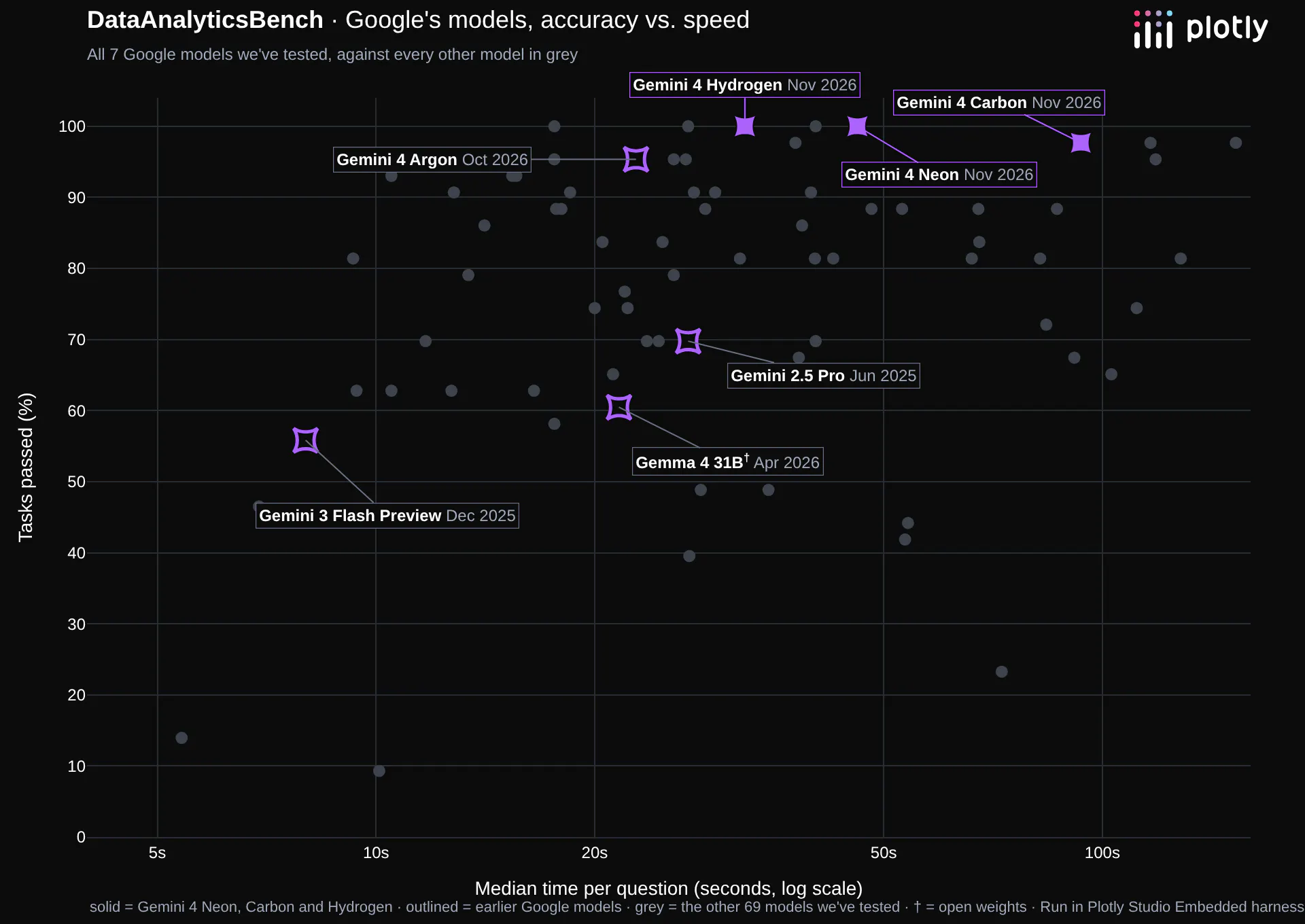
The same Google models against median time per question. Hydrogen is the fastest of November's three; Carbon is one of the slowest models we've tested.
How Gemini tiers map to Claude and GPT
Each lab sells a ladder of models from expensive and capable to cheap and fast. Here's how they line up by each lab's own description, with list prices per 1 million input and output tokens. The rungs don't match exactly, so read the rows as rough equivalents.
Tier
Google (Gemini 4)
Anthropic (Claude)
OpenAI (GPT)
Top tier
Carbon, $2 / $10, rising to $4 / $20 on Dec 1. "Strongest reasoning model" (Google)
Fable 5.2, $8 / $40. "For demanding reasoning and long-horizon agentic work" (Anthropic)
GPT-6.2 Astra, $8 / $40. "Our most capable model for your hardest projects" (OpenAI)
Balanced
Neon, $3 / $15. "Balances depth and efficiency" (Google)
Opus 5.5, $4 / $20. "For long-running agentic coding and knowledge work"; Anthropic's suggested starting point
GPT-6.2 Sol, $2 / $10. "Our go-to model for everyday work, from coding to powering agents at scale"
Fast, everyday
Hydrogen, $1.50 / $7.50. "Our daily driver for agentic workflows" (Google)
Sonnet 5.5, $2 / $10. "The best combination of speed and intelligence"
GPT-6.1 Terra, $1 / $5. "A fast, efficient model for visual reasoning, precise computer use, and clear, natural writing"
Cheapest, high volume
No Gemini 4 model yet
Haiku 5.5, from $0.10 / $0.50. "For high-volume, latency-sensitive tasks such as classification, extraction, and routing"
GPT-6 Luna, $0.10 / $0.50. "Our most efficient model for focused, high-volume tasks"
Prices are each lab's standard API list prices as of November 25, 2026, and match OpenRouter's. Where the mapping is fuzzy:
- Google's top tier is cheaper per token than its middle tier, for now. Until November 30, Carbon costs less per token than Neon. From December 1, Carbon's $4 / $20 puts it back above Neon, though still half the price of Fable 5.2 and GPT-6.2 Astra.
- The labs recommend different defaults. Anthropic says to start with Opus 5.5 "for most workloads". OpenAI says "if you're not sure where to start, use GPT-6.2 Astra". Google doesn't name a default, but calls Hydrogen its daily driver.
- OpenAI has four rungs where Google has three. By price, GPT-6.2 Sol sits between Neon and Hydrogen, and OpenAI describes it as an everyday model, so it could sit in either row. Terra has no 6.2 version yet.
- Google has no Gemini 4 model at Haiku or Luna prices. Hydrogen is the cheapest Gemini 4 model, at 15 times their list price.
Our results across all three labs
Here's how every current tier from the three labs did on our exam, along with a few previous versions that are still available. The table is grouped by lab, from the top tier down.
Model
Released
Score
Cost of one full run
Median time per question
Gemini 4 Carbon
Nov 10, 2026
42 / 43
$11.55
93.4 s
Gemini 4 Neon
Nov 18, 2026
43 / 43
$17.03
46.0 s
Gemini 4 Hydrogen
Nov 12, 2026
43 / 43
$6.36
32.2 s
Gemini 4 Argon
Oct 13, 2026
41 / 43
$13.47
22.8 s
Claude Fable 5.2
Nov 9, 2026
43 / 43
$35.74
40.3 s
Claude Fable 5.1
Sep 1, 2026
39 / 43
$31.49
27.4 s
Claude Opus 5.5
Sep 22, 2026
41 / 43
$13.31
26.7 s
Claude Sonnet 5.5
Sep 28, 2026
38 / 43
$7.30
18.0 s
Claude Haiku 5.5
Oct 7, 2026
37 / 43
$0.38
14.1 s
GPT-6.2 Astra
Nov 17, 2026
41 / 43
$4.11
12.4 s
GPT-6 Astra
Sep 4, 2026
43 / 43
$19.97
26.9 s
GPT-6.2 Sol
Nov 17, 2026
40 / 43
$1.22
10.5 s
GPT-6.1 Sol
Sep 29, 2026
43 / 43
$2.61
17.6 s
GPT-6.1 Terra
Oct 26, 2026
40 / 43
$1.31
15.4 s
GPT-6 Luna
Sep 22, 2026
38 / 43
$0.13
17.7 s
The chart below plots accuracy against the cost of one full run for every Claude, GPT and Gemini model we've tested, including a few older versions that aren't in the table, in each lab's colour. Every other model on our board is in grey, and the labs' open-weight models, Gemma and gpt-oss, are left out. Labels in bold mark this group's cost-accuracy frontier: no other Claude, GPT or Gemini model scores higher for less.
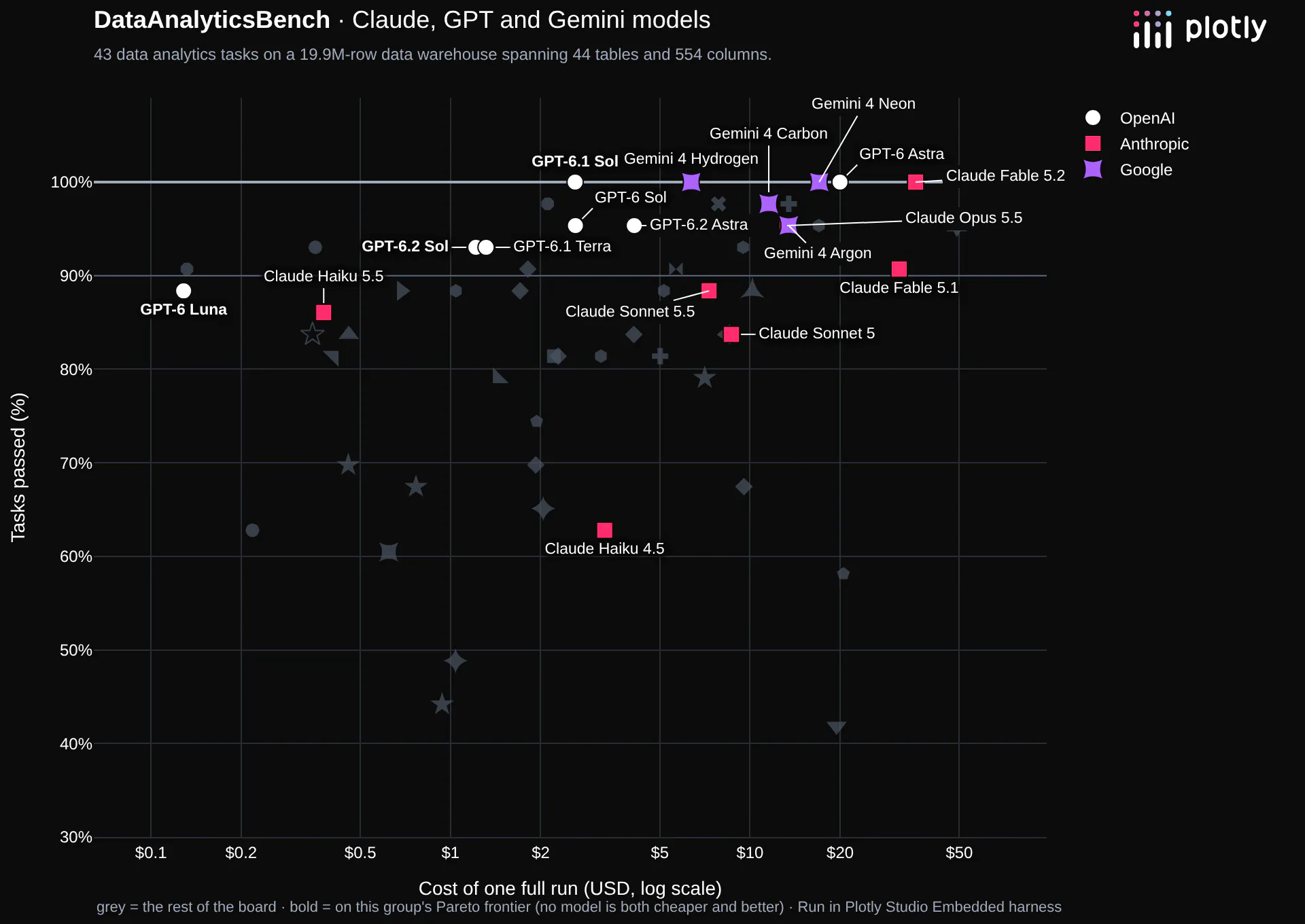
A few things stand out.
- The spread from top to bottom is small. Within each lab, the best model scored 43 and the cheapest scored 37 or 38, a gap of five or six questions. That's 86% to 88% of the top score for a fraction of the price: Claude Haiku 5.5 costs about 1% of Fable 5.2 per run, and GPT-6 Luna under 1% of GPT-6 Astra.
- Tier order doesn't always match our scores. Claude Sonnet 5.5 scored three below Opus 5.5 but only one above Haiku 5.5, at 19 times Haiku's cost. Opus 5.5 beat the older Fable 5.1, 41 to 39, for less than half the price. And Gemini's everyday model tied its middle one and beat its top one.
- OpenAI's newest versions trade a little accuracy for a lot of speed and cost. GPT-6.2 Astra scored 41 against GPT-6 Astra's 43, for about a fifth of the cost and half the time per question. GPT-6.2 Sol scored 40 against GPT-6.1 Sol's 43, for less than half the cost. Both gaps are close to our run-to-run noise, but they point the same way.
- OpenAI holds this group's whole frontier. It runs from GPT-6 Luna, at 38 for $0.13, to GPT-6.2 Sol, at 40 for $1.22, and GPT-6.1 Sol, still the cheapest perfect score at $2.61. Hydrogen is the cheapest perfect score outside OpenAI, at $6.36. The frontier across every model we've tested is in Introducing DataAnalyticsBench.
Coding agents: the cheapest tier falls much further
Our exam measures data analysis. If you're picking a model for a coding agent, the tiers may matter more. The most complete public comparison we found for these exact models is Artificial Analysis's Coding Agent Index (version 2.1), which averages three benchmarks, FrontierCode-AA 2.0, Terminal-Bench 4.1 and SWE-Atlas-QnA-AA, with each model running in its own lab's coding agent: Antigravity CLI for Gemini, Claude Code for Claude and Codex for GPT. The page doesn't show a date; we read it on November 25, 2026. Where it lists a model at several reasoning settings, we show the highest score.
Model
Coding Agent Index (setting)
Agent
Cost per task
Our score
Gemini 4 Neon
59 (xhigh)
Antigravity CLI
$6.86
43 / 43
Gemini 4 Carbon
55 (high)
Antigravity CLI
$9.75
42 / 43
Gemini 4 Hydrogen
52 (xhigh)
Antigravity CLI
$4.45
43 / 43
Gemini 4 Argon
45 (high)
Antigravity CLI
$13.67
41 / 43
Claude Fable 5.2
58 (high)
Claude Code
$7.51
43 / 43
Claude Opus 5.5
58 (max)
Claude Code
$12.61
41 / 43
Claude Sonnet 5.5
56 (max)
Claude Code
$11.40
38 / 43
Claude Fable 5.1
52 (max)
Claude Code
$11.70
39 / 43
Claude Haiku 5.5
30 (max)
Claude Code
$2.25
37 / 43
GPT-6.2 Astra
53 (max)
Codex
$5.12
41 / 43
GPT-6 Astra
53 (max)
Codex
$7.63
43 / 43
GPT-6.1 Sol
52 (max)
Codex
$1.51
43 / 43
GPT-6.2 Sol
50 (xhigh)
Codex
$0.90
40 / 43
GPT-6.1 Terra
49 (max)
Codex
$1.53
40 / 43
GPT-6 Luna
26 (max)
Codex
$0.19
38 / 43
Coding Agent Index scores, settings and cost per task are Artificial Analysis's. Claude Fable 5.2 also scored 58 at xhigh, for $15.47 a task. Our score is from DataAnalyticsBench.
Comparing the top model in each lab with its cheapest:
- Anthropic: Fable 5.2 scored 58 on the coding index and Haiku 5.5 scored 30, about 52% of the top score. On our exam, Haiku scored 37 of Fable's 43, about 86%.
- OpenAI: GPT-6.2 Astra and GPT-6 Astra scored 53 and GPT-6 Luna 26, about 49%. On our exam, Luna scored 38 of 43, about 88%.
- Google: with no budget-tier Gemini 4 model, the widest gap is Neon at 59 against Hydrogen at 52, about 88%. On our exam, Hydrogen tied Neon.
So for coding agents, the cheapest tier falls much further behind than it does on data analysis. Above that tier, the coding gaps are small too: Sonnet 5.5 is two points behind Fable 5.2 and Opus 5.5, GPT-6.1 Sol is one point behind the Astras, and GPT-6.2 Sol is three behind. Sonnet 5.5 actually sits closer to the top on coding than on our exam.
The order also changes for Google. On coding, Neon leads and Carbon is second; on our exam, Hydrogen and Neon tie and Carbon is third. And just as on our exam, GPT-6.2 Sol scored a little below GPT-6.1 Sol, for less money per task.
Some caveats. These are different measures: a share of three coding benchmarks against questions passed out of 43, so compare the gaps, not the raw numbers. Our exam has a ceiling, and with several models at 43 it can't show differences at the very top. Each lab ran in its own agent, at the reasoning settings Artificial Analysis chose, so a model's score reflects the agent as well as the model. And we didn't find these models on other leaderboards we checked: Scale's SWE-Bench Pro leaderboard doesn't list any of them yet.
The Test Harness
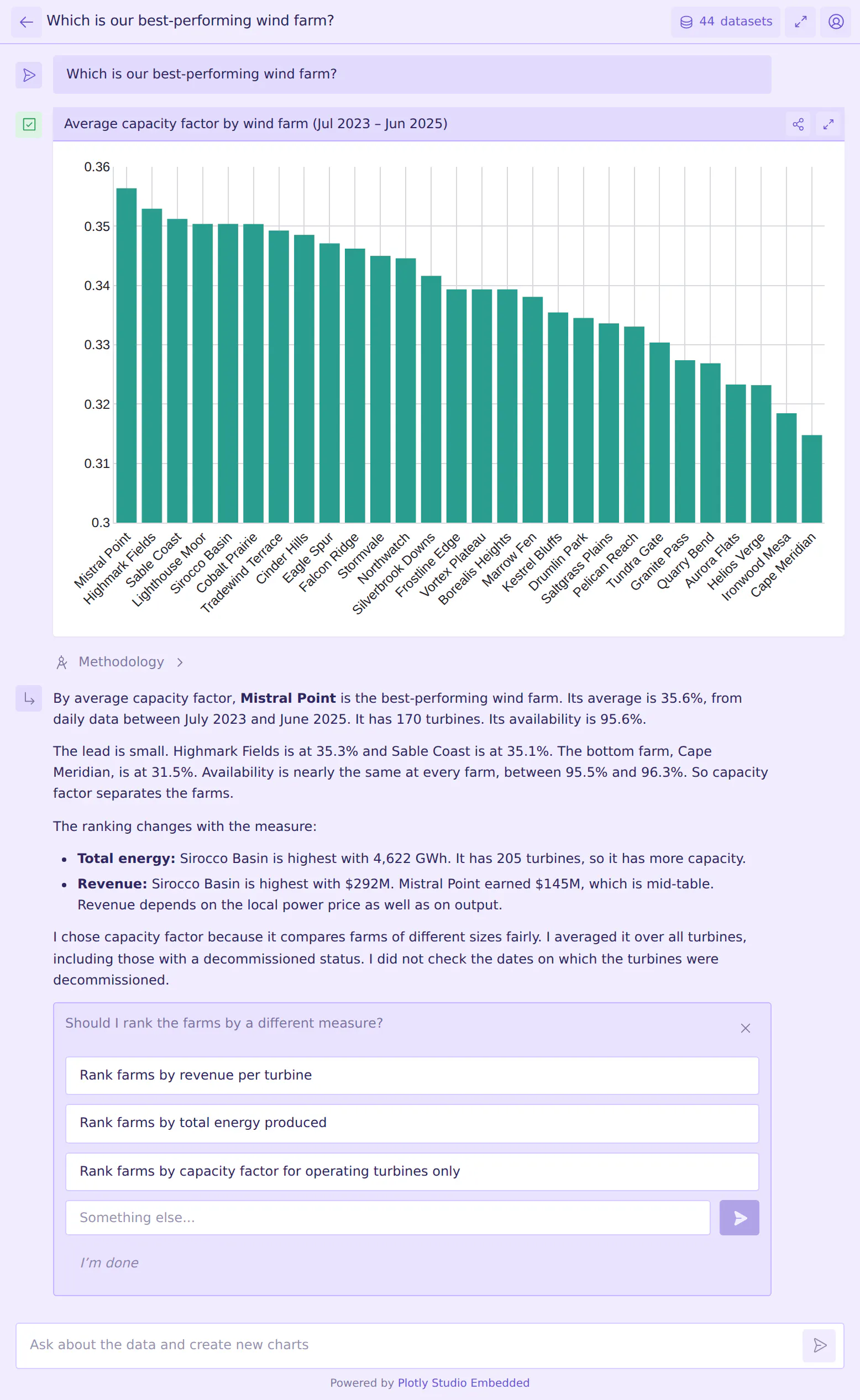
We run every model in Plotly Studio Embedded, a drop-in analytics agent that runs on Dash apps. This harness is tuned to run data analytics queries and make charts with multi-turn tool calling, with less emphasis on writing text. It's meant to put the data front and center.
Frequently asked questions
What's the difference between Gemini 4 Neon, Carbon and Hydrogen?
They're three tiers of Google's Gemini 4 family. Carbon is Google's strongest model, for the hardest long-horizon and security work. Neon "balances depth and efficiency" for complex coding and enterprise workflows. Hydrogen is the fast everyday model. All three have a 1 million-token context window. List prices are $2 / $10 per million input and output tokens for Carbon (rising to $4 / $20 on December 1), $3 / $15 for Neon and $1.50 / $7.50 for Hydrogen.
Which Gemini 4 model is best for data analysis?
On our exam, Gemini 4 Hydrogen. It tied Neon with a perfect 43 of 43, for $6.36 a run against $17.03, and its median question took 32 seconds against 46. Carbon scored 42 and took 93 seconds.
Which Gemini 4 model is best for coding agents?
On Artificial Analysis's Coding Agent Index, Gemini 4 Neon, at 59, ahead of Carbon at 55 and Hydrogen at 52. We didn't test coding ourselves.
Is Gemini 4 Carbon worth it?
Not for data analysis, on our results. Carbon was the slowest of the three and the only one to miss a question, and its price doubles on December 1. Google built it for long-horizon coding and cybersecurity work, which our exam doesn't test.
How do Gemini 4 models map to Claude and GPT?
Roughly: Carbon sits with Claude Fable 5.2 and GPT-6.2 Astra at the top, Neon with Claude Opus 5.5 and GPT-6.2 Sol in the middle, and Hydrogen with Claude Sonnet 5.5 and GPT-6.1 Terra as the fast everyday models. Google has no Gemini 4 model at the price of Claude Haiku 5.5 or GPT-6 Luna.
Are cheap models like Claude Haiku 5.5 and GPT-6 Luna good enough?
For data analysis, often. They scored 37 and 38 of 43, for $0.38 and $0.13 a run. For coding agents, less so: on Artificial Analysis's Coding Agent Index they scored about half as much as their labs' top models.
Are Gemini 4 Neon, Carbon and Hydrogen open source?
No. Google hasn't released the weights. You can use them through the Gemini API in Google AI Studio and providers such as OpenRouter.
About the benchmark
We run new models through the same exam as they're released, and we'll keep sharing what we find. We ran every model in this post through OpenRouter, with the same harness and grading.
To see every model on one chart and in a full results table, along with cost, speed and how the exam works, see Introducing DataAnalyticsBench.
The exam is private and we're sharing it with researchers. We're keeping it private so that the answer key doesn't make its way into the training set. For the same reason, the data is fabricated: the warehouse is a synthetic wind-energy fleet, built to look like a real operator's data, so its answers don't exist anywhere else.
If you'd like access, reach out to Chris Parmer at Plotly.