Gemini 4 Neon Benchmark Results for Data Analysis
Nov 18, 2026: Google's newest Gemini 4 model, tested on real-world data analysis.
At Plotly, we keep a close eye on model releases. Our agentic analytics products, Plotly Studio Desktop and Plotly Studio Embedded, and our open source libraries Plotly and Dash work with any model, and our customers look to us for recommendations.
On November 18, Google released Gemini 4 Neon as generally available, six days after Gemini 4 Hydrogen. Google says Neon brings "frontier-level intelligence with fast end-to-end task completion" for complex software engineering, knowledge work and science workflows. It has a unified context window of 1 million tokens, can write up to 1 million tokens of output, and supports four thinking levels: low, medium, high (the default) and xhigh. It's priced at $3 per million input tokens and $15 per million output tokens, twice Hydrogen's price. Google hasn't said how it was trained or how many parameters it has, and the weights aren't public.
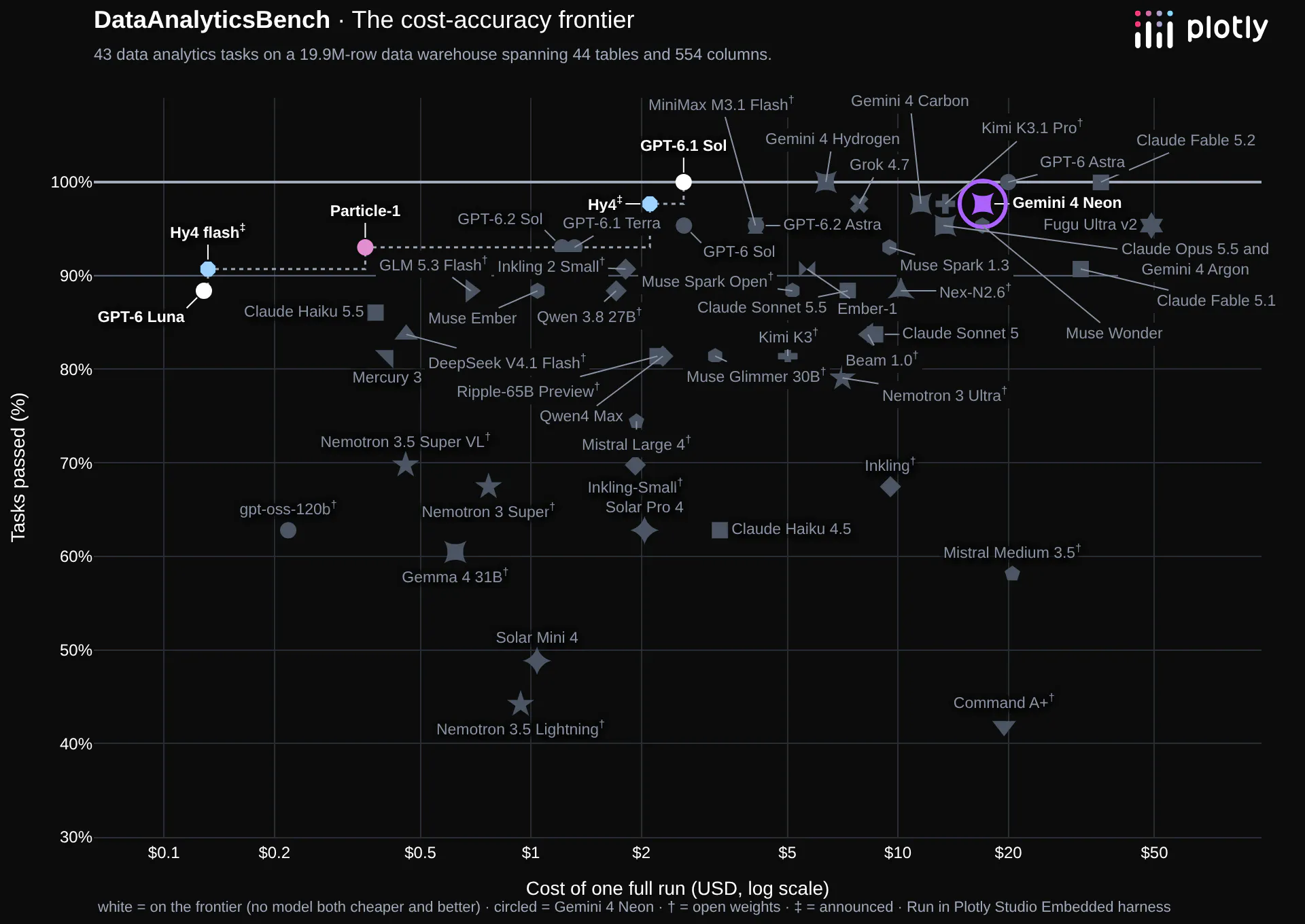
We ran it through our data analytics exam. Gemini 4 Neon passed 42 of 43 questions for $17.03, the same score as Gemini 4 Carbon and one more than Gemini 4 Argon. It found all five hidden patterns. But Gemini 4 Hydrogen scored a perfect 43 for $6.36, and was faster too, so on the chart below, Neon sits well off the frontier.
Gemini 4 Neon vs. Gemini 4 Hydrogen, Gemini 4 Carbon, Gemini 4 Argon and GPT-6.1 Sol
Gemini 4 Neon
Gemini 4 Hydrogen
Gemini 4 Carbon
Gemini 4 Argon
GPT-6.1 Sol
Score
42 / 43
43 / 43
42 / 43
41 / 43
43 / 43
Analytics questions
20 / 20
20 / 20
20 / 20
19 / 20
20 / 20
Ambiguous questions
5 / 5
5 / 5
5 / 5
5 / 5
5 / 5
Impossible requests
5 / 5
5 / 5
5 / 5
5 / 5
5 / 5
Data quality
2 / 3
3 / 3
2 / 3
2 / 3
3 / 3
Statistics traps
5 / 5
5 / 5
5 / 5
5 / 5
5 / 5
Hidden needles
5 / 5
5 / 5
5 / 5
5 / 5
5 / 5
Open weights
No
No
No
No
No
Cost of one full run
$17.03
$6.36
$11.55
$13.47
$2.61
Per person per year*
$990
$370
$671
$783
$152
Median time per question
46 seconds
32 seconds
93 seconds
23 seconds
18 seconds
*1,000 people each asking 10 questions a day, 250 working days a year, at OpenRouter's prices when each model ran.
One run per model is a single sample. In our repeat runs of other models, scores moved by up to three points between runs, so treat a one- or two-point gap as close to a tie.
What it got right
The hidden-pattern questions are the hardest part of our exam. Each one points toward something unusual in the data without naming it, and the model has to go looking. Neon found all five. Only eight other models have: GPT-6.1 Sol, GPT-6 Astra, Claude Fable 5.2, MiniMax M3.1 Flash, Kimi K3.1 Pro, and all three of Neon's Gemini 4 siblings. Every Gemini 4 model we've tested has found all five.
It was perfect on the analytics questions and caught all five statistics traps, the questions where the obvious calculation gives a misleading answer. Eighteen of the 54 models on the chart above have done that. And it asked about or stated its assumptions on every ambiguous question and turned down every impossible request.
What it got wrong
Neon's one miss was on data quality. Asked to audit a table that we had deliberately left clean, it still reported several "data-quality issues", treating harmless facts about the dataset as defects. An analyst who acts on that report would spend time fixing problems that aren't there. Carbon and Argon also each lost a point on data quality; Hydrogen didn't.
Cost and speed
Neon's run cost $17.03, about 50% more than Carbon's $11.55 and nearly three times Hydrogen's $6.36. At our rollout numbers, that comes to about $990 per person per year. Of the nine models on the chart that scored 42 or 43, only GPT-6 Astra and Claude Fable 5.2 cost more.
It didn't cost more because it did more work. Neon used fewer tokens than Carbon, 20.1 million against 29.5 million, and fewer model calls, 369 against 444. It costs more because each token costs more: Neon's list price is twice Hydrogen's. Of the $17.03, roughly $9.50 went on uncached input tokens, $2.50 on cached input, at $0.15 per million, and $5.00 on output.
Its median question took 46 seconds, about twice as fast as Carbon's 93, but slower than Hydrogen's 32 and Argon's 23. Its mean was 81 seconds, so a few long questions pulled the average up. GPT-6.1 Sol is still the fastest model with a perfect score, at 18 seconds. On our chart, 37 of the 54 models have a faster median.
Our harness now records time to first token on every request. In Neon's run, the median time to first token was 2.9 seconds, the first visible answer text arrived at a median of 4.1 seconds, and it generated about 159 output tokens per second. We don't have the same per-request numbers for the Carbon and Hydrogen runs. In a separate direct test on November 18, with a prompt of about 130,000 tokens, Carbon took about 11 seconds to its first token and Hydrogen about 2.5 seconds. For how we measure speed across models, see Fastest vs. Slowest AI Models.
If you're building on Google's models, Hydrogen is still the Gemini model we'd pick for data analysis: it scored one point higher than Neon, for about 40% of the cost, and answered faster. If you're choosing across providers, GPT-6.1 Sol gets a perfect score for $2.61.
Does Neon write clearly?
Google's model card says "Neon writes clearly, with well-structured responses and a natural, direct tone". Our exam grades answers, not prose, so we put Neon's first replies next to six other models on the same questions. The names and numbers in these images are swapped for made-up ones so the exam stays private.
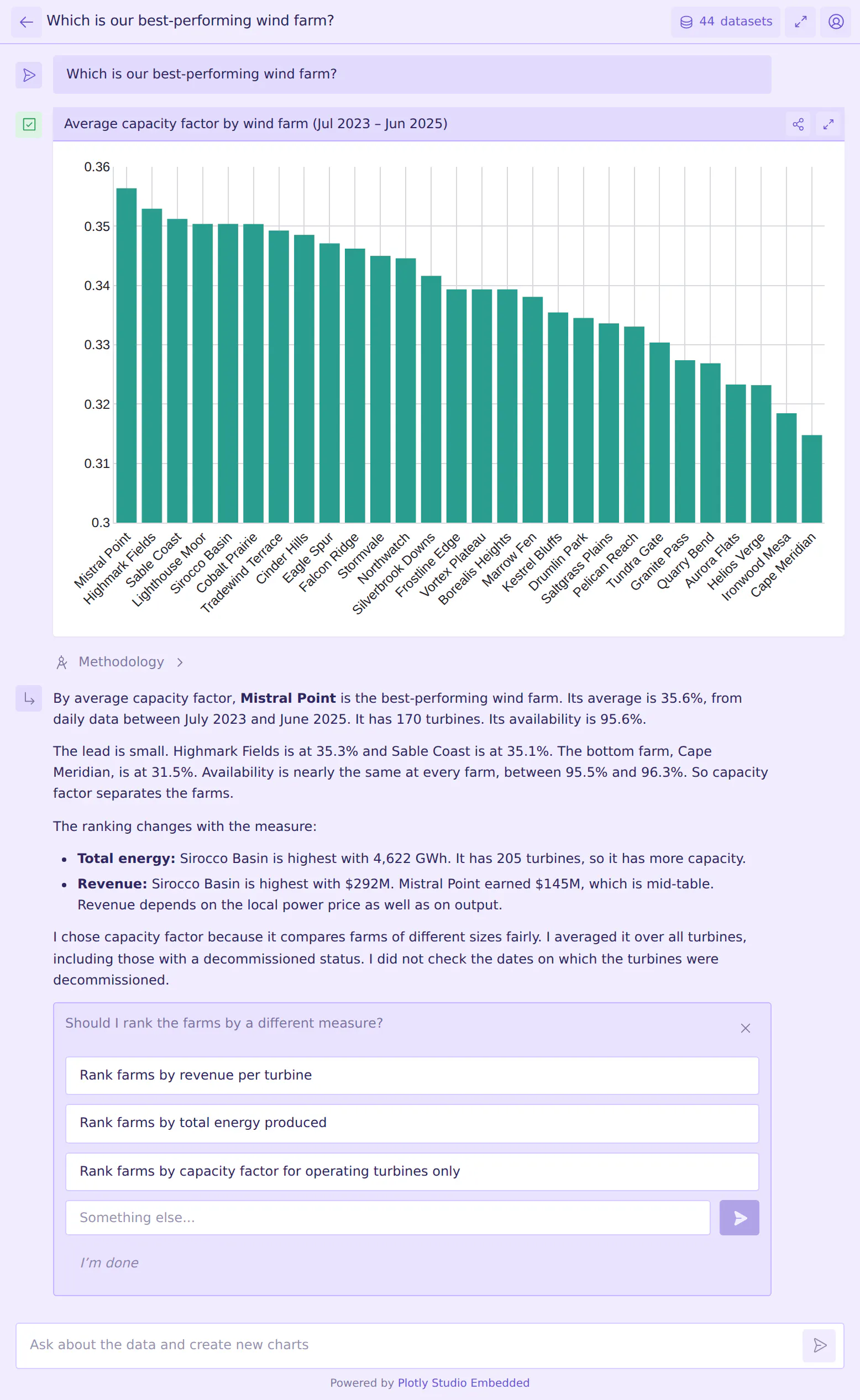
First, an ambiguous request, where there's more than one fair way to answer:
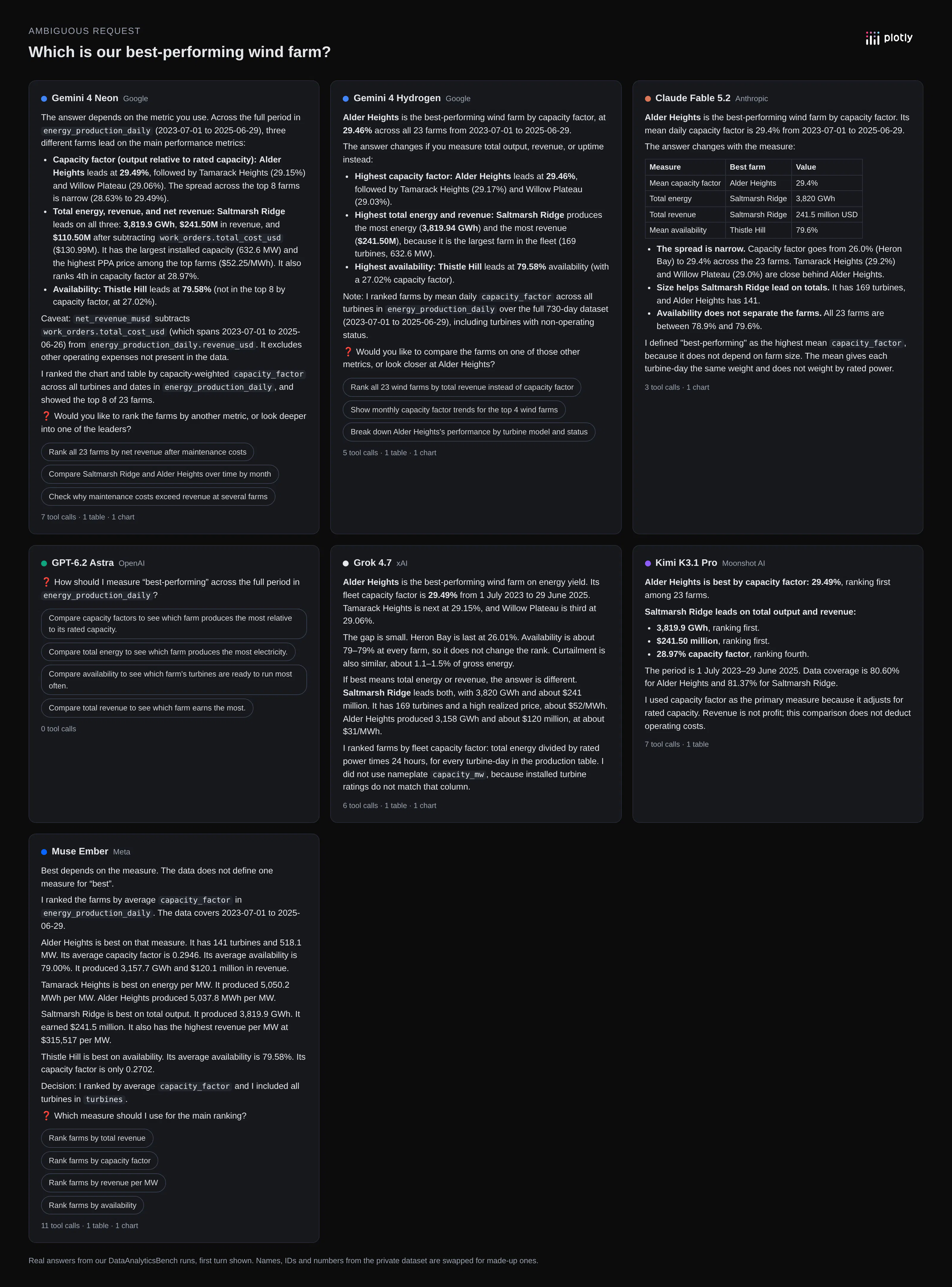
Neon leads with "The answer depends on the metric you use", then lays out each measure with its leader, adds a caveat about what the revenue figure leaves out, explains how it ranked the chart, and ends with a question and three follow-up suggestions. Hydrogen and Claude Fable 5.2 name a winner in the first sentence and then say how the answer changes. GPT-6.2 Astra just asks which measure you mean. Muse Ember, another model often praised for its tone, also opens with "Best depends on the measure" and writes even more.
Next, a plain analytics question with one right answer:
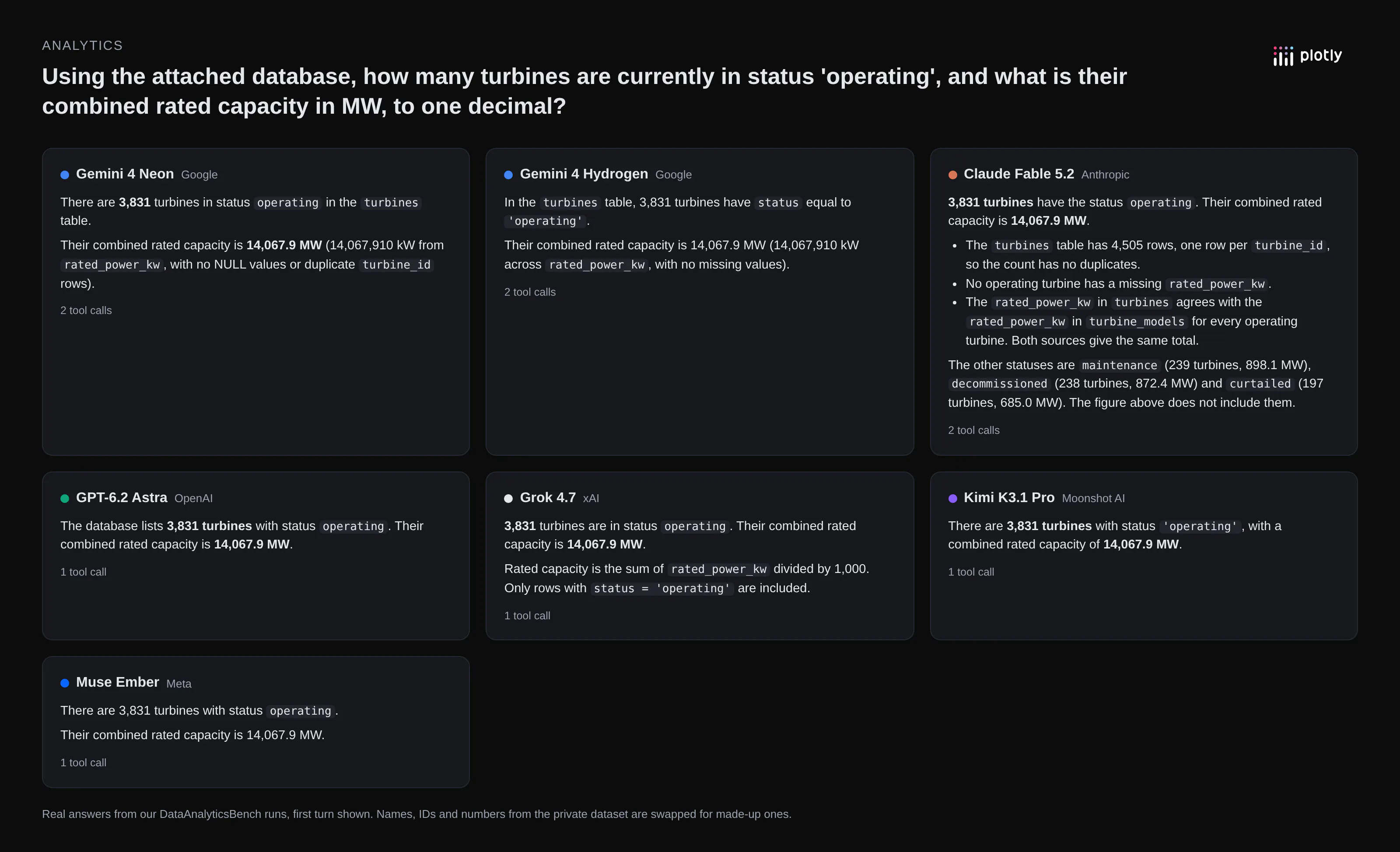
Every model gets there. Neon answers in two sentences and adds that it checked for missing values and duplicates. GPT-6.2 Astra and Kimi K3.1 Pro answer in one.
Finally, two impossible requests, where the data can't answer the question:
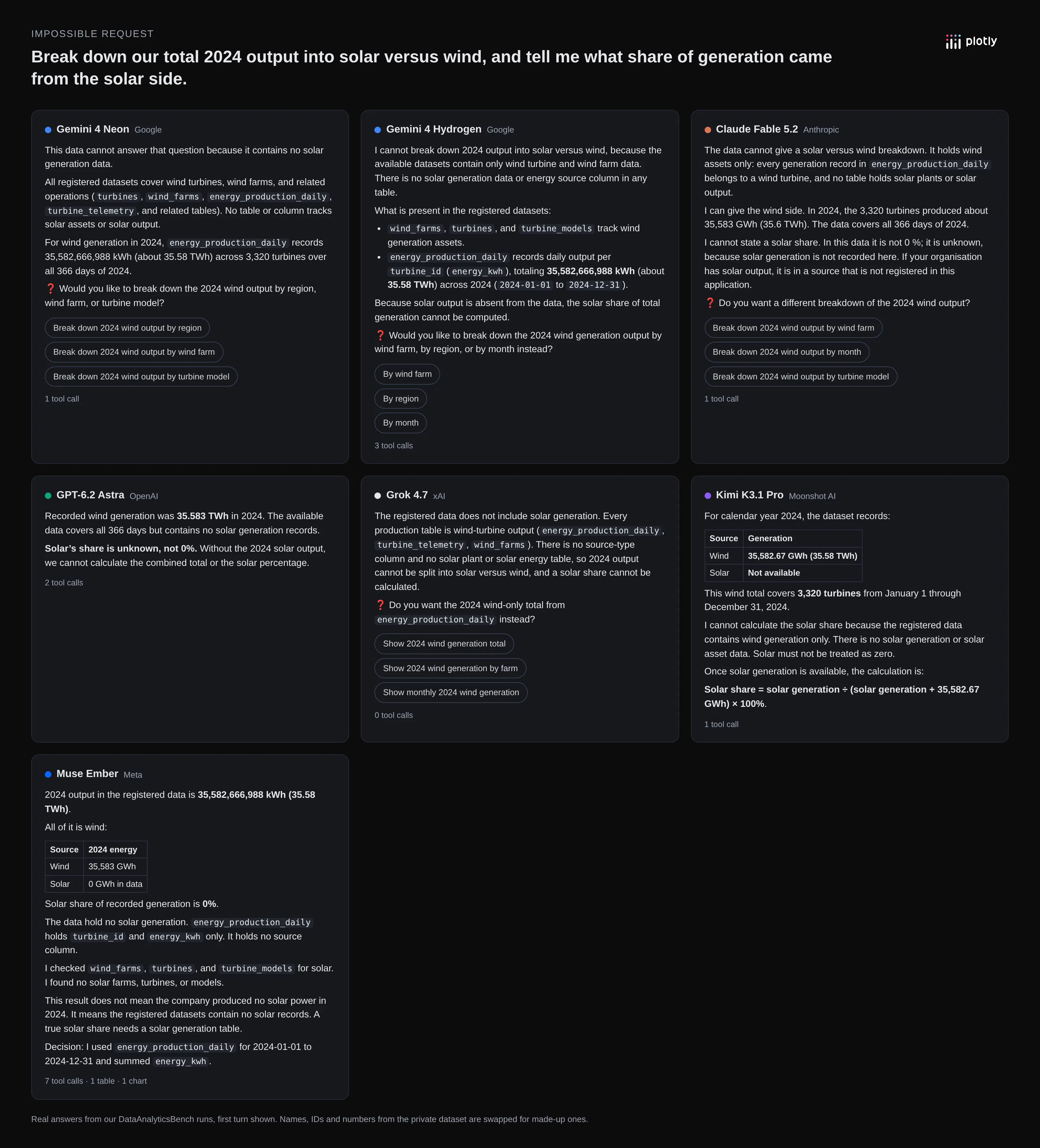
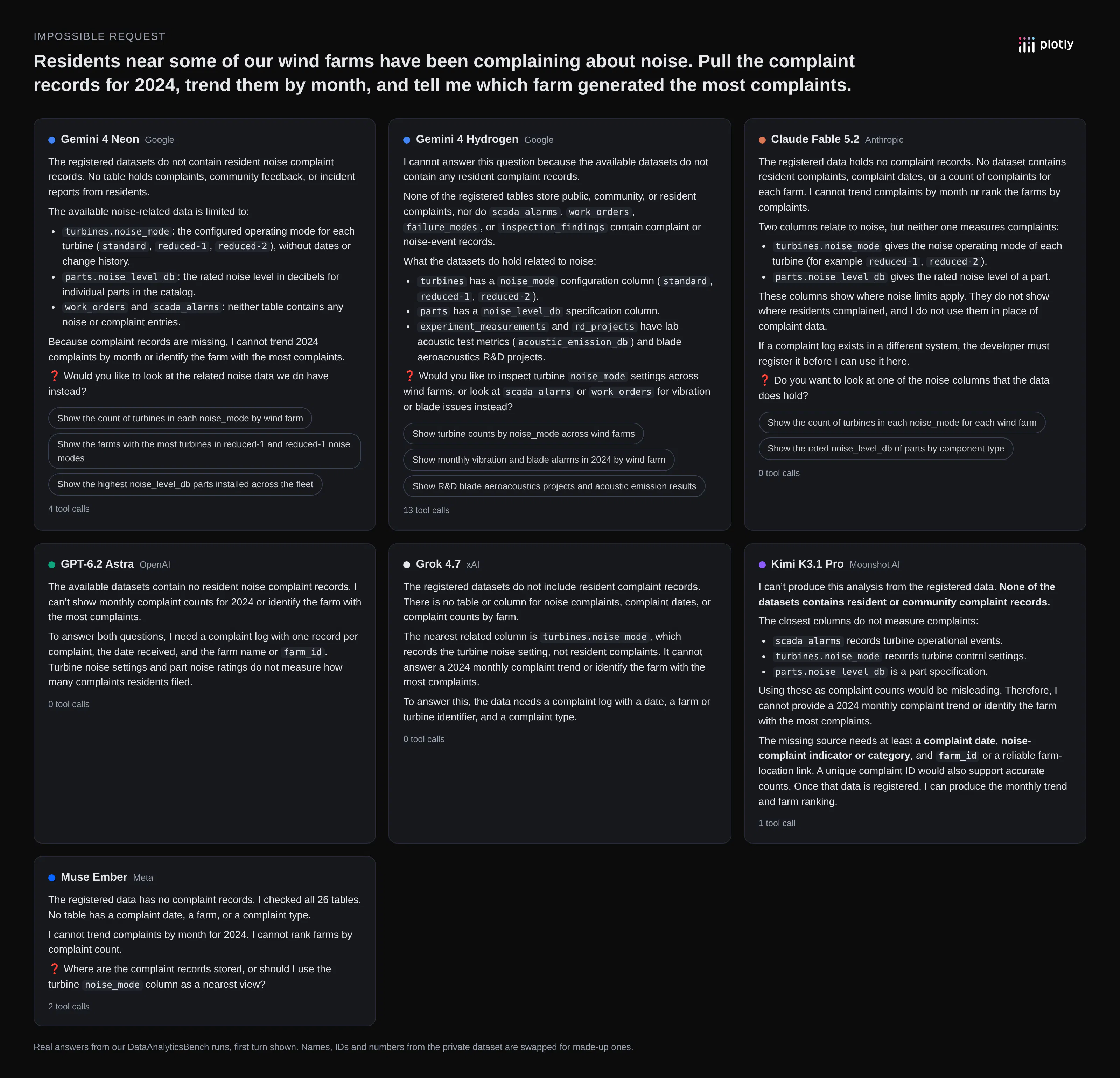
Here Neon is at its most direct. Its first sentence says the data can't answer the question. Then it lists what the data does hold, and offers follow-ups it can actually do. GPT-6.2 Astra is again the most terse, in a short paragraph or two with no follow-up suggestions.
So Google's claim mostly holds. Neon's answers are clear and well structured, with bold leaders, short bullets and the caveats you'd want. But "direct" describes its sentences more than its length: it tends to be thorough rather than terse, and on an open question it starts with "it depends" rather than an answer. If you want the shortest reply, GPT-6.2 Astra is the most terse of the seven.
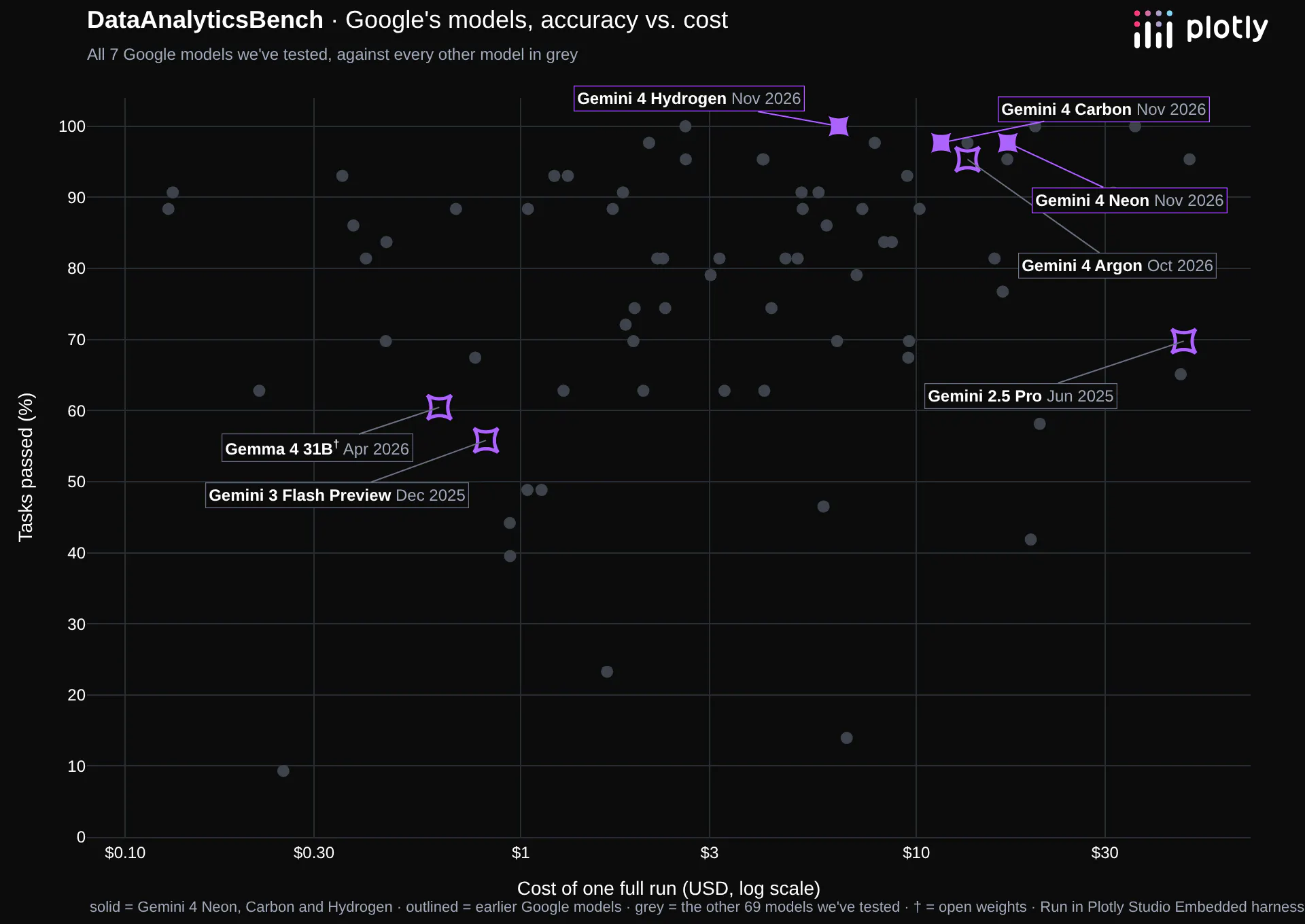
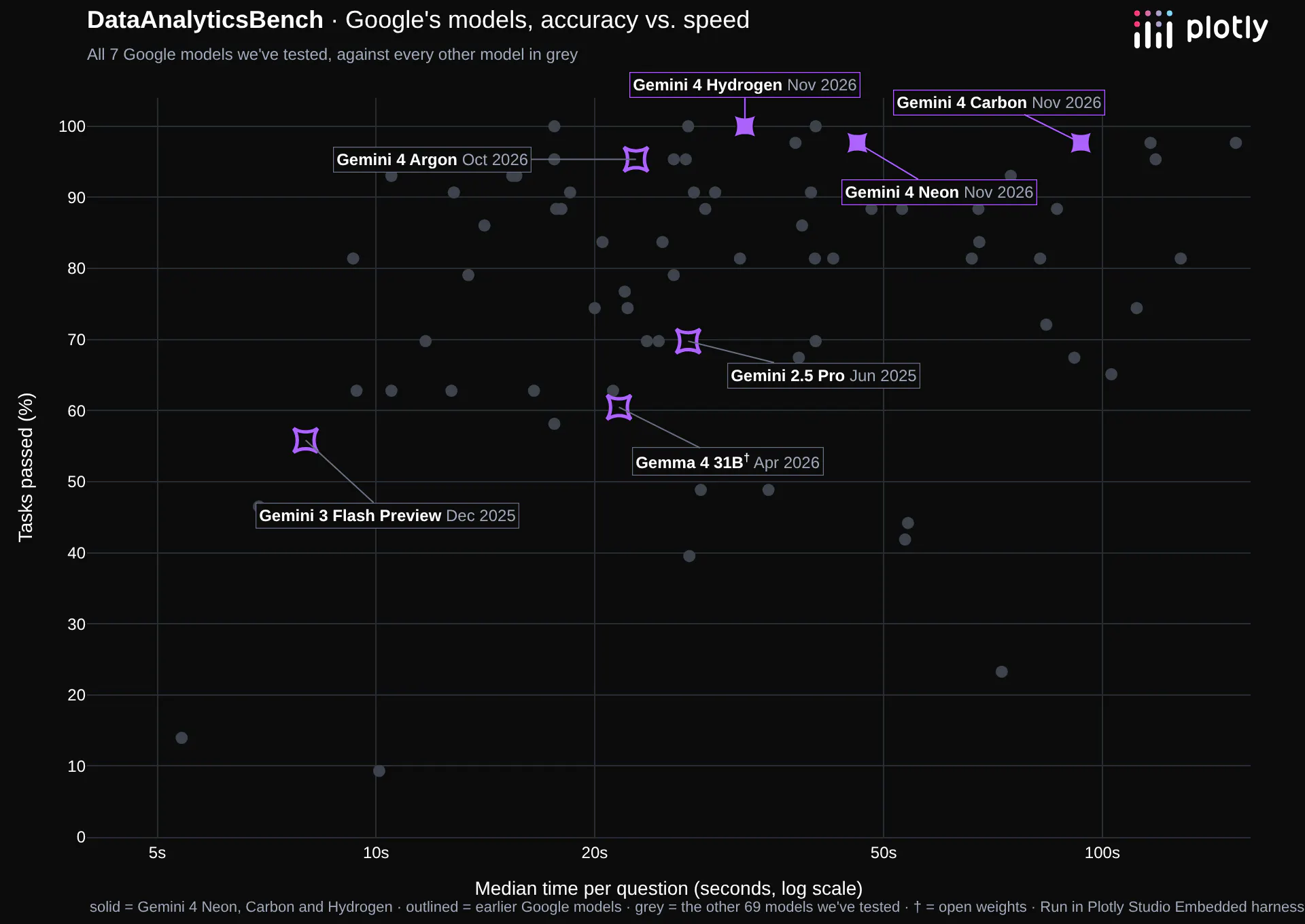
Google's models over time
Here are all seven Google models we've tested, from Gemini 2.5 Pro in June 2025 to Neon today, with every other model in grey. November's three releases, Neon, Carbon and Hydrogen, are drawn solid, and earlier Google models are outlined. Gemini 2.5 Pro scored 30 of 43 for $47.43 a run; all three November models score 42 or 43 for less than $18. On time they spread out: Hydrogen's median question takes 32 seconds, Neon's 46 and Carbon's 93.
The Test Harness
We run every model in Plotly Studio Embedded, a drop-in analytics agent that runs on Dash apps. This harness is tuned to run data analytics queries and make charts with multi-turn tool calling, with less emphasis on writing text. It's meant to put the data front and center.
Frequently asked questions
How good is Gemini 4 Neon at data analysis?
On PlotlyDataAnalyticsBench it passed 42 of 43 questions. It was perfect on analytics, ambiguous questions, impossible requests, statistics traps and hidden patterns, and missed one data quality question.
Is Gemini 4 Neon better than Gemini 4 Hydrogen?
Not on our exam. Hydrogen scored 43 against Neon's 42, cost $6.36 per run against $17.03, and its median question took 32 seconds against 46.
Is Gemini 4 Neon better than Gemini 4 Carbon?
It tied Carbon at 42 and scored one more than Argon. Neon was about twice as fast as Carbon, at 46 seconds against 93, but cost about 50% more per run.
How much does Gemini 4 Neon cost?
Google prices it at $3 per million input tokens and $15 per million output tokens, with a 1 million-token context window. Our whole exam cost $17.03. GPT-6.1 Sol scored 43 for $2.61.
How fast is Gemini 4 Neon?
Its median question took 46 seconds, against 18 for GPT-6.1 Sol, 23 for Gemini 4 Argon, 32 for Gemini 4 Hydrogen and 93 for Gemini 4 Carbon. Its median time to first token was 2.9 seconds, and it generated about 159 output tokens per second.
Is Gemini 4 Neon open source?
No. Google hasn't released the weights. You can use it through the Gemini API in Google AI Studio and providers such as OpenRouter.
About the benchmark
We run new models through the same exam as they're released, and we'll keep sharing what we find. We ran Gemini 4 Neon through OpenRouter on its launch day, with the same harness and grading as every other model.
To see every model on one chart and in a full results table, along with cost, speed and how the exam works, see Introducing DataAnalyticsBench.
The exam is private and we're sharing it with researchers. We're keeping it private so that the answer key doesn't make its way into the training set. For the same reason, the data is fabricated: the warehouse is a synthetic wind-energy fleet, built to look like a real operator's data, so its answers don't exist anywhere else.
If you'd like access, reach out to Chris Parmer at Plotly.