Fastest vs. Slowest AI Models: 75 Compared (2026)
Nov 18, 2026: what makes an AI model fast or slow at data analysis, measured across 75 models.
Why are some models slower at data analysis than others?
Our customers are rolling out agentic analytics to their workforce with Plotly Studio, and we've been advising them on which model to use.
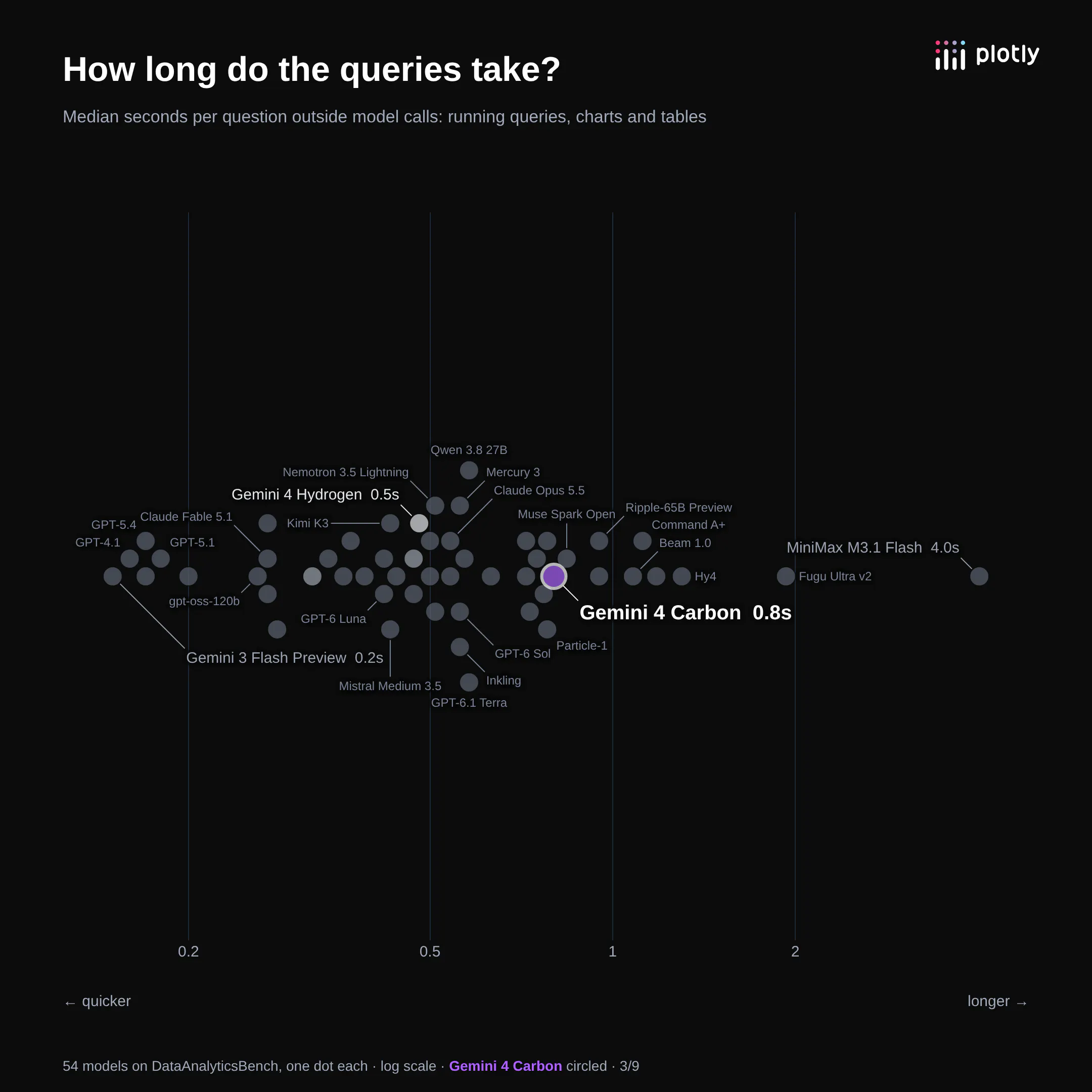
On our data analysis exam, the median time per question ranges from about 5 seconds to over 3 minutes. Speed isn't just about tokens per second. There are actually 6 things that impact speed: the number of tool calls, wordiness, the speed of the tool calls, time to first token, tokens per second, and parallelism.
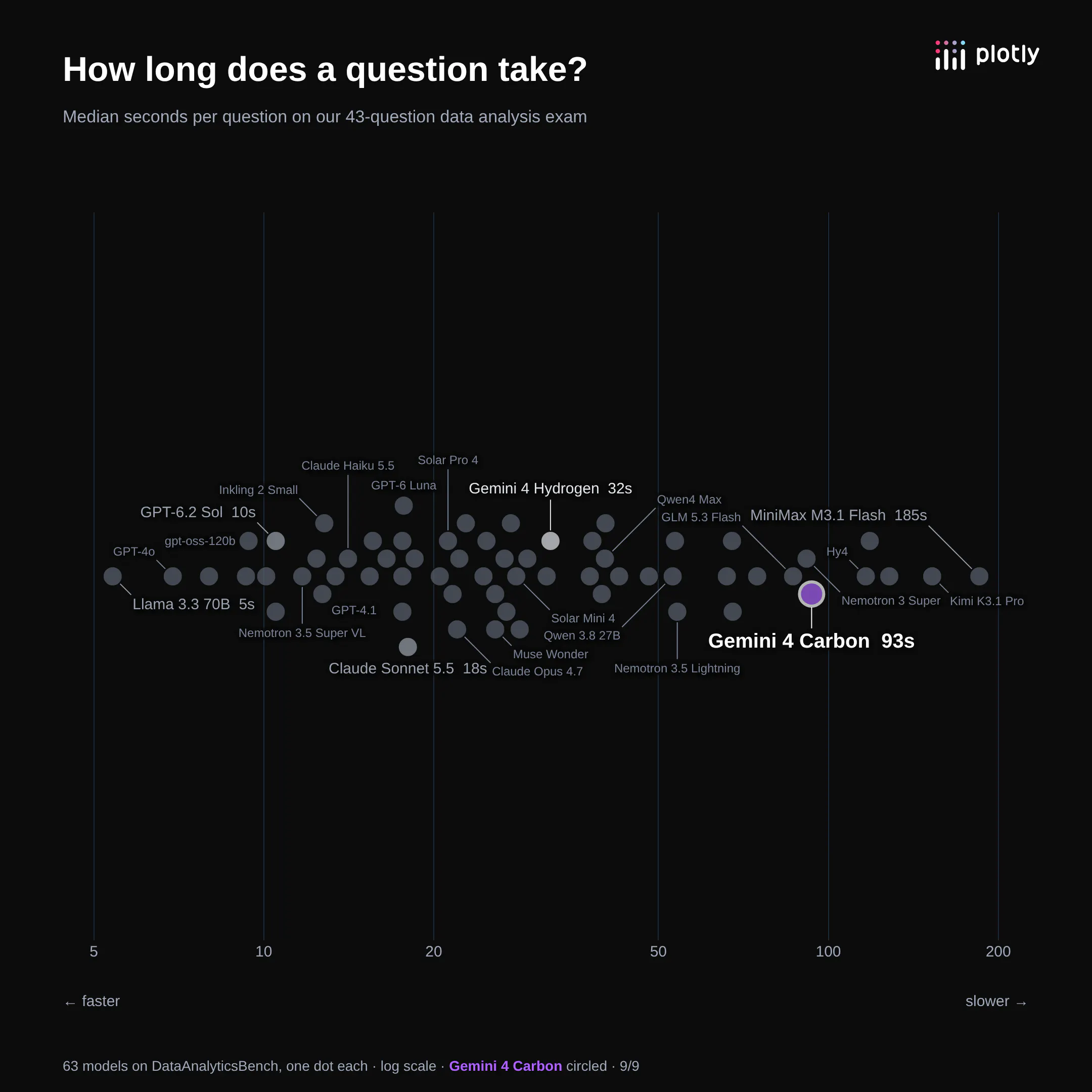
1. Number of tool calls
Most models make 3 to 23 tool calls per question, with a median of 8. The most thorough make 40 or more on our "find the hidden pattern" questions.
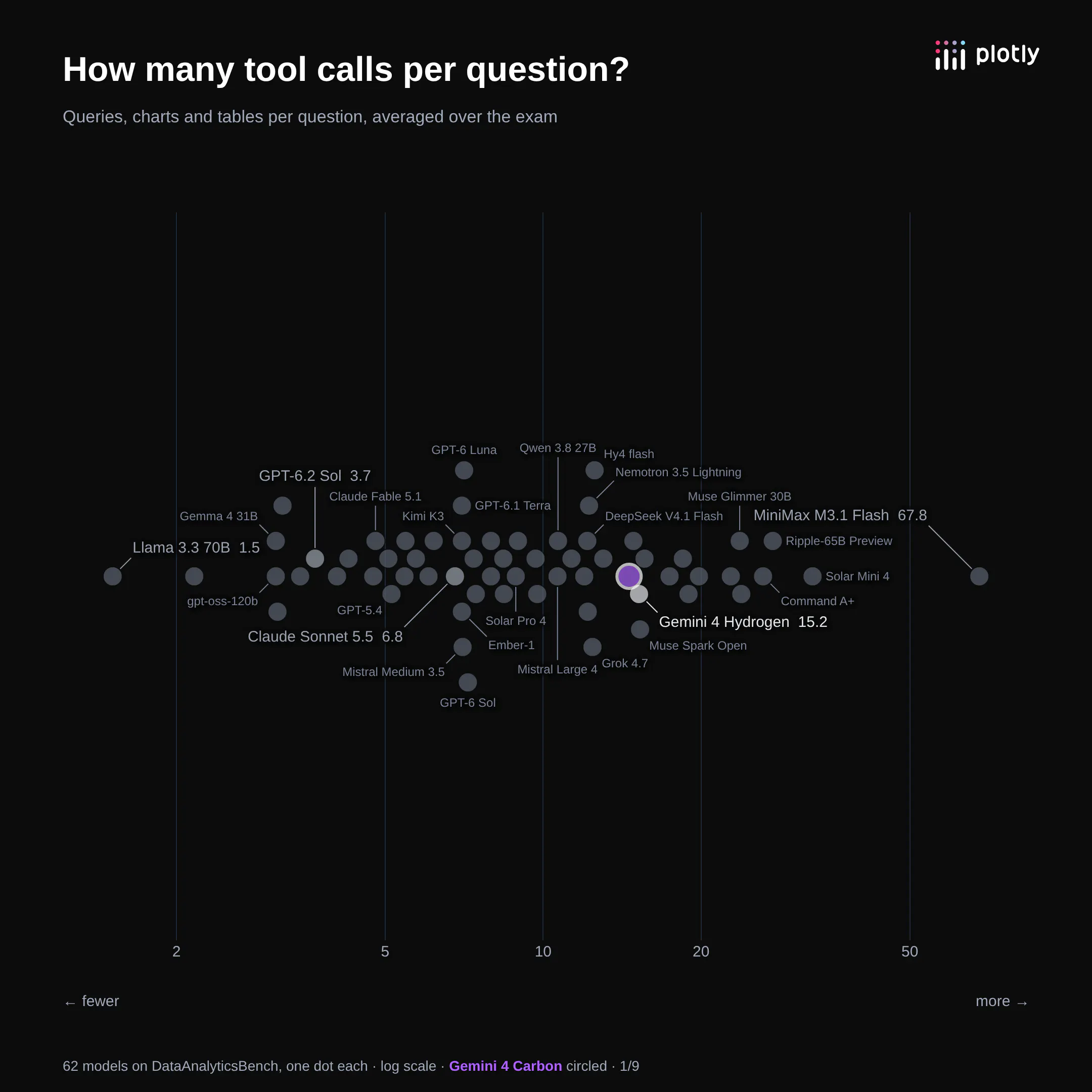
2. Wordiness
Models range from about 150 to 2,200 output tokens per call, thinking included. Claude Fable 5.2 and Kimi K3.1 Pro are slow partly because they write a lot.
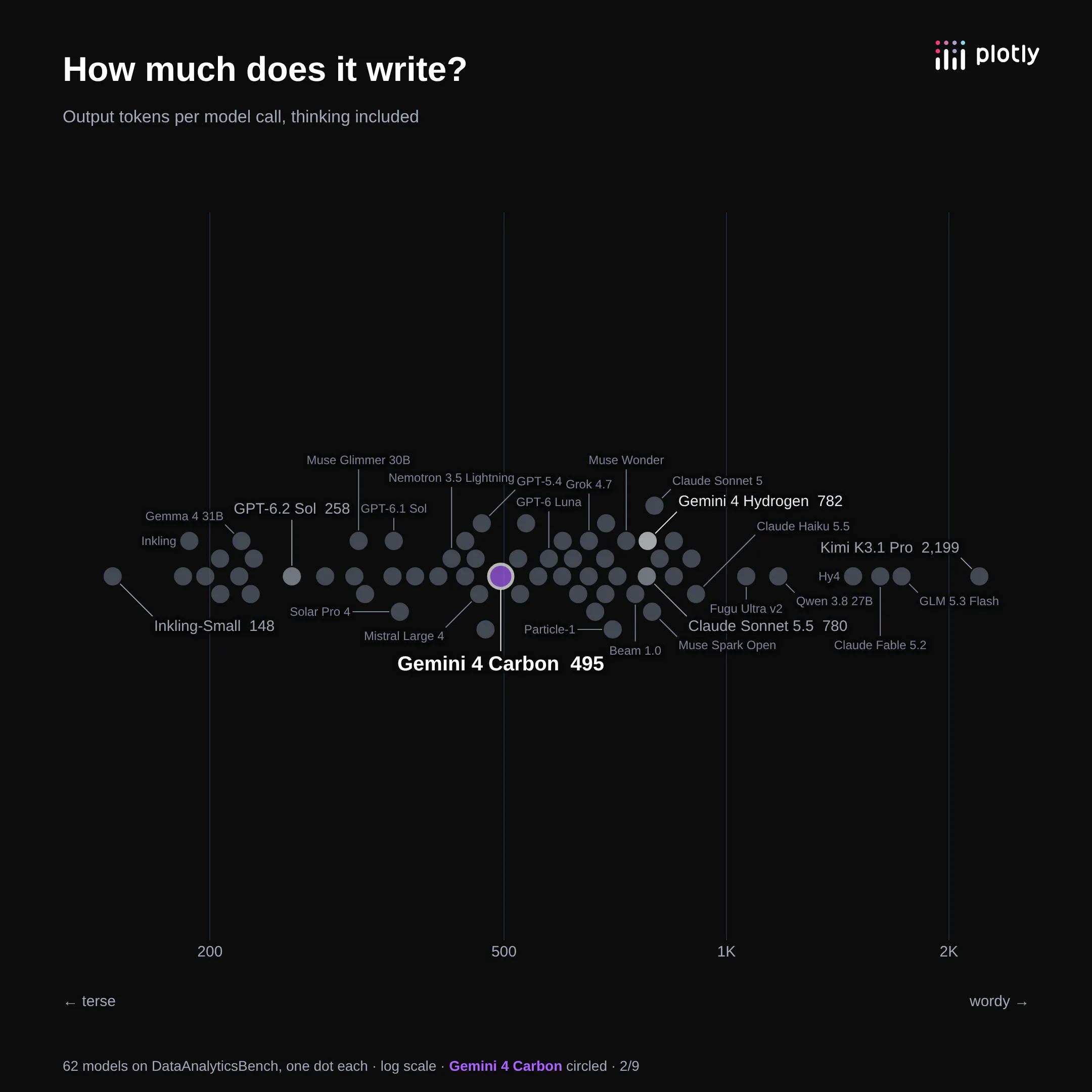
3. Speed of tool calls
Do the queries take a long time? Usually not. The median model spends about half a second per question running its queries and making charts and tables. In our harness, queries run in DuckDB against the app's own data, so even a clumsy query finishes quickly.
4. Time to first token
Gemini 4 Carbon waits about 11 seconds before it starts responding on a long prompt; most models start in 1 to 5 seconds. This matters more than you'd think because the wait happens on every step of the agent loop, not once per question. (Why Gemini 4 Carbon is slow)
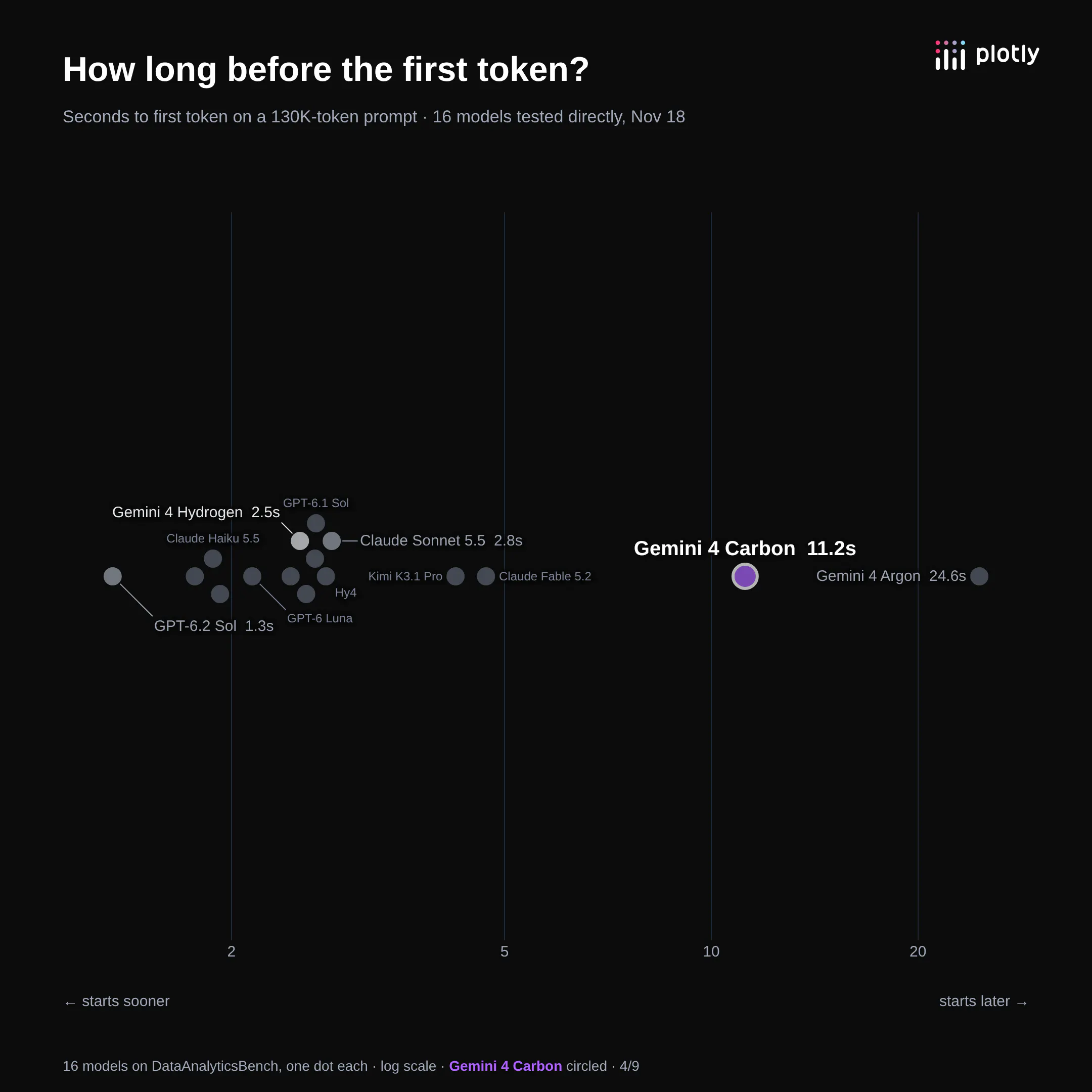
5. Tokens per second
Once a model starts, output speed varies from about 25 to about 400 tokens per second. This chart divides output tokens by total model time, so slow starters score lower here too.
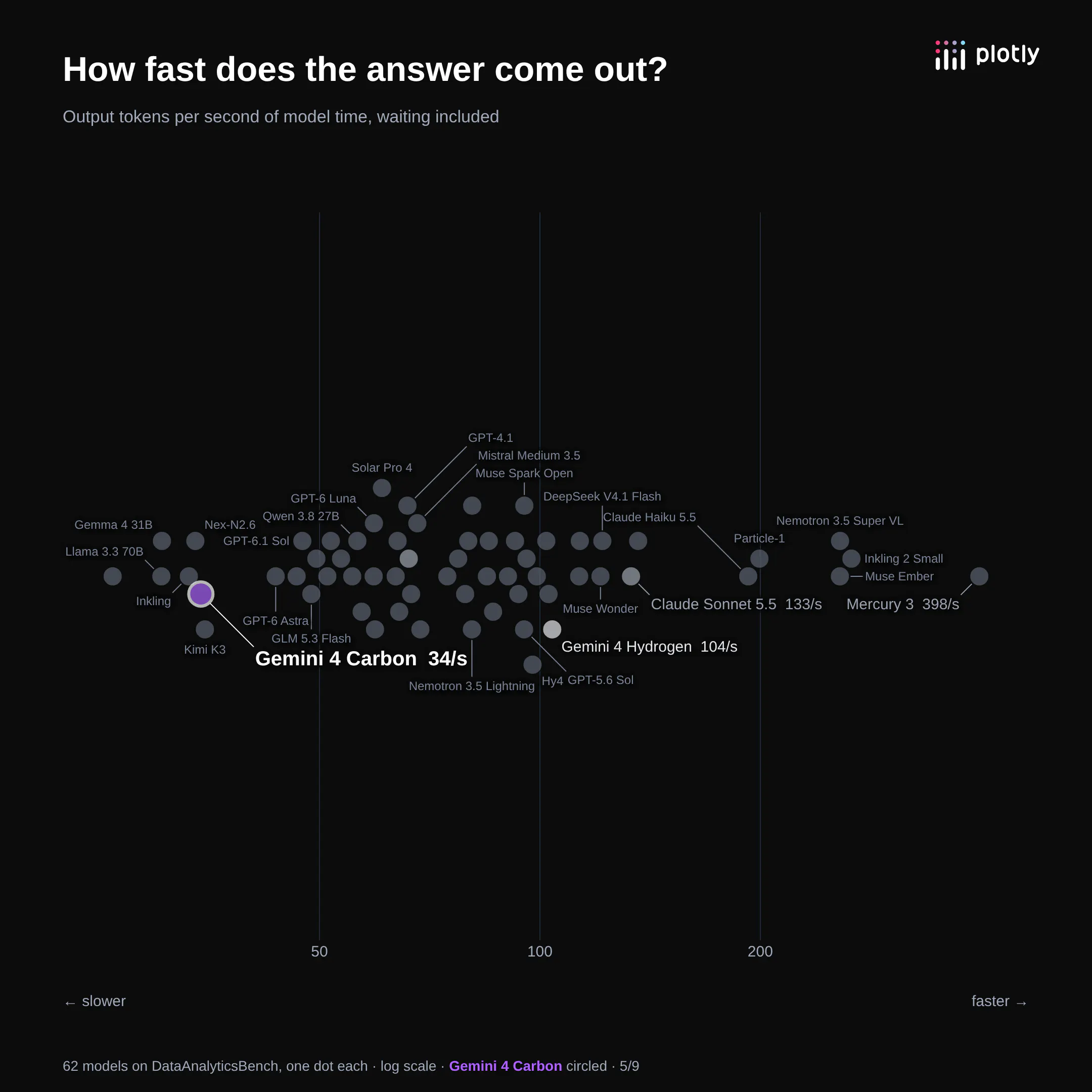
6. Parallelism
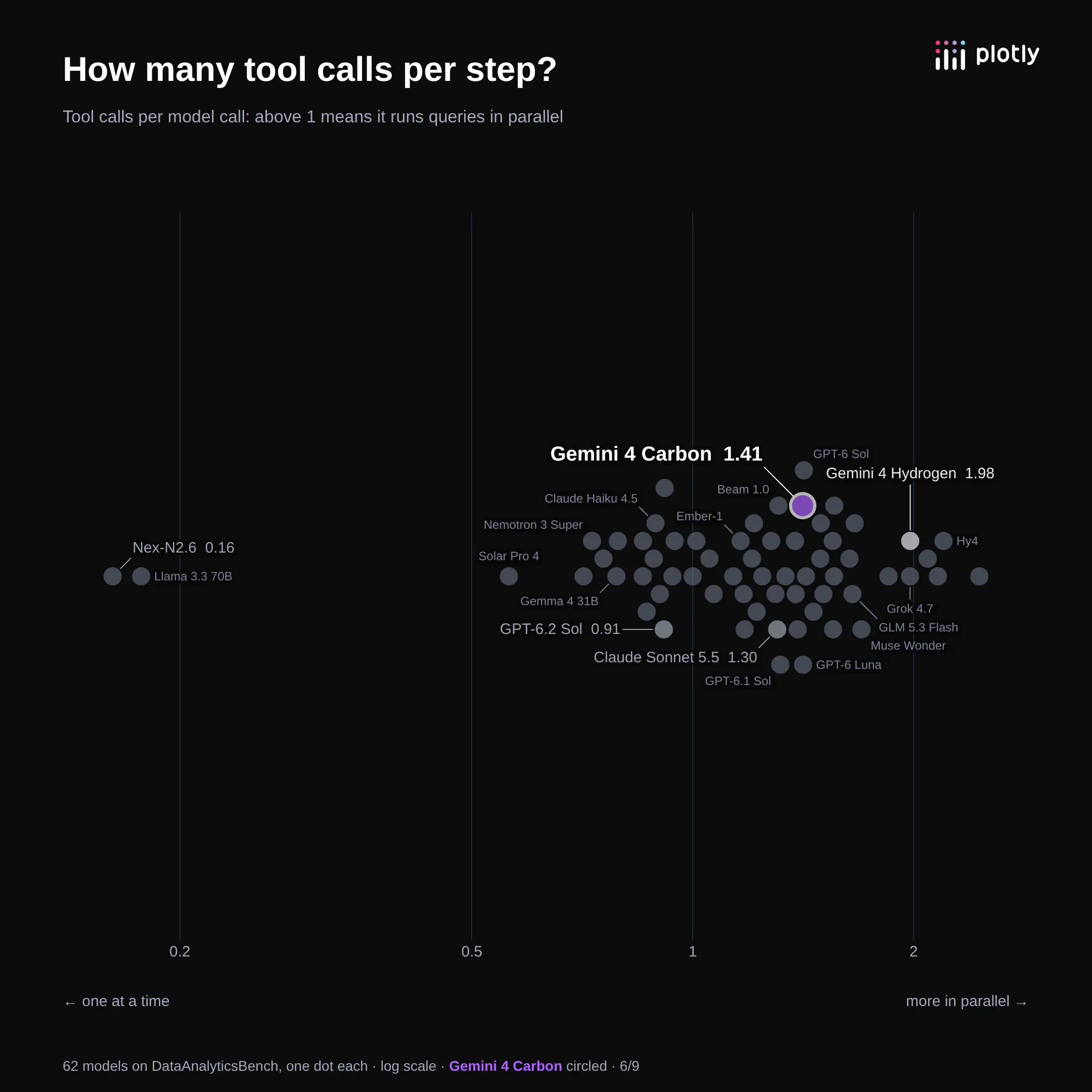
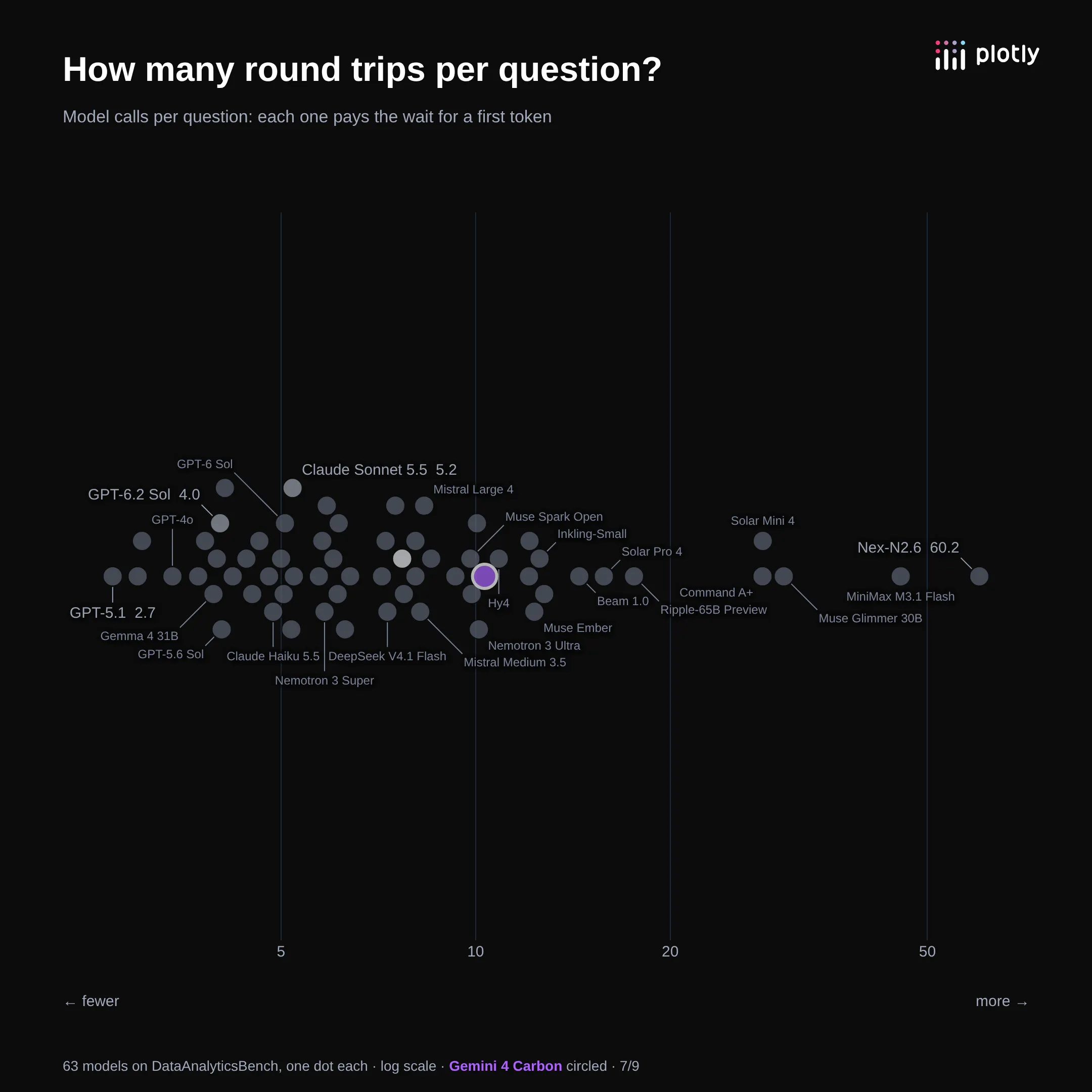
Some models fire two or more queries at once, others go one at a time. Gemini 4 Hydrogen and Gemini 4 Carbon run about the same number of queries, about 15 per question, but Hydrogen batches about 2 per step and Carbon about 1.4. So Carbon makes a third more round trips, and each one pays its slow start.
Slow isn't always bad
Some questions ask the model to look for issues in the dataset. Models that are more thorough, making more tool calls, find more issues.
That's a good thing, but it can make time per task feel slow, when in practice we'd just call it thorough.
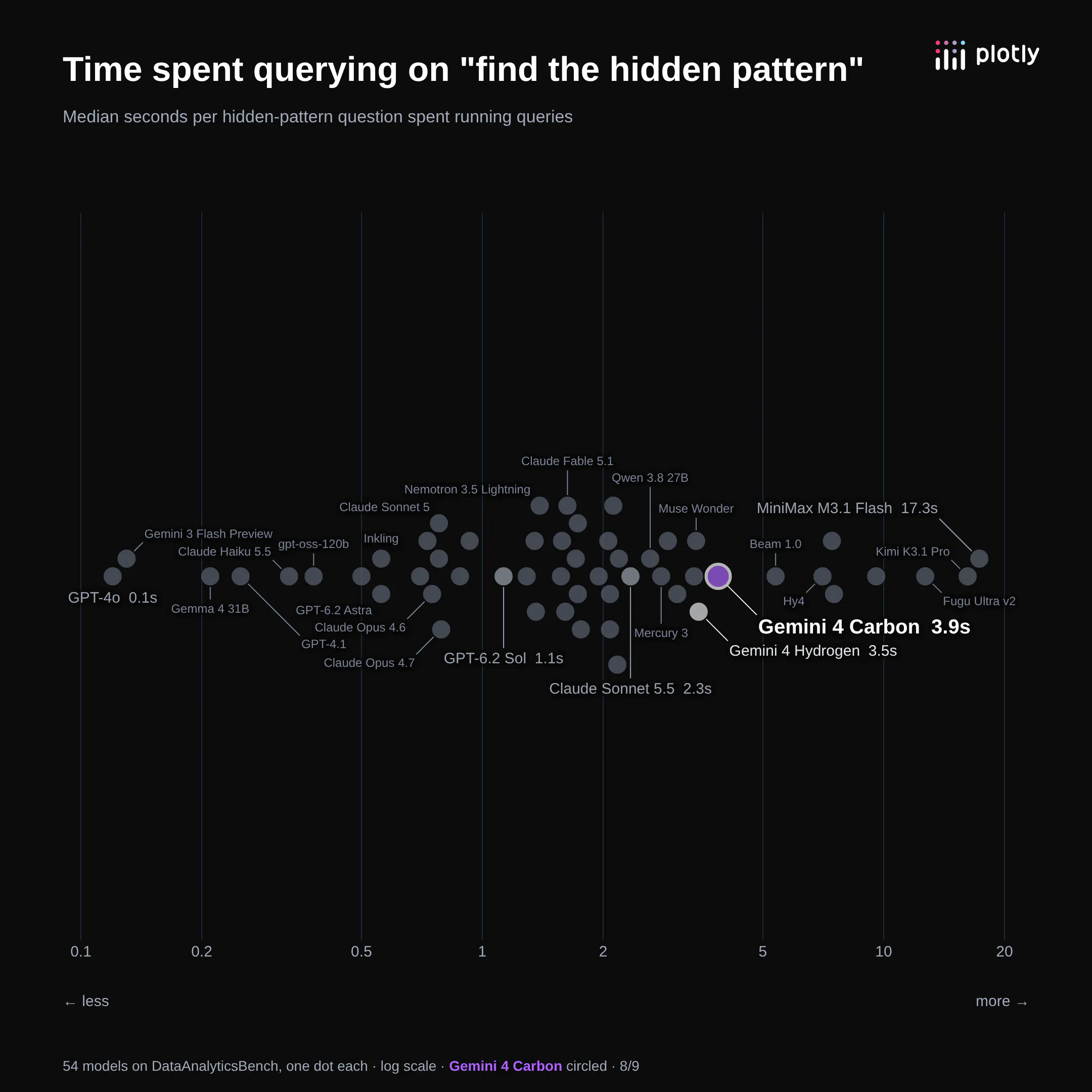
But this behavior is a matter of intelligence and taste, too. You don't want models running away and querying too much without checking in. For example, MiniMax M3.1 Flash ran about 100 queries per hidden-pattern question. It found all five patterns, but it's the slowest model we've tested, at over 3 minutes per question.
And if models can find issues sooner than others, then that's a good thing. GPT-6 Astra is efficient: it found all five with about 15 queries each. But Ripple-65B Preview ran about 66 queries per question and found none.
How we measured
Every number comes from our data analysis exam, 43 questions run through OpenRouter with the same harness for every model. We've tested 75 models; 63 of them have the per-request logs these charts need. Time to first token comes from direct requests we sent to 16 models on November 18, 2026, with a one-line prompt and a prompt of about 130,000 tokens; for Gemini models it includes hidden thinking. Query time is each model's median question, so a one-off stalled request doesn't count against a model's queries. From now on we record time to first token on every request of every run.
The Test Harness
We run every model in Plotly Studio Embedded, a drop-in analytics agent that runs on Dash apps. This harness is tuned to run data analytics queries and make charts with multi-turn tool calling, with less emphasis on writing text. It's meant to put the data front and center.
Frequently asked questions
What is the fastest AI model for data analysis?
Among models that scored 40 or more of 43, GPT-6.2 Sol is the fastest on our exam, at a median of 10.5 seconds a question, followed by GPT-6.2 Astra at 12.4. Mercury 3 and gpt-oss-120b are faster, at about 9 seconds, but scored 35 and 27.
What is the slowest AI model for data analysis?
MiniMax M3.1 Flash, at a median of 185 seconds a question, followed by Kimi K3.1 Pro at 153. Both are thorough: they found all five hidden patterns.
Is tokens per second a good measure of speed?
Not on its own. For an agent, time per task also depends on how many steps the model takes, how much it writes, how long it waits before each response starts, and whether it runs queries in parallel.
Why is Gemini 4 Carbon so slow?
Mostly time to first token: about 11 seconds on a long prompt, paid on each of its 10 round trips per question. It isn't wordy and its queries are fast. More in our Gemini 4 Carbon post.
About the benchmark
To see every model on one chart and in a full results table, along with cost, speed and how the exam works, see Introducing DataAnalyticsBench.
The exam is private and we're sharing it with researchers. We're keeping it private so that the answer key doesn't make its way into the training set. For the same reason, the data is fabricated: the warehouse is a synthetic wind-energy fleet, built to look like a real operator's data, so its answers don't exist anywhere else.
If you'd like access, reach out to Chris Parmer at Plotly.