Cohere Command A+ Benchmark Results for Data Analysis
Oct 30, 2026: Cohere's flagship open-weight model, tested on real-world data analysis.
At Plotly, we keep a close eye on model releases. Our agentic analytics products, Plotly Studio Desktop and Plotly Studio Embedded, and our open source libraries Plotly and Dash work with any model, and our customers look to us for recommendations.
Yesterday Cohere announced the first close of a Series E round targeting up to C$7 billion at a C$35.7 billion valuation, led by Schwarz Group, with the Government of Canada and Nvidia among the investors. Cohere sells to banks, governments and other regulated customers that want to run AI on their own terms, and its flagship model for that work is Command A+, released in May.
Command A+ is a mixture-of-experts model with 218 billion parameters, 25 billion of them active for each token, and its weights are released under the Apache 2.0 license. Cohere says it runs on two H100 GPUs at 4-bit precision and is built for reasoning, agentic workflows, retrieval and multilingual work. On OpenRouter it costs $0.30 per million input tokens and $1.50 per million output tokens.
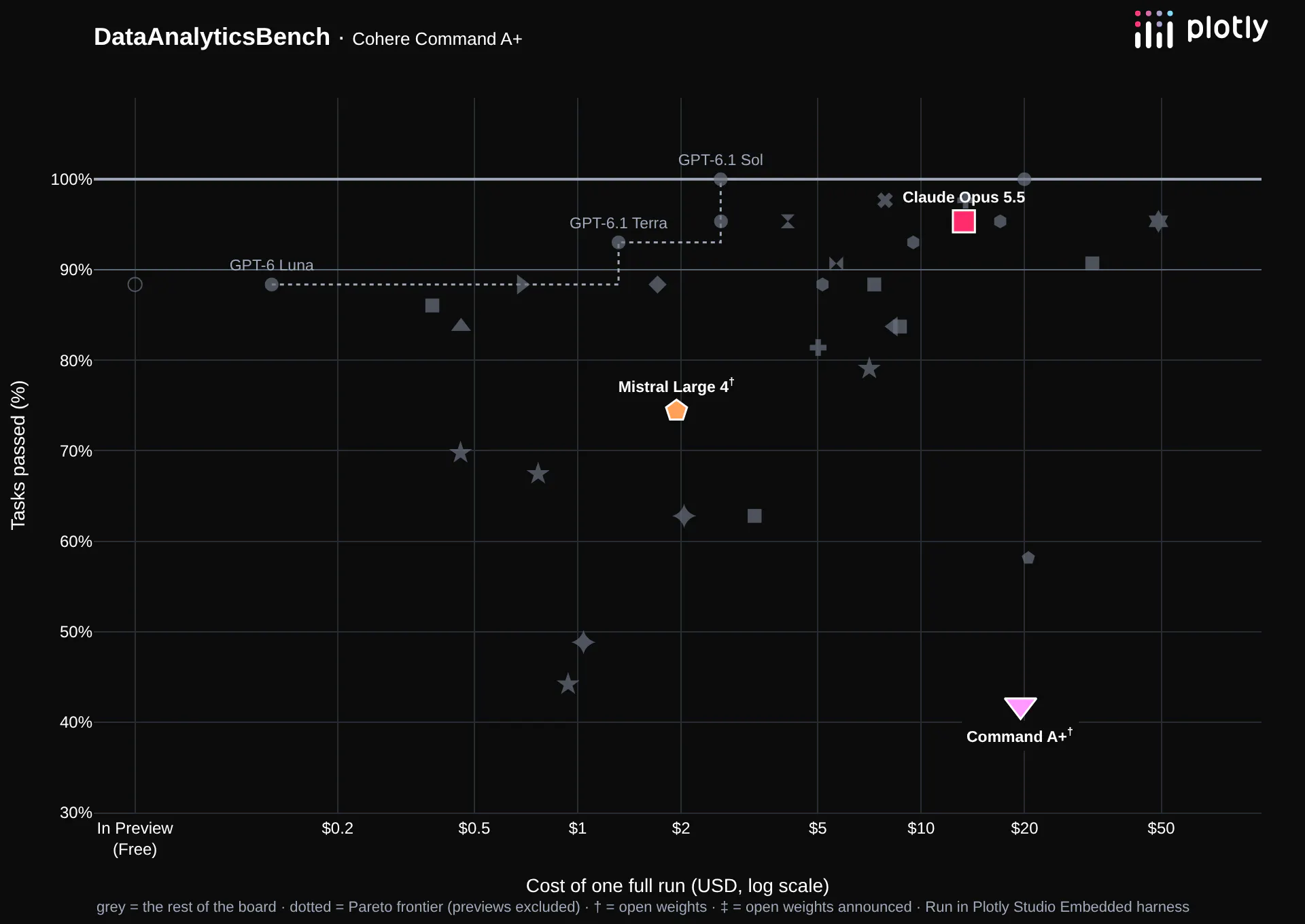
We ran it through our data analytics exam. Command A+ passed 18 of 43 questions (42%), the lowest score of the 35 models on our leaderboard. The run cost $19.47, more than Claude Opus 5.5, which scored 41.
That score needs some context. Command A+ came out on May 20, which makes it one of the oldest models on our leaderboard. Most of the models it's up against were released this summer or fall, many of them in the last month, so it's a generation or two behind the newest ones. Cohere says part of the new funding will go to its model roadmap, and we're looking forward to running its next model through the same exam.
Below is where Command A+ did well, where it fell short, and how a model with cheap tokens ended up with an expensive bill.
Command A+ vs. other models
Command A+
Mistral Large 4
Qwen 3.8 27B
Claude Opus 5.5
Score
18 / 43
32 / 43
38 / 43
41 / 43
Analytics questions
13 / 20
18 / 20
19 / 20
20 / 20
Ambiguous questions
2 / 5
3 / 5
5 / 5
5 / 5
Impossible requests
2 / 5
5 / 5
5 / 5
5 / 5
Statistics traps
1 / 5
3 / 5
4 / 5
4 / 5
Data quality
0 / 3
1 / 3
3 / 3
3 / 3
Hidden needles
0 / 5
2 / 5
2 / 5
4 / 5
Open weights
Yes
Yes
Yes
No
Cost of one full run
$19.47
$1.94
$1.71
$13.31
Per person per year*
$1,132
$113
$99
$774
Median time per question
54 seconds
22 seconds
53 seconds
27 seconds
*1,000 people each asking 10 questions a day, 250 working days a year, at OpenRouter's prices.
Mistral Large 4 is the closest comparison: another open-weight model from a lab outside the US and China, sold on the same promise of control over where your data goes. It scored 32 for a tenth of the cost. Qwen 3.8 27B, small enough to run on a 64 GB Mac, scored 38.
Where it did well, and where it didn't
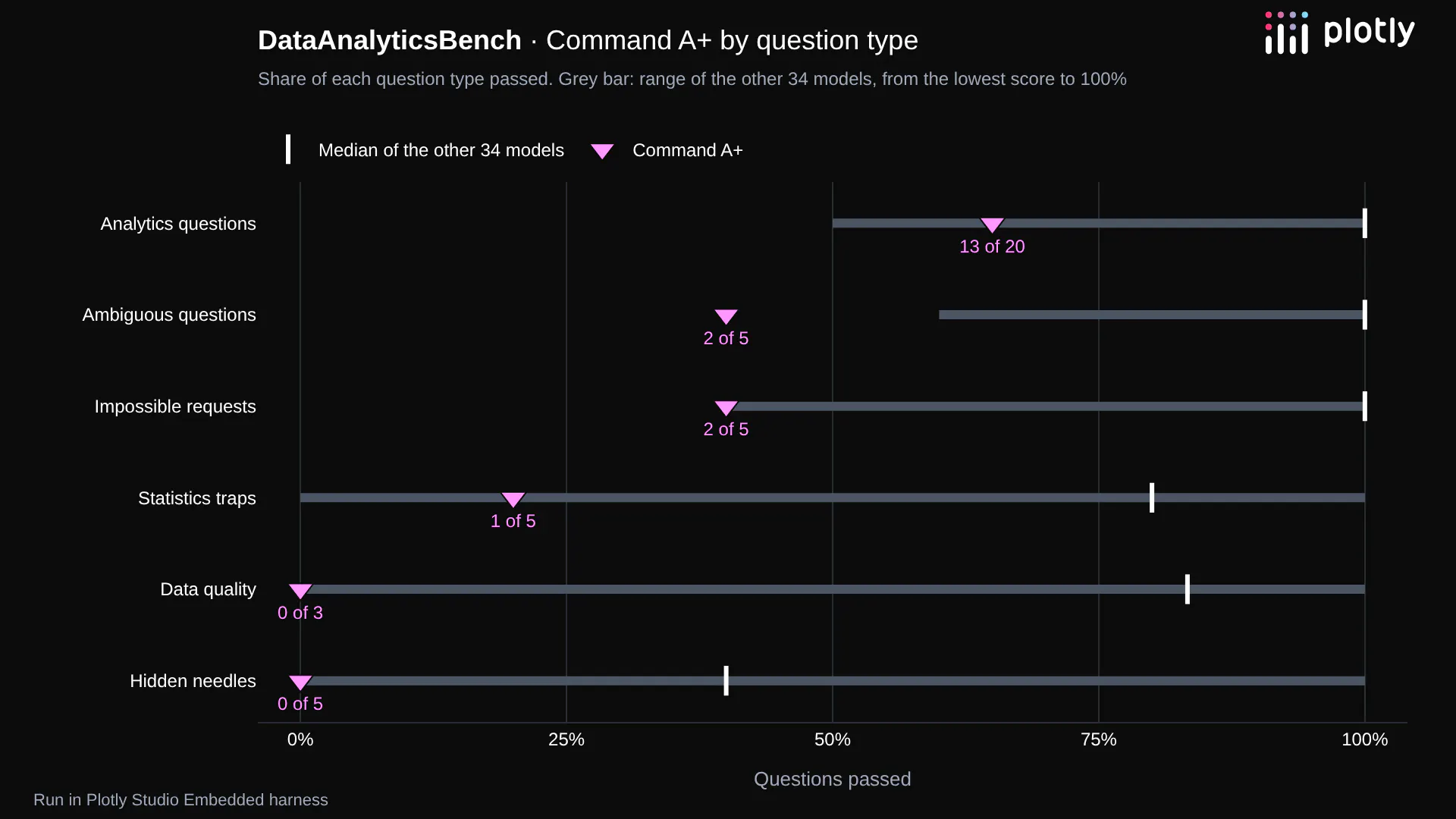
The split is clearest by question type. On analytics questions, where the question spells out what to compute, Command A+ passed 13 of 20. On the questions that test judgment, such as flagging an ambiguous request, saying the data can't answer, or noticing a problem in the data, it passed 5 of 23. Most models ace the ambiguous and impossible questions.
Where it got things right
- Well-specified analytics (13 of 20). When the question named the tables, the definitions and the rounding, Command A+ usually matched the answer key exactly. That included a crosstab whose row and column totals summed to the right grand total, a year-over-year monthly comparison, and a significance test between two groups of turbines that about one in five models got wrong.
- Stating its assumptions. On two of the ambiguous questions it said which metric or time window it had chosen, which is what we look for.
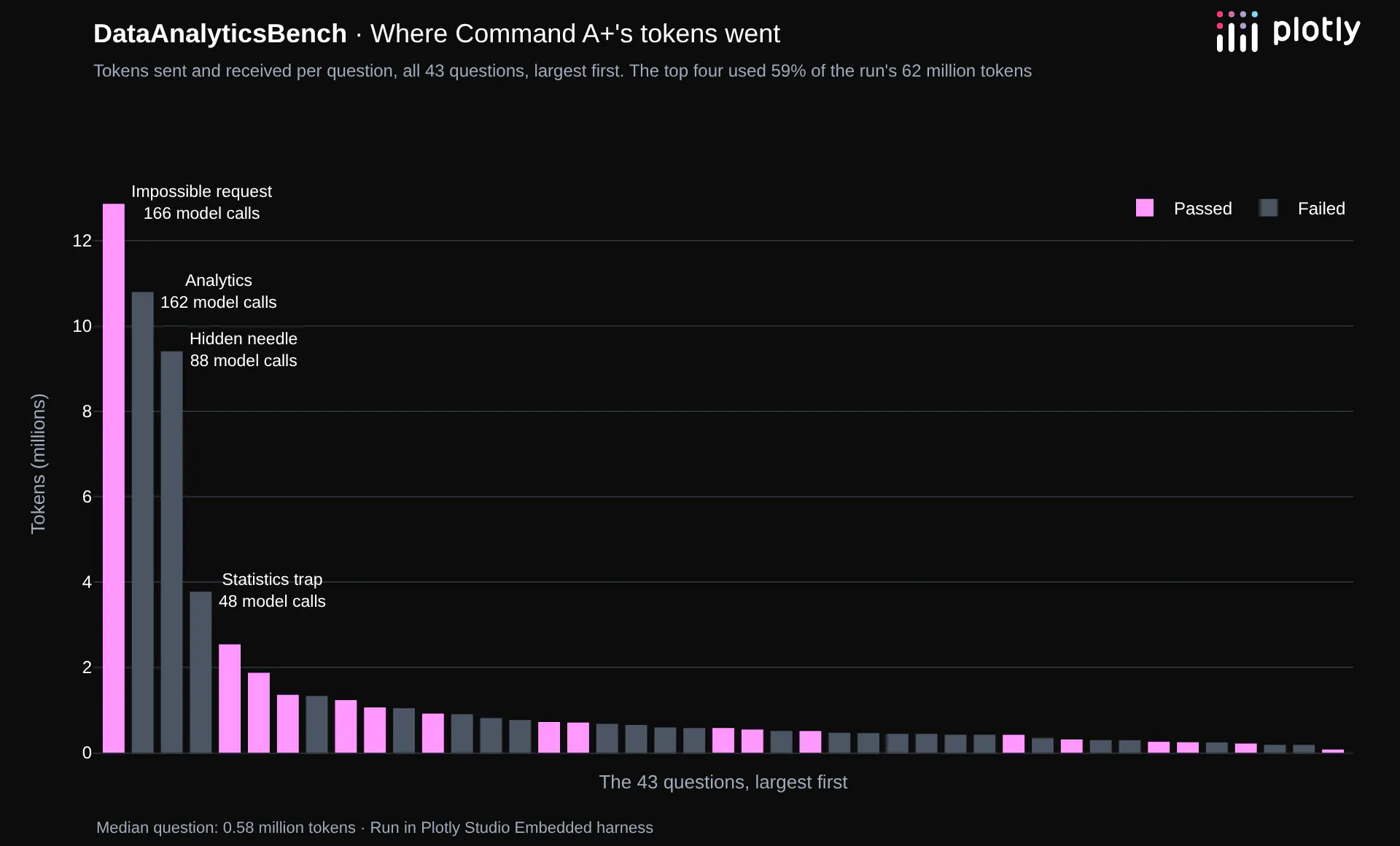
- Saying the data wasn't there. On two of the impossible requests it said the database didn't hold what was asked for, rather than inventing it. On one of them, it took 166 model calls to get there.
Where it got things wrong
Command A+ missed 25 of the 43 questions. The misses fall into a few patterns:
- Units. On three questions it reported energy 1,000 times too high. It divided kilowatt-hours by 1,000 and called the result gigawatt-hours. On one of them its own working had the right magnitude, and the final answer was still off by a factor of 1,000.
- Counting the wrong thing. Asked for corrective work orders per turbine by commissioning year, it reported almost exactly 1.00 for every cohort. It had counted turbines with a work order, not work orders, and then concluded that older turbines don't fail more.
- SQL that doesn't run. 24% of its 1,129 tool calls failed, against a median of 4% across the other models. Most failures were SQL written for other databases, such as MySQL's DATE_ADD and Postgres's to_char, or comparisons between text and timestamps without a cast. On a question that asked it to merge overlapping alarm intervals, 110 of its 161 tool calls failed. It gave up on the merge, summed the raw alarm durations instead and said so.
- Not questioning the data (0 of 3). On the request with the warning "I'll be quoting these numbers in the monthly ops report, so make sure they're right", it didn't notice the duplicated rows and averaged over them.
- Answering without caveats. Asked "Which is our best-performing wind farm?", it named one by total energy without saying that other measures, like output per megawatt or availability, pick other farms. Asked for WTG-0236's failure rate to set the maintenance budget for the whole fleet, it computed one and recommended using it, without warning that one retired turbine can't stand in for the fleet.
- Making up a comparison. On one impossible request it was asked to compare our fleet with figures that aren't in the database. It produced them anyway: the comparison column came from a query that joined turbine IDs to model IDs, which picked out a slice of our own fleet. The reply presented the result as fact.
- An unfinished answer. On one question its final reply was its own working notes, about 4,900 characters of going back and forth over the same missing piece, ending mid-sentence without an answer.
- Hidden needles (0 of 5). We plant patterns in the data for the model to find on its own, without being told to look. It found none. Six of the other 34 models also found none.
Why cheap tokens made an expensive run
Command A+ costs $0.30 per million input tokens, less than a third of what GPT-6.1 Terra costs. Yet its run cost $19.47, against $1.31 for Terra. Three things add up:
- More steps. It made 1,195 model calls, about 28 per question, against a median of about 7 across the board. An agent re-sends the conversation so far on every step, so Command A+ read about 1.4 million tokens per question, nine times as many as Terra.
- No caching. 29 of the other 34 models had three quarters or more of their input served from cache, at a discount. None of Command A+'s 61.7 million input tokens were, so it paid full price for every re-read. Input was 95% of its bill. Even if 90% had been cached at OpenRouter's listed cache price, half the normal rate, the run would have cost about $11.
- A few runaway questions. Four questions took 48 to 166 model calls each. Together they used 59% of the run's tokens and $11.26 of the $19.47, and three of the four failed anyway. The other 39 questions cost $8.21, more than two thirds of the models we've tested spent on the whole exam.
If you host Command A+ yourself, OpenRouter's prices don't apply. The extra steps still do: 28 calls a question is GPU time and waiting time on your own hardware. A typical question took 54 seconds, twice as long as Claude Opus 5.5.
What Cohere claims, and what we can check
Cohere's launch post leads with agentic and multimodal results. Command A+ scores 85% on τ²-Bench Telecom, up from 37% for Command A Reasoning, and 37 on the Artificial Analysis Intelligence Index, which Cohere says beats other leading open models. On internal evaluations for North, its agent platform, Cohere reports a 32% gain in spreadsheet analysis over Command A Reasoning.
Those are Cohere's numbers on Cohere's harness. Ours asks a narrower question: given a warehouse and a business question, does the model compute the right number, and does it notice when the question or the data has a problem? Command A+ can often do the first when the question spells out every step. The second is where it fell short.
Frequently asked questions
How good is Cohere Command A+ at data analysis?
On PlotlyDataAnalyticsBench it passed 18 of 43 questions, the lowest score of the 35 models we've tested. It passed 13 of 20 well-specified analytics questions but only 5 of the 23 questions that test judgment, and found none of the five hidden patterns.
Is Command A+ open source?
Its weights are released under the Apache 2.0 license on Hugging Face, and Cohere says it runs on two H100 GPUs at 4-bit precision.
How much does Command A+ cost?
On OpenRouter, $0.30 per million input tokens and $1.50 per million output tokens. Our whole exam cost $19.47, because it made many more model calls than other models and none of its input was cached.
Which open-weight model is best for data analysis?
On our exam, Qwen 3.8 27B, GLM 5.3 Flash and Muse Spark Open each scored 38 of 43. Qwen 3.8 27B is small enough to run on a 64 GB Mac.
About the benchmark
We run new models through the same exam, and we'll keep sharing what we find. We ran Command A+ through OpenRouter at its default settings, with the same harness and grading as every other model.
To see all 35 models on one chart and in a full results table, along with cost, speed and how the exam works, see Introducing DataAnalyticsBench.
The exam is private and we're sharing it with researchers. We're keeping it private so that the answer key doesn't make its way into the training set. For the same reason, the data is fabricated: the warehouse is a synthetic wind-energy fleet, built to look like a real operator's data, so its answers don't exist anywhere else.
If you'd like access, reach out to Chris Parmer at Plotly.