
Matt Brown

Robert Claus
August 13, 2026
Part 3 of 3: Token Cost
Doing the math on vibe-coded apps
Part 3 of 3 in a series on why you should ask Claude to build data apps in Dash instead of a full-stack app. Part 1 made the architecture case: a Dash app is one application, in one language, with a smaller blast radius when something breaks. Part 2 covered the risks that show up after launch: dependencies, inheritance, support. This part explores the token cost of both approaches, and closes with our advice on when you should reach for full stack. Access the full PDF of the 3-part series.
TL;DR: When you ask Claude to build a data app, naming the framework in the prompt matters. For a comprehensive walkthrough, watch our recent webinar.
Here's the short version of why that framework should be Dash from the perspective of cost.
- It shows up in the token bill. We ran the numbers and Dash apps cost roughly 33% less than the equivalent full-stack app costs.
- The exception: for a highly custom, consumer-facing product with a designer in the loop, full stack’s flexibility is still the right call. This piece is about the data apps, internal tools, and reports that make up most of what people are actually vibe-coding.
Read on for the details behind each one.
Everything in this series so far has been an architectural argument: fewer moving parts, a smaller dependency tree, an easier app to inherit. All of that should cost less to build and maintain with Claude. We wanted a number instead of just a theory.
Let’s see the receipts
We ran a benchmark: the same set of data app prompts, built twice, once as a traditional full-stack app, a React front end plus a back end, and once in Dash, tracking actual token spend across the build.
Early results point to Dash apps costing roughly 33% less than what the equivalent full-stack app costs. In both cases, there’s generally one big cost up front to generate the boilerplate. Feature additions in Dash tend to be cheaper given the more limited scope of the code that is needed to be written. Testing/probing costs once the app is operational tend to be the most expensive and higher for full-stack apps.
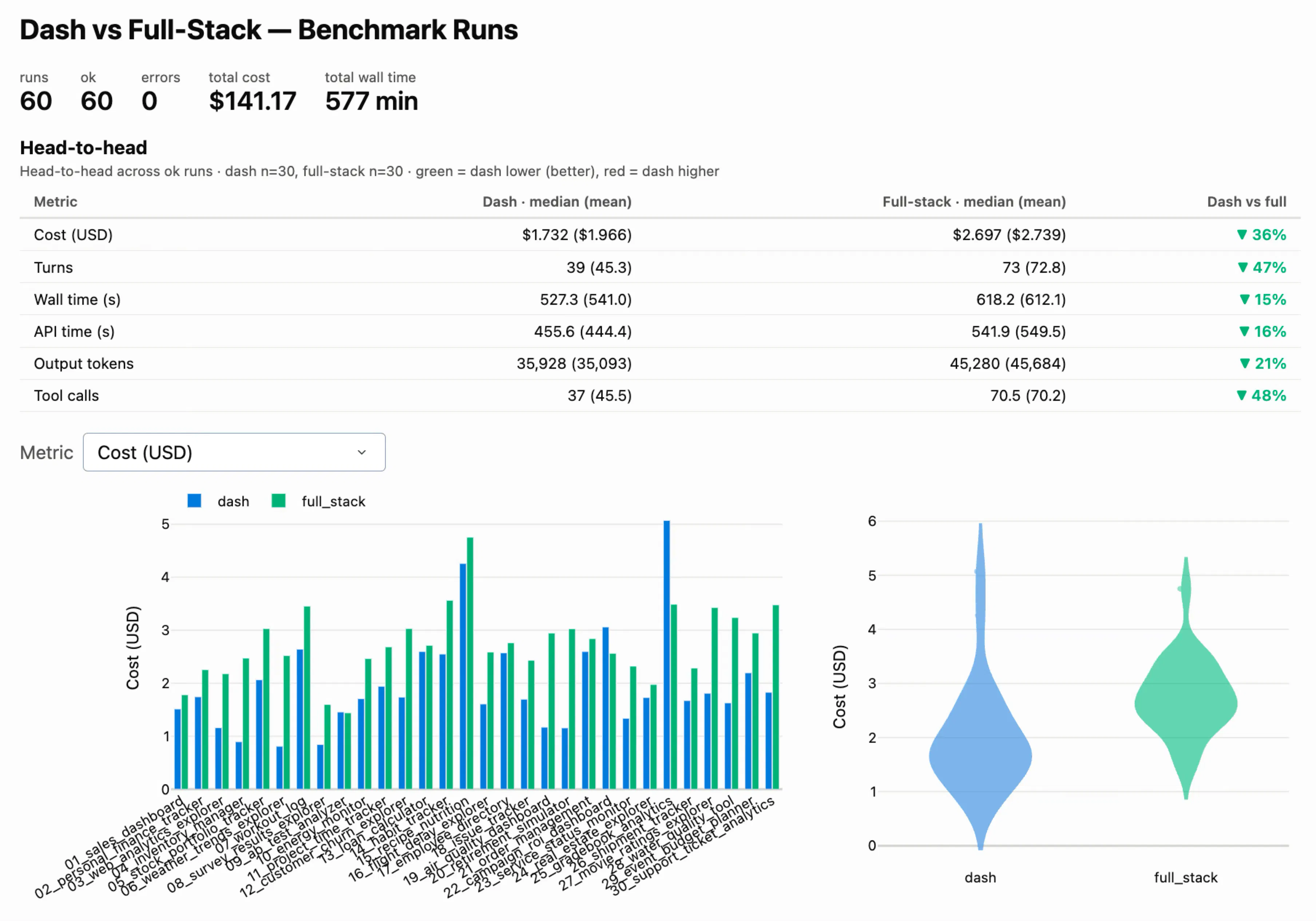
The sample is just a handful of app builds and the numbers could vary depending on app complexity, the model doing the building, and how disciplined the prompting is on either side. We plan to publish a separate article going in depth into the benchmark itself with the prompts, apps, and raw token counts, so anyone can take a closer look and check our math. Stay tuned!
When to reach for full stack
None of this makes full stack a bad choice for everything. If what you're building is a highly custom, consumer-facing product with novel interactions and a designer in the loop, full stack’s flexibility is the reason to reach for it. Dash is a framework built specifically for data apps and internal tools, and it shows: the more your project looks like a general-purpose consumer product, the less that focus works in your favor.
But that's a narrower slice of what people are actually vibe-coding. Most of the "build me an app" prompts flying into Claude right now describe a dashboard, an internal tool, a report, something to explore or share data through. For that job, the smaller footprint is desirable – less for the AI to get wrong, less for you to review, and less standing between a good idea and something you can actually put in front of your team.
Keeping a front end and a back end in sync isn't a problem a lightweight model can shrug off. It takes something like Fable, a genuinely capable model, to hold both halves of the contract in its head at once and catch the drift before it becomes a bug, and that's not a cost you pay once. It compounds every time the project grows, every feature that touches both sides, every year the app stays in production and someone asks Claude to change something.
If the dashboard or internal tool you're building never needed two applications in the first place, none of that spend was necessary. A little care at the outset, naming Dash instead of leaving Claude to default to full stack, is the difference between paying for a bigger model to manage a problem you created and not having the problem at all. Over the life of a project, that's a material number of tokens, plus the harder-to-see cost of a team's time spent debugging a seam that never needed to exist.
Pick a framework, any framework, preferably Dash
So the next time you sit down to describe an app to Claude, consider naming the framework instead of leaving it up to chance. One line in the prompt is the difference between inheriting a single Python application you can read end-to-end, and inheriting two complex applications stitched together with a brittle API and backed by a dependency tree hundreds of packages deep.
Tell Claude to build it in Dash.
Let’s review the full list of reasons to choose Dash over full stack for data apps.
- One app, not two. You asked for an app, but full stack gave you two: a front end and a back end with an API layer gluing them together. That’s two things that have to be built, hosted, and kept in sync, or worse, a front end that never got a back end at all. Dash is one application, one language, one process.
- No translation tax. Your data already speaks Python. Dash callbacks call pandas, NumPy, and scikit-learn directly. Full stack has to flatten that same data into JSON first, a boundary that breaks on ordinary things like datetimes and NaN values.
- Fewer decisions, fewer forks in the road. Full stack doesn't have a default state-management pattern, so Claude has to pick one for every project introducing possible inconsistencies and complexity. Dash's callback model is one well-worn default that works every time.
- The wiring is just as important as the charts. Cross-filtering and linked components in Dash are just another callback. In full stack, Claude has to invent the state architecture connecting components from scratch, every time.
- A smaller blast radius when something breaks. One language, one runtime, one place for a bug to live, and a much shorter path to understanding why.
- A smaller, checkable dependency tree. A fresh Dash install resolves 27 packages vs. a full stack app which resolves to hundreds, in an ecosystem seeing growth in malicious and AI-hallucinated packages.
- Easier handoff. Someone else has to read the code eventually. A Dash app can be reviewed by anyone on a Python-fluent data team. A full-stack app asks whoever inherits it to either trust Claude's account of unfamiliar code or learn a new language.
- Dash has a steward. Plotly owns the Python visualization stack and deployment platform: Dash (10M downloads/month), Plotly graphing libraries (68M/month), and on-prem/cloud hosting. No competing visualization stack is as vertically integrated or widely deployed. Full stack has no single company to call when something breaks.
- It shows up in the token bill. We ran the numbers and Dash apps cost roughly 33% less than the equivalent full-stack app costs.
- The exception: for a highly custom, consumer-facing product with a designer in the loop, full stack’s flexibility is still the right call. This piece is about the data apps, internal tools, and reports that make up most of what people are actually vibe-coding.
Want to learn more about Dash vs. full stack? Watch our recent webinar.