Claude Fable 5.2 Benchmark Results for Data Analysis
Nov 10, 2026: Anthropic's most capable model, tested on real-world data analysis.
At Plotly, we keep a close eye on model releases. Our agentic analytics products, Plotly Studio Desktop and Plotly Studio Embedded, and our open source libraries Plotly and Dash work with any model, and our customers look to us for recommendations.
On November 9, Anthropic released Claude Fable 5.2, its most capable model for technical work. Anthropic says it's a step above Claude Opus 5.5 on almost every benchmark it ran, that it writes up to 30% faster than Fable 5.1, and that it costs less: $8 per million input tokens and $40 per million output tokens, down from $10 and $50. Fable 5.2 is the same underlying model as Claude Mythos 5.2, which Anthropic offers with fewer safeguards to approved cybersecurity and biomedical research organizations. Anthropic hasn't released the weights or said how many parameters the model has, or whether it was pretrained from scratch or trained further from Fable 5.1.
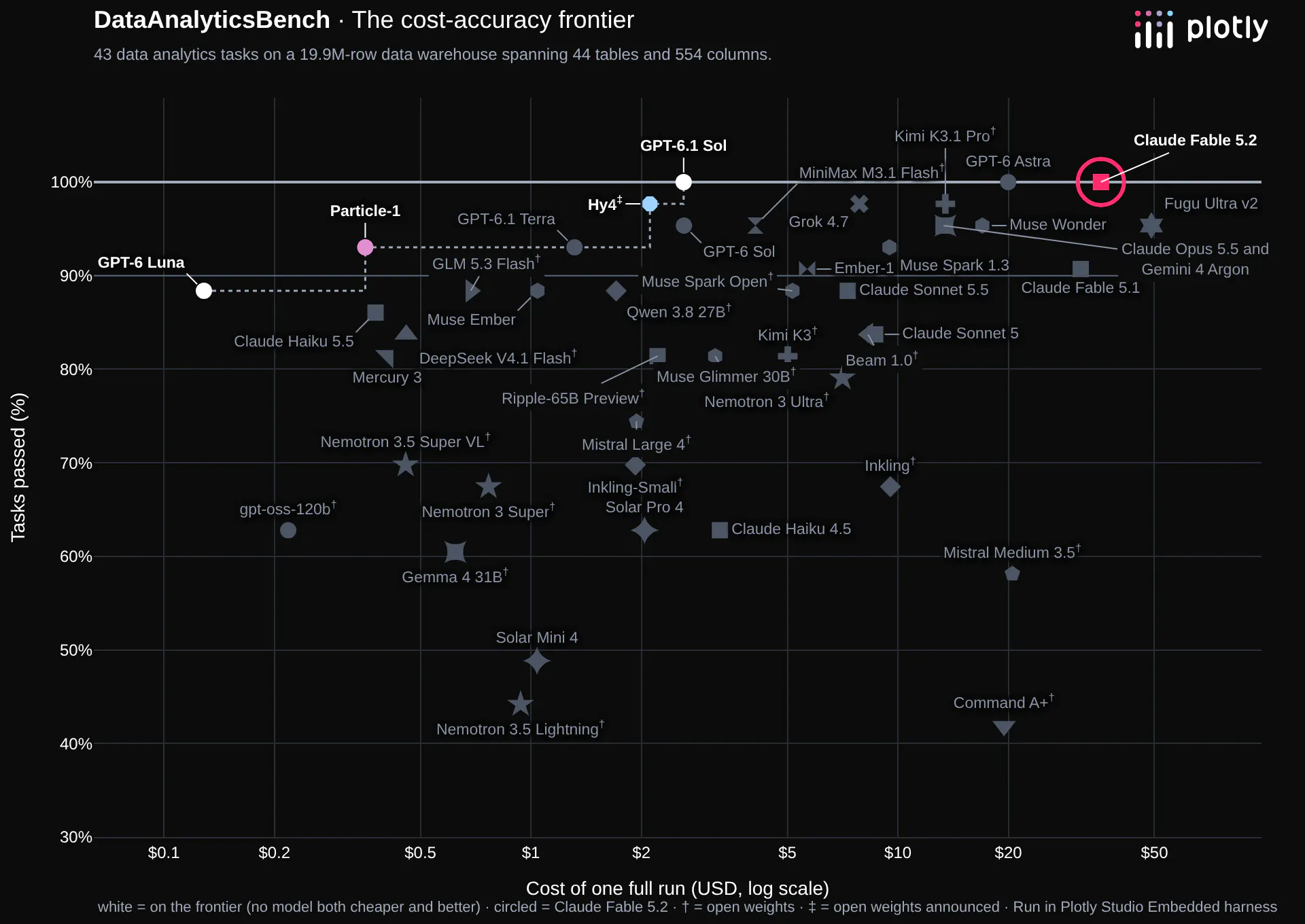
We ran it through our data analytics exam. Fable 5.2 passed all 43 questions, the third model to get a perfect score, after OpenAI's GPT-6.1 Sol and GPT-6 Astra. That's four points better than Fable 5.1, which scored 39. But it's expensive: our run cost $35.74, the second most of the 45 models on our board, and GPT-6.1 Sol got the same perfect score for $2.61. On the chart below, Fable 5.2 sits at the top right, off the frontier.
Claude Fable 5.2 vs. Fable 5.1, Opus 5.5 and GPT-6.1 Sol
Claude Fable 5.2
Claude Fable 5.1
Claude Opus 5.5
GPT-6.1 Sol
Score
43 / 43
39 / 43
41 / 43
43 / 43
Analytics questions
20 / 20
20 / 20
20 / 20
20 / 20
Ambiguous questions
5 / 5
5 / 5
5 / 5
5 / 5
Impossible requests
5 / 5
5 / 5
5 / 5
5 / 5
Data quality
3 / 3
3 / 3
3 / 3
3 / 3
Statistics traps
5 / 5
3 / 5
4 / 5
5 / 5
Hidden needles
5 / 5
3 / 5
4 / 5
5 / 5
Open weights
No
No
No
No
Cost of one full run
$35.74
$31.49
$13.31
$2.61
Per person per year*
$2,078
$1,831
$774
$152
Median time per question
40 seconds
27 seconds
27 seconds
18 seconds
*1,000 people each asking 10 questions a day, 250 working days a year, at OpenRouter's prices when each model ran.
All four models were perfect on the 33 questions with a clear answer or a clear right move. The difference is in the open-ended work. Fable 5.2 found all five hidden patterns, something only six of the 45 models on our board have done, and it caught all five statistics traps. Fable 5.1 got three of each.
One run per model is a single sample. In our repeat runs of other models, scores moved by up to three points between runs, so treat a one- or two-point gap as close to a tie.
A lower price, a higher bill
Fable 5.2's list price is 20% lower than Fable 5.1's, but our run cost more: $35.74 against $31.49. Two things explain it. Fable 5.2 used more tokens, 10.1 million against 9.0 million. And most of the bill was writing the prompt cache. Anthropic charges $10 per million tokens to write to the cache and $0.20 per million to read from it. Our run wrote 2.1 million tokens to the cache, about $21 of the total. Output came to about $13 and cache reads to about $1.50.
It's also slower on our exam. Its median question took 40 seconds, against 27 for Fable 5.1 and Claude Opus 5.5 and 18 for GPT-6.1 Sol. Anthropic says Fable 5.2 writes up to 30% faster than 5.1 and offers a fast mode at double the price; we ran it in the standard mode.
What a perfect score looks like
Fable 5.2 didn't brute-force the open-ended questions. On the five questions with hidden patterns it ran 33 queries on average, close to the board's median of 25 and less than half of what Meta's Muse Ember ran while finding just one. Its median question used five queries, and its median answer ran about 200 words.
Where other models pull up the number that points to a pattern and then explain it away, Fable 5.2 kept breaking the data down until the pattern was isolated, and then said so plainly. On the statistics questions, it stated its criteria up front and checked whether a relationship held up once the obvious confounder was accounted for.
The Test Harness
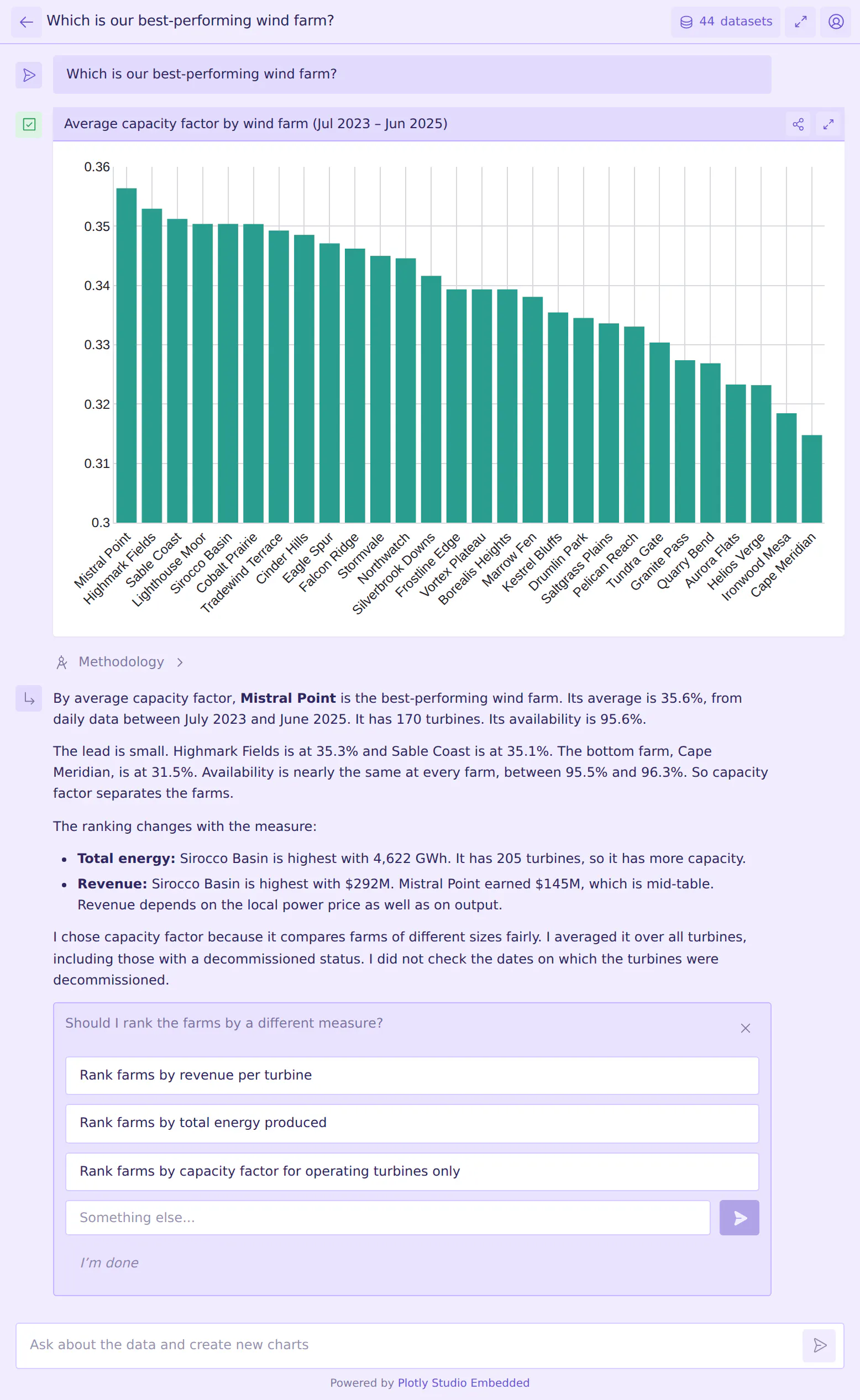
We run every model in Plotly Studio Embedded, a drop-in analytics agent that runs on Dash apps. This harness is tuned to run data analytics queries and make charts with multi-turn tool calling, with less emphasis on writing text. It's meant to put the data front and center.
Frequently asked questions
How good is Claude Fable 5.2 at data analysis?
It passed all 43 questions on PlotlyDataAnalyticsBench, one of only three models to do so, alongside OpenAI's GPT-6.1 Sol and GPT-6 Astra. It found all five hidden patterns and caught all five statistics traps.
How much does Claude Fable 5.2 cost?
$8 per million input tokens and $40 per million output tokens, with cache reads at $0.20 per million. Our whole exam cost $35.74, the second most expensive run on our board. GPT-6.1 Sol got the same score for $2.61.
Is Claude Fable 5.2 better than Fable 5.1?
On our exam, yes: 43 against 39. It found two more hidden patterns and caught two more statistics traps. It cost a little more per run and was slower.
What's the difference between Claude Fable 5.2 and Claude Mythos 5.2?
Anthropic says they're the same underlying model. Fable has cybersecurity and biology safeguards and is available to everyone. Mythos is offered to approved organizations doing cybersecurity or biomedical research.
Is Claude Fable 5.2 open source?
No. Anthropic hasn't released the weights. You can use it through Anthropic's API, the major clouds, and providers such as OpenRouter.
About the benchmark
We run new models through the same exam as they're released, and we'll keep sharing what we find. We ran Claude Fable 5.2 through OpenRouter with the same harness and grading as every other model.
To see all 45 models on one chart and in a full results table, along with cost, speed and how the exam works, see Introducing DataAnalyticsBench.
The exam is private and we're sharing it with researchers. We're keeping it private so that the answer key doesn't make its way into the training set. For the same reason, the data is fabricated: the warehouse is a synthetic wind-energy fleet, built to look like a real operator's data, so its answers don't exist anywhere else.
If you'd like access, reach out to Chris Parmer at Plotly.