Muse Wonder Data Analytics Benchmark Results
Oct 13, 2026: Muse Wonder ties Claude Opus 5.5 on our data analytics exam, and answers three times faster than Meta's last model.
At Plotly, we keep a close eye on model releases. Our agentic analytics products, Plotly Studio Desktop and Plotly Studio Embedded, and our open source libraries Plotly and Dash work with any model, and our customers look to us for recommendations. Yesterday Meta released Muse Wonder. Mark Zuckerberg announced it as "a much larger and more advanced class of models that brings us to the frontier," just over a year after Meta started Meta Superintelligence Labs. There are two models: Muse Wonder, "for fast frontier performance," and Muse Wonder Full, "the full version of the model." Muse Wonder is the one available on OpenRouter, so that's the one we tested, and we'll run Muse Wonder Full when it's available. Muse Wonder is priced like the top frontier models, at $4 per million input tokens and $20 per million output tokens.
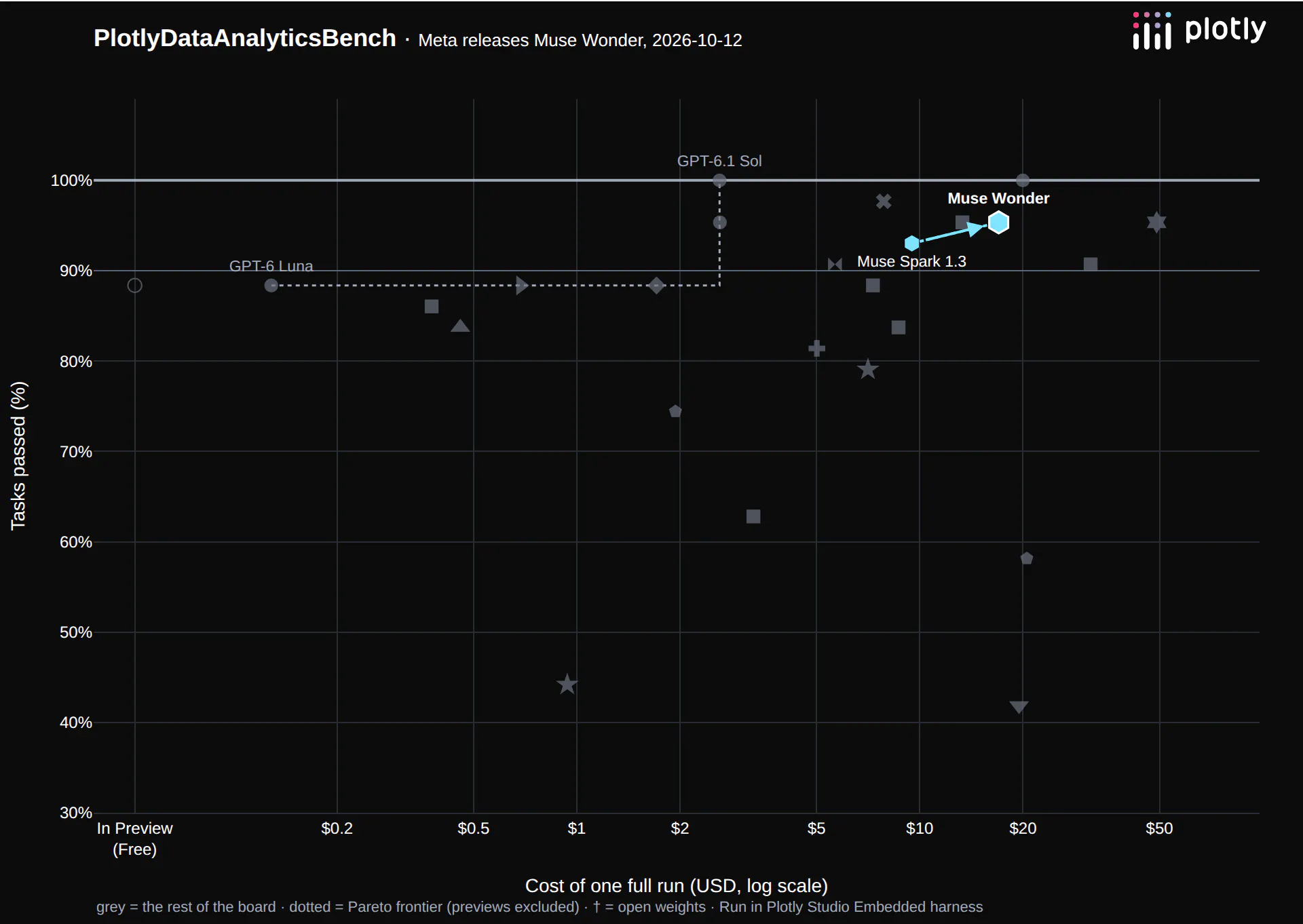
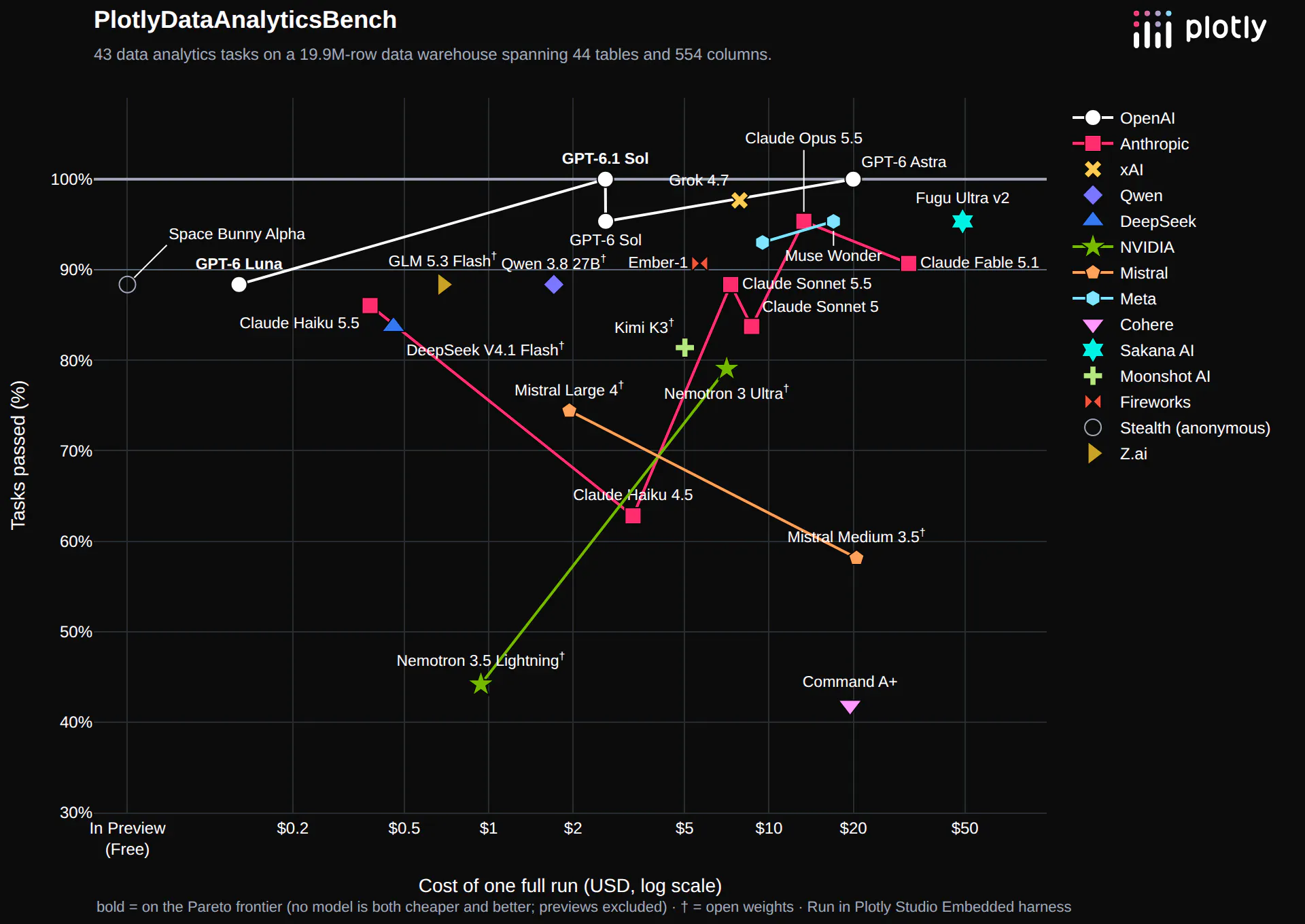
We ran it through our data analytics exam. It passed 41 of 43 questions (95%, an A), one more than Muse Spark 1.3, and it answers a typical question in 26 seconds instead of 75. That puts it level with Claude Opus 5.5, GPT-6 Sol and Fugu Ultra v2, behind only GPT-6.1 Sol and GPT-6 Astra (43 of 43) and Grok 4.7 (42).
The exam
Our data analytics exam tests how well models do at real data analysis. It runs within Plotly Studio Embedded, with the same agent, tools and prompts that app viewers use and only the model swapped, and it answers 43 questions through a series of tool calls and analysis steps. The data warehouse is representative of the real world: 20M rows across 44 tables and 554 columns. The questions cover a broad range of data analytic skills: answering questions, recognizing ambiguity, avoiding hallucinations, and finding a needle in a haystack.
The dataset is a mock wind turbine analytics dataset: 5,200 turbines across 28 wind farms over two years. It covers everything from hourly SCADA telemetry and alarms to work orders, inspections, oil samples, firmware rollouts and weather. And like real operational data it's messy, with frozen sensors, duplicated rows and turbines decommissioned mid-period, so a good analyst has to catch problems before quoting a number.
Every question has either an answer, checked against a verified key, or "a catch": an ambiguous question to raise, an impossible request to decline, a planted data defect to flag. There is no partial credit, and a confident answer that ignores the catch fails.
Muse Spark 1.3, released in September, passed 40 of 43 (93%). Muse Wonder passes 41 of 43 (95%). It found one more of the patterns we hid in the data, and matched Muse Spark 1.3 everywhere else:
Category
Muse Spark 1.3
Muse Wonder
Analytics questions
20 / 20
20 / 20
Impossible requests
5 / 5
5 / 5
Ambiguous questions
5 / 5
5 / 5
Data quality
3 / 3
3 / 3
Hidden needles
3 / 5
4 / 5
Statistics traps
4 / 5
4 / 5
Total
40 / 43 (93%)
41 / 43 (95%)
Cost of one full run
$9.48
$16.98
Median time per question
75 seconds
26 seconds
Cost and speed
It cost $16.98 in inference tokens for Muse Wonder to complete the exam, about 40 cents per question. That's in the range of other frontier models at its price: Claude Opus 5.5 scored the same 41 of 43 for $13.31, and GPT-6 Astra scored 43 for $19.97. GPT-6.1 Sol is the exception, with a perfect score for $2.61.
For a sense of scale: if 1,000 people each asked it 10 questions a day, at the cost per question we measured, it would come to about $990 per person per year. GPT-6.1 Sol would cost about $152.
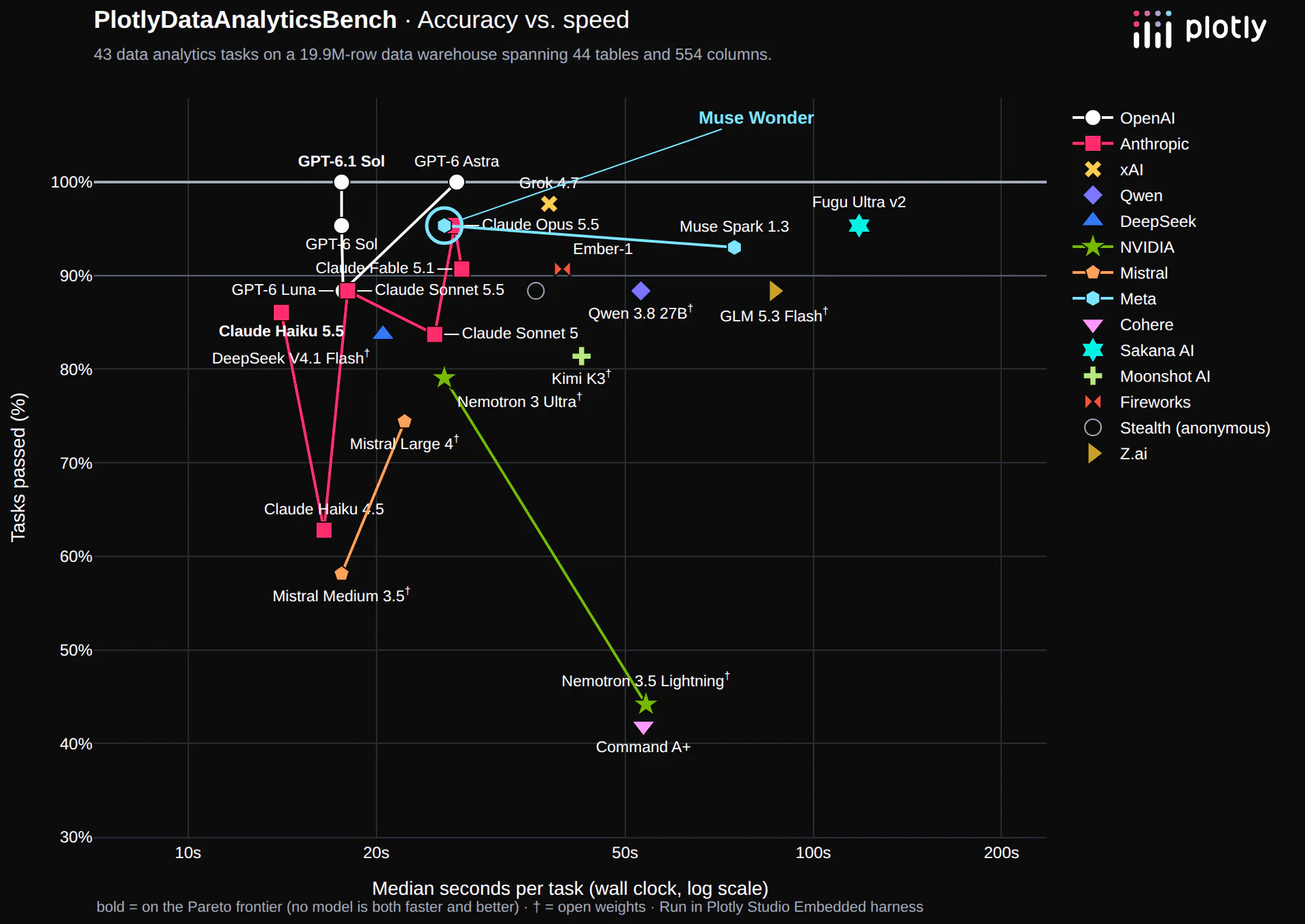
The bigger change from Muse Spark 1.3 is speed. Muse Spark 1.3 took a median of 75 seconds per question, and 2 minutes on average. Muse Wonder takes 26 seconds, and 45 on average, about the same as Claude Opus 5.5.
Where it got things right
Muse Wonder got every question right in four of the six categories: all 20 analytics questions, and every ambiguous, impossible and data quality question. For example:
- Ambiguous questions (5 of 5). Asked "How did the fleet do last winter compared to the rest of the year?", it said exactly which months it took "last winter" to mean, next to the comparison.
- Impossible requests (5 of 5). Asked for a decommissioned turbine's "reliable annual failure rate" to set the whole fleet's maintenance budget, it explained that one retired turbine can't support a fleet-wide rate, and pointed to the fleet-wide rate instead.
- Data quality (3 of 3). Summarizing a quarter of gearbox oil temperatures, it found the week of missing readings and checked that the other sensor channels were intact, so the gap came from the data feed rather than a shutdown.
It also found 4 of the 5 patterns we hid in the data, up from 3 for Muse Spark 1.3. That ties Claude Opus 5.5, Grok 4.7 and GLM 5.3 Flash. Only GPT-6.1 Sol and GPT-6 Astra found all five.
Where it got things wrong
Muse Wonder missed 2 of the 43 questions:
- Half of a hidden pattern. For one of the patterns we planted in the alarm data, it found where the alarms come from, but not when they happen.
- Mediators instead of confounders. Asked whether windy days drive up SCADA alarms, it offered load as the explanation, which is itself driven by the wind. It did not check for a third variable, such as season, that could drive both, and offered to break the alarms down by type as a follow-up instead of doing it.
About the benchmark
We run new models through the same exam as they're released, and we'll keep sharing what we find.
The exam is private and we're sharing it with researchers. We're keeping it private so that the answer key doesn't make its way into the training set. For the same reason, the data is fabricated: the warehouse is a synthetic wind-energy fleet, built to look like a real operator's data, so its answers don't exist anywhere else.
If you'd like access, reach out to Chris Parmer at Plotly.