
Plotly
October 7, 2026
The Future of Analytics in the AI Era: What’s Changing in the Workflow
TL;DR
- The AI analytics workflow has already solved speed. Analysts can draft queries, clean data, and generate charts faster than before, with help from a new wave of AI productivity tools.
- Governance hasn't kept pace with that speed, and closing the gap is now the more urgent problem to solve.
- Four shifts are already reshaping analytics teams: governed infrastructure, verification as a core skill, managing a growing fleet of AI-generated apps, and choosing tools that keep your work portable.
- Build analytical review into the AI workflow before results reach stakeholders. Separately, define ownership, access controls, and lifecycle policies for every deployed application.
The hard part of the job is no longer writing the query. A 2026 survey of more than 350 analytics practitioners and leaders, published in dbt Labs' State of Analytics Engineering report, found that 72% now prioritize AI-assisted coding in their development work, but only 24% prioritize AI-assisted pipeline management which includes testing, observability, and quality controls. This imbalance suggests that investment in faster creation is outpacing investment in the controls needed to make analytical outputs reliable.
What follows in this article is a look at what's different in the day-to-day analytics workflow and why the fastest-moving part of it is opening up a trust gap underneath. There are four specific shifts already underway, and the gap covers several distinct responsibilities.
What's Different in the Analytics Workflow Today
Ask a data analyst what changed in the past two years, and the honest answer is narrower than the AI headlines suggest. AI is increasingly assisting with a specific, well-defined set of tasks: drafting a first-pass SQL query or Python script, cleaning up a messy dataset, generating an exploratory chart, summarizing what a table of numbers is saying.
These tasks are often repetitive and easier to describe than an entire analytical project. It's the kind of work large language models are reliably good at, and it's exactly where today's AI productivity tools earn their keep. However, their outputs still require validation because generated code, transformations, and summaries can contain incorrect assumptions or logic.
AI tools for data analysts are also expanding beyond isolated tasks. Some can now use connected data and natural-language instructions to generate code-backed charts, reports, and interactive applications.
Plotly Studio works this way, turning a dataset and a short prompt into a functioning app rather than a single output. That's a form of AI workflow automation that operates at the application level. The generated logic and results still require human review.
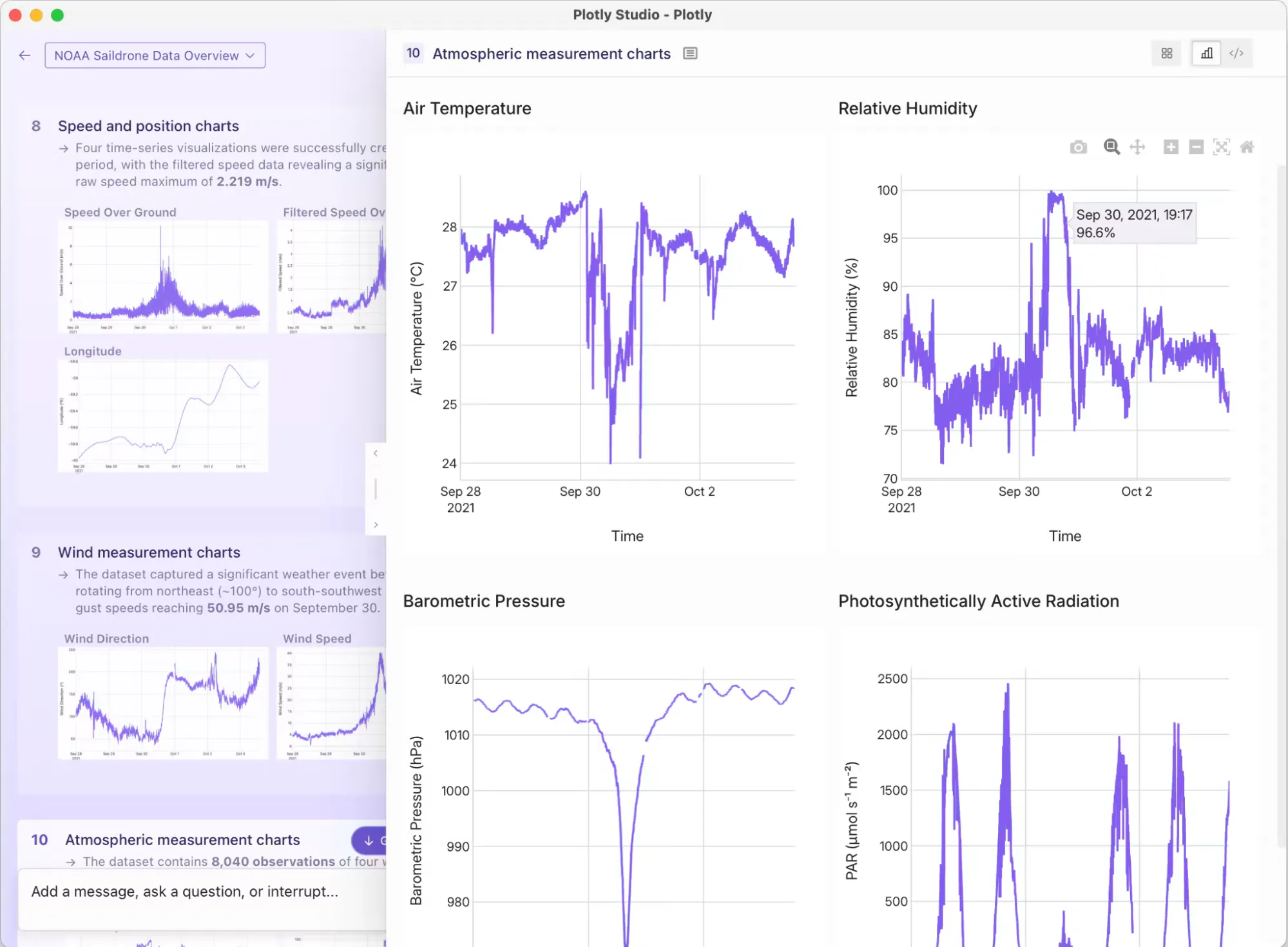
This AI workflow is one part of a broader shift, reshaping how analytics teams operate.
Four Shifts Reshaping the Analytics Workflow
From Faster Creation to Governed Deployment
AI has almost solved the speed problem. An analyst can automate a first-pass query or chart in an afternoon that might once have taken a week. That's the straightforward part. What happens to the analysis after that first draft, is a different problem entirely.
That same speed is exactly what's now pushing organizations to expect governance to keep pace with it. Gartner’s top trends in data analytics names this as a rising trend in its own right.
As AI regulation grows more complex and autonomous agents spread, standard assurance methods no longer hold, and organizations are turning to governance built into the platforms they adopt rather than added after the fact.
In practice, that means controlling who can access the work, assigning clear ownership, and keeping a record of who checked it. Teams that leave this for later will end up rebuilding it under pressure. Teams that build it into their AI workflow from the start, already have the infrastructure the rest of their work can depend on.
Dash Enterprise is built around that expectation rather than treating it as an add on. Role-based access control applies at the user, group, and app level, inherited automatically from whichever identity provider an organization already runs, from Okta and Active Directory to SAML and LDAP.
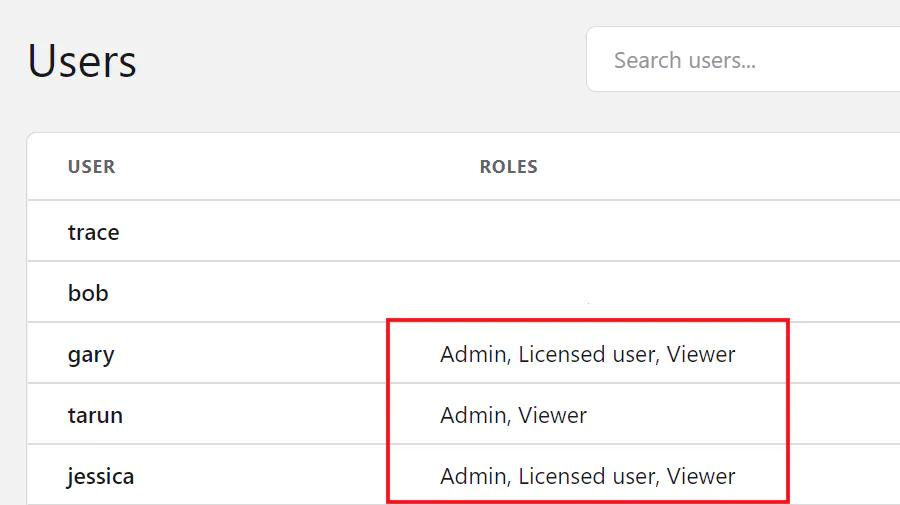
The App Manager tracks each app's usage built in rather than added on. Governance travels with the app from the start instead of getting bolted on once something goes wrong.
From Producing Analysis to Verifying It
If AI increasingly writes the first draft, the scarce skill shifts from writing the query to knowing whether its output is right. That skill carries a measurable payoff. A separate Gartner analysis predicts that explicitly modeled, governed decisions will be five times more trusted and 80% faster than ungoverned ones by 2029, enabled by the adoption of decision-intelligence platforms. This forecast concerns decision governance and supports the broader case for making business rules and decision logic explicit and auditable.
In practice, verification means reading and auditing AI-generated logic (a join, a filter, the definition behind a metric) is becoming a core part of the analyst's job.Teams should define formal review criteria and document approval, instead of assuming that platform access controls or audit logs establish analytical correctness.
From One Dashboard to a Fleet You Have to Manage
The unit of analytics work is shifting from building the dashboard to maintaining a growing, half-documented collection of AI-assisted apps and analyses, some of which nobody remembers building.
A 2026 research note from the Cloud Security Alliance found that none of the major AI security frameworks currently in active use provide dedicated, accessible guidance for people building this kind of software without a formal engineering background. The research concerns application security and shadow development broadly, not the analytical accuracy of dashboards or models. Its relevance here is the security and ownership risk created when AI-generated applications are deployed outside established controls.
The Shadow Builders report reviewed 380,000 assets, roughly 5,000 of which were built for corporate purposes. 40% of those exposed sensitive corporate data.
None of them were malicious. They were built fast, shared informally, and never brought inside any governed environment. That's a preview of what happens when AI workflow automation outruns the governance meant to catch it.
This ecosystem-wide research does not estimate how many ungoverned applications exist within a typical analytics team. Nevertheless, every team should be able to identify which AI-assisted apps and analyses remain in use, who owns them, which data they access, who can use them, and when they were last reviewed.
Analytical accuracy, security, and application ownership should then be evaluated separately.
Portability Becomes a Separate Procurement Question
Business intelligence platforms, notebooks, and AI automation tools are visibly blending into one another, and that convergence is worth noticing. The more consequential question is whether that convergence happens inside a closed environment you can't leave, or an open one you can inspect and move. Portability should be evaluated separately from governance and analytical correctness.
One concrete signal worth watching: the Model Context Protocol, originally developed by Anthropic, has since been donated to the Linux Foundation's Agentic AI Foundation. MCP supports interoperability between AI tools and data sources, but it does not determine whether a generated application can be independently exported or hosted.
That's a deliberate industry move to keep interoperability open as agentic tools scale, rather than let it default to whichever vendor wins the current cycle. The same principle applies at a smaller scale to individual tools.
Plotly Studio is a concrete example: a generated app's underlying code can be exported and run on Plotly Cloud or Dash Enterprise, rather than running locally. Teams evaluating AI analytics tools should therefore clarify what can be exported, which proprietary dependencies remain, what licenses apply, and where the resulting application can run.
How to Get Ahead of This
Each of the shifts above has one clear action attached to it, the kind that turns diagnosis into decision.
- Give one automated report a real test. Pick a single recurring report your team already builds by hand, automate the first draft with an AI workflow automation tool, and assign one person to own and review it before it ships. Once it's run cleanly for a month, you'll have real evidence for how to extend this safely to other reports.
- Make review a formal step in the AI workflow. Before an AI-generated analysis reaches a stakeholder, have someone verify the join, the filter, and the metric definition, giving it the same scrutiny a number would get before it showed up in a board deck. Catching a wrong assumption at this stage costs an hour. Catching it after a decision has been made on it costs a lot more.
- Find out what already exists. Ask around for dashboards, notebooks, and one-off apps built with AI tools for data analysts that never made it into a shared, governed environment. Most teams find more than they expect. The goal is a real list, each app with an owner or a decision to retire it.
- Ask the export question before you commit. Before adopting new AI productivity tools, find out whether what they build can be exported and hosted somewhere you control, or whether it only ever lives inside that tool. That's a much more useful thing to know before a year of work is built on the platform than after.
The Skill That Will Matter Most
As AI generates more of the analytical first draft teams will take responsibility for how results are used.
Reliable AI-assisted analytics requires several distinct layers. Analytical review establishes correctness. Security controls protect data and access. Platform governance manages ownership, deployment, monitoring, and application lifecycle. Connecting these layers within one workflow allows teams to move faster without treating governance as proof that every analytical result is accurate.
For a closer look at what it takes to move an AI-assisted analysis from a working first draft to a governed, production-ready application, Plotly's guide to building production-grade data apps is a useful next stop.